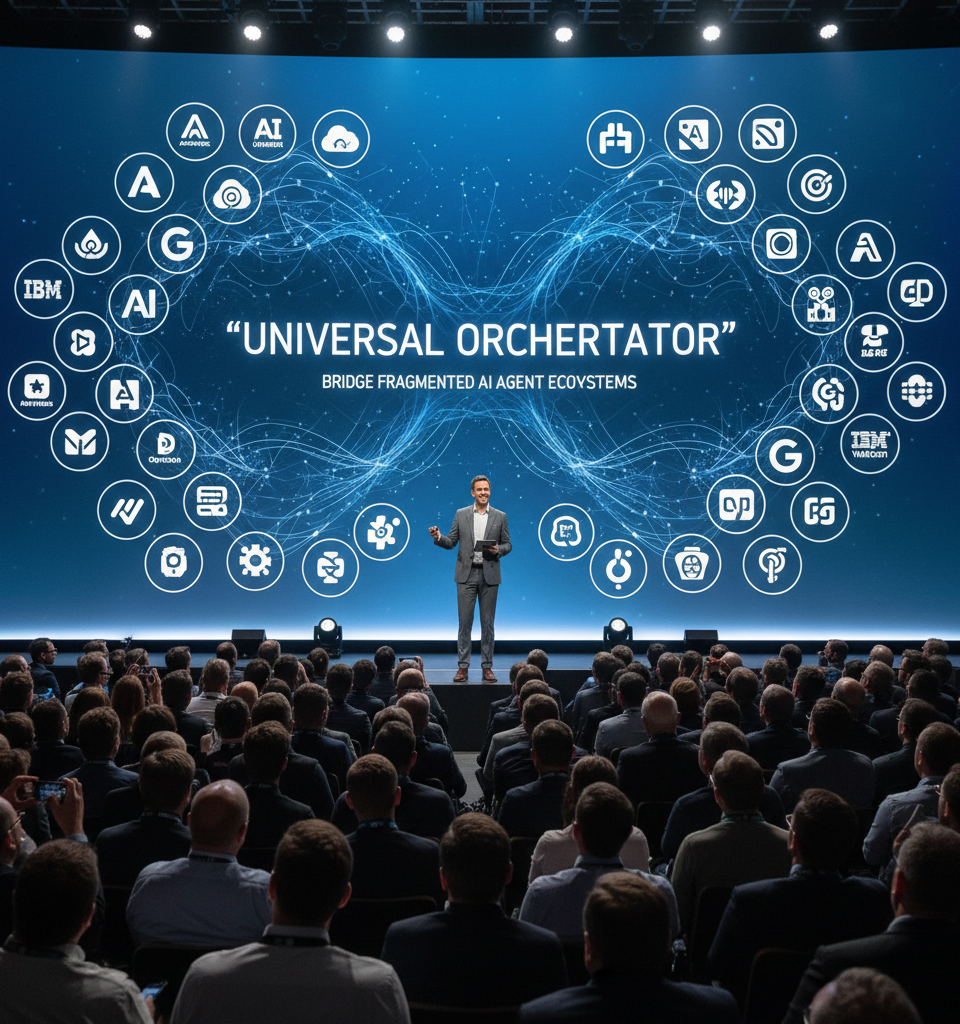
The Fragmentation Problem: A Growing Bottleneck For the past eighteen months, the corporate world has been engrossed in a fervent race to deploy autonomous
AI agents across myriad functions, from automating customer support interactions to optimizing complex codebase refactoring. While these digital workers have demonstrated immense potential, their rapid, often uncoordinated, adoption has inadvertently created a new, structural problem: fragmentation. Agents developed using one framework, such as LangChain, often lack the inherent ability to communicate or hand off tasks to those built on another, like CrewAI. Similarly, agents embedded within platforms such as Salesforce or ServiceNow operate in isolation, lacking native mechanisms for seamless coordination with agents operating elsewhere. This architectural dissonance impedes end-to-end automation, restricts scalability, and ultimately limits the total addressable value AI can deliver to an organization.
BAND's Solution: A Symphony of Agents
BAND's 'universal orchestrator' acts as a central nervous system, providing a standardized protocol for AI agents to discover, communicate, negotiate, and execute tasks with one another, irrespective of their underlying framework or deployment environment. The company's proprietary technology leverages a sophisticated meta-agent layer that translates task definitions and data payloads between disparate systems, effectively creating a common language for AI collaboration. Early adopters, including a Fortune 500 financial services firm and a leading e-commerce giant, have reported up to a 30% increase in operational efficiency for multi-agent workflows during a private beta phase, along with a 15% reduction in integration costs associated with disparate AI tooling.
Industry Impact and Market Shift
This innovation by BAND is poised to significantly impact the broader AI industry. By solving the interoperability challenge, it could accelerate the adoption of complex, multi-agent AI systems, moving enterprises beyond isolated use cases to truly integrated and adaptive AI workforces. The current market for enterprise AI software is projected to reach over $300 billion by 2027, with integration and orchestration constituting an increasingly critical segment. BAND's entry positions it as a key player in this evolving landscape, potentially unlocking a new wave of value creation for businesses that have been hampered by fragmented AI deployments. Analysts suggest that the 'orchestration layer' could become as crucial as the underlying LLM itself in determining the success of enterprise AI strategies.
Expert Perspectives on the AI Interoperability Challenge Dr. Anya Sharma, a leading
AI governance expert and research director at the Gartner Group, commented, "The fragmentation in enterprise AI has been an unspoken bottleneck. Companies are investing heavily, but often creating islands of automation. Solutions like BAND's are not just 'nice-to-haves'; they are quickly becoming foundational infrastructure for any organization serious about scaling AI across its operations. The ability for agents to dynamically collaborate will be the hallmark of advanced AI deployments in the coming years." Industry venture capitalists have also taken notice, with one unnamed source stating, "BAND is tackling a problem that every CSO and CTO is grappling with. If they can truly deliver on universal orchestration, their market potential is enormous."
What's Next: Expanding Ecosystems and Future-Proofing AI
Looking ahead, BAND plans to rapidly expand its ecosystem of supported AI frameworks and enterprise applications. Roadmaps include deeper integrations with major cloud AI platforms like AWS SageMaker, Azure AI, and Google Cloud AI, as well as an open API for community-driven agent integrations. The company also intends to explore AI-driven governance and compliance features within its orchestrator, ensuring that cross-agent collaborations adhere to organizational policies and regulatory requirements. This forward-looking strategy aims to future-proof enterprise AI investments, paving the way for adaptive, resilient, and truly intelligent autonomous operations that can evolve with technological advancements and business needs. The advent of BAND's orchestrator signals a maturation in the enterprise AI market, shifting focus from mere deployment to effective integration and seamless interaction. As companies seek to maximize their AI investments, solutions that unify disparate digital workforces will undoubtedly play a critical role in shaping the future of business automation.