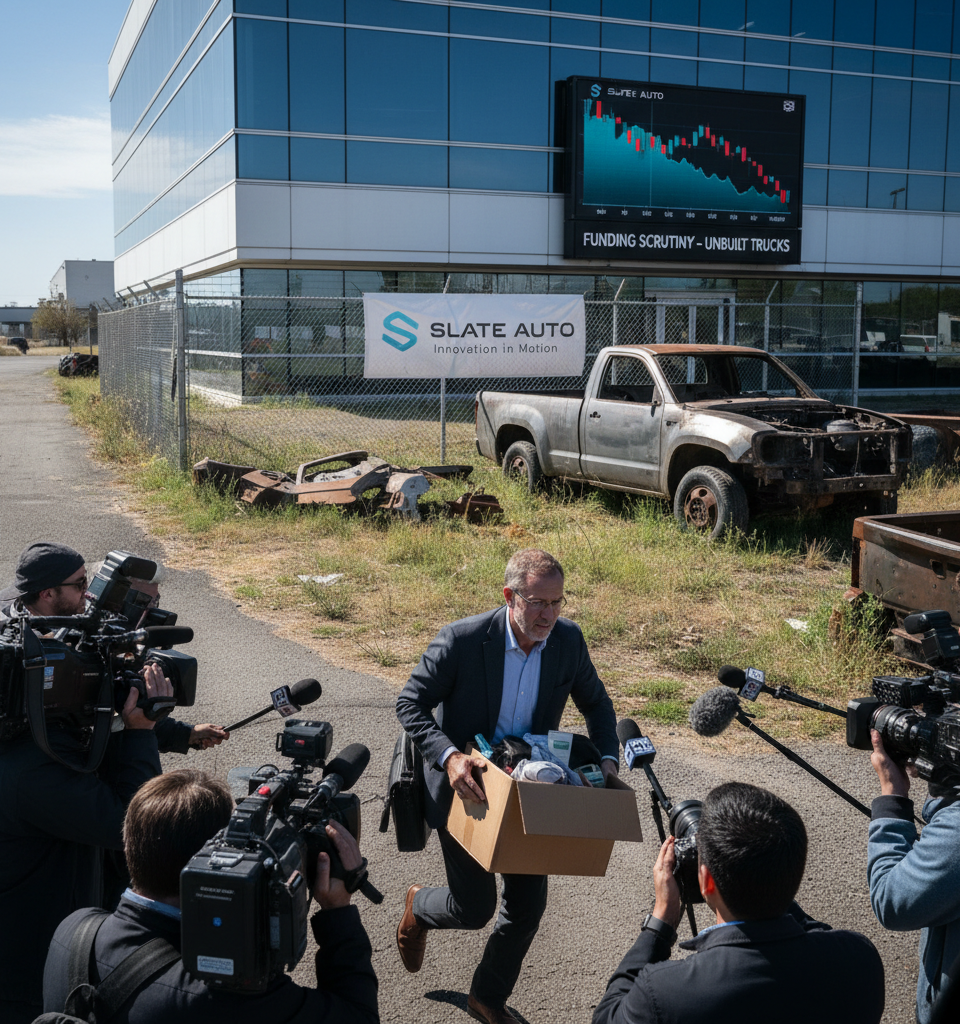
Melinda Lewison, the representative of Jeff Bezos's family office and a prominent figure in the investor community, has exited the board of directors for Slate Auto, an electric vehicle startup that has amassed an eye-watering $1.4 billion in funding without yet delivering a single production vehicle. Lewison's departure, confirmed by corporate filings, occurred months before the company's previously announced timeline for rolling out its inaugural truck, raising significant alarm bells within the automotive and investment sectors about the company's operational progress and the efficacy of its high-profile backing.
This development casts a critical spotlight on Slate Auto, a company that has largely leveraged its association with Jeff Bezos to attract substantial capital. Lewison's role was instrumental in connecting the Amazon founder with the nascent EV venture, providing it with an invaluable seal of approval and facilitating its massive fundraising efforts. Her exit now raises questions about Bezos's continued confidence, or lack thereof, in the company's ability to execute its ambitious vision, especially as the competitive landscape for electric trucks intensifies daily.
Slate Auto, incorporated recently, has been a darling of the venture capital world, securing its impressive $1.4 billion war chest from a syndicate of institutional investors and private equity firms. The core promise revolves around developing a revolutionary line of electric trucks, aiming to disrupt the commercial vehicle market. However, despite the significant capital injection, the company has yet to showcase a production-ready vehicle. Industry watchers note that initial timelines projected the first trucks to roll off the assembly line in late 2024, a milestone that now appears increasingly challenging to meet given the lack of substantial updates on manufacturing progress. The focus on fundraising, rather than tangible product development, has become a growing concern among stakeholders.
The departure of a key board member, especially one with such direct ties to a major institutional backer like Jeff Bezos, often signals internal dissent or a significant shift in strategic direction. For the burgeoning electric vehicle market, this incident serves as a cautionary tale. Numerous EV startups have emerged in recent years, many attracting billions based on promising prototypes and bold claims. However, the path from concept to profitable mass production is fraught with immense technical, logistical, and financial challenges. This event could lead to increased scrutiny from investors and regulators on the due diligence processes applied to these capital-intensive endeavors.
Industry analysts are weighing in on the implications. "Lewison's exit is more than just a change in board composition; it's a potential withdrawal of a powerful endorsement," states Sarah Chen, a senior analyst at Auto Insights Group. "For a company like Slate Auto, which has traded heavily on its association with high-profile names, this could significantly impact future fundraising rounds and investor confidence. It underscores the critical need for these startups to demonstrate tangible progress, not just visionary promises, to maintain trust." Others suggest that the pressure to deliver has become untenable, leading to such high-level departures.
Looking ahead, Slate Auto faces an uphill battle to regain market confidence and justify its valuation. The company will need to provide concrete evidence of manufacturing progress, perhaps accelerate the unveiling of a functional prototype, or pivot its strategy entirely. The coming months will be crucial for the company to demonstrate its ability to move beyond fundraising and into actual production. Failure to do so could lead to a rapid devaluation and further erosion of investor trust, potentially impacting the broader appetite for speculative investments in the EV sector.
The competitive landscape for electric trucks is already crowded, with established players like Tesla's Cybertruck, Ford's F-150 Lightning, and Rivian's R1T already on the market or nearing full-scale production. Additionally, legacy automakers như General Motors, Volvo, and Daimler are investing heavily in electrifying their commercial fleets. Slate Auto's delays place it at a distinct disadvantage, particularly if it cannot quickly bridge the gap between its substantial funding and its lack of produced vehicles. The market demands not just innovation, but demonstrable execution.
This incident also highlights a broader trend: the increasing scrutiny of special purpose acquisition companies (SPACs) and other alternative fundraising mechanisms favoured by some EV startups. While not explicitly stated that Slate Auto utilized a SPAC, the rapid influx of capital followed by a lack of tangible product delivery is a pattern seen in several other ventures that went public via SPACs. Investors are becoming more discerning, prioritizing operational milestones over aspirational narratives.
Ultimately, Slate Auto's future hinges on its ability to transition from a high-profile, highly funded concept to a legitimate vehicle manufacturer. The departure of Melinda Lewison serves as a stark reminder that even the most well-capitalized startups face immense pressure to deliver on their promises, especially when operating in a sector as competitive and capital-intensive as electric vehicles. The industry will be closely watching for comprehensive updates on Slate Auto's manufacturing capabilities and timelines in the coming quarters.
The coming months will undoubtedly be a pivotal period for Slate Auto. The company's response to this significant leadership change and its subsequent actions regarding production and delivery schedules will largely determine its standing in the fiercely competitive electric vehicle market. Stakeholders will be looking for clear, actionable plans to move beyond the fundraising phase and deliver on the promises that attracted over billion in investment.