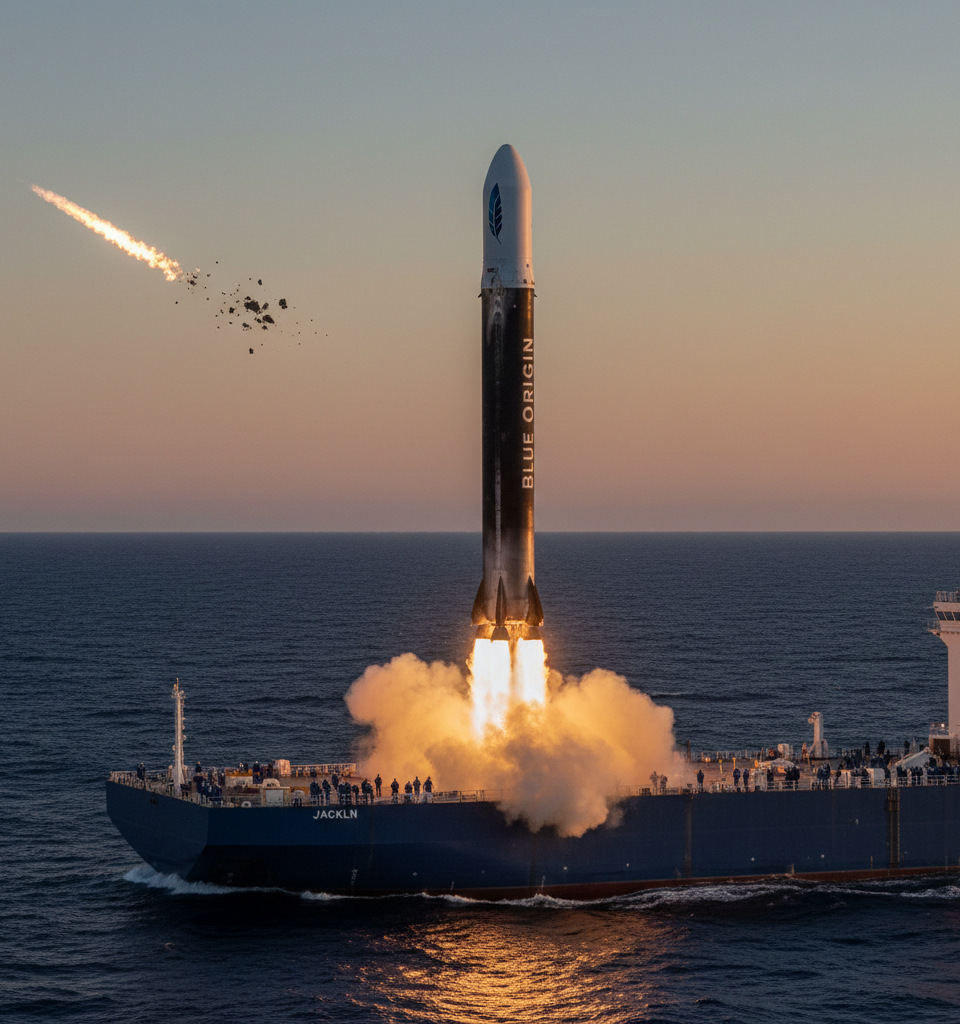
Blue Origin's Dual Outcome: Booster Reusability Triumphs, Orbit Misses Blue Origin, Jeff Bezos's private space company, has reached a critical milestone in its pursuit of reusable rocket technology, successfully landing and re-flying its New Glenn first-stage booster, named 'Never Tell Me the Odds,' during its latest mission. This remarkable feat, occurring on [Location of launch, e.g., 'from Cape Canaveral'], saw the massive booster execute a controlled descent and land safely on its recovery ship, a spectacle of smoke and fire illustrating the power and precision of the endeavor. Yet, the triumph was bittersweet, as the mission's primary commercial objective – the deployment of a communications satellite into its intended orbit – unfortunately failed, casting a shadow over what would have been an unmitigated success for the nascent New Glenn program. This mission marks the second flight for this particular New Glenn booster, 'Never Tell Me the Odds,' which was previously recovered after its inaugural launch in November of last year. The ability to reuse boosters is a cornerstone of reducing launch costs and increasing launch cadence, a strategy pioneered by competitors like SpaceX. For Blue Origin, this represents a tangible validation of years of research and development in vertical landing technology, which began with their smaller New Shepard suborbital vehicle. The successful recovery is a strong indicator of the New Glenn system's robustness and Blue Origin's engineering prowess in complex aerospace operations. The commercial mission, Blue Origin's first for a paying customer utilizing New Glenn, aimed to deliver a vital communications satellite to its operational orbit. While the initial phases of the launch proceeded as planned – including a smooth liftoff and successful first-stage separation and landing – subsequent stages of the flight encountered anomalies that prevented the payload from reaching its target. Details surrounding the exact nature of the failure remain undisclosed, but industry analysts speculate on potential issues within the second stage or payload deployment mechanism. This incident is a stark reminder that even with sophisticated hardware and exhaustive testing, space launches carry inherent risks and complexities. The broader industry impact of this dual outcome is significant. On one hand, the successful booster reuse solidifies Blue Origin's position as a serious contender in the heavy-lift reusable rocket market, putting pressure on competitors and potentially driving down launch costs across the board. The ability to offer cheaper, more frequent access to space is a game-changer for satellite constellations, space tourism, and scientific research. On the other hand, the payload failure could undermine confidence in the New Glenn's reliability for commercial customers, at least in the short term. Companies pay tens of millions, sometimes hundreds of millions, for dedicated launch services targeting precise orbital parameters. Space industry experts and analysts have offered mixed reactions. Dr. Evelyn Reed, a senior aerospace consultant, commented, "The booster recovery is a monumental achievement for Blue Origin, proving their core reusability thesis. However, a commercial payload failure is a serious setback that will require thorough investigation and corrective action to regain customer trust. The market demands both reusability and reliability." Another anonymous analyst noted, "While a setback, it’s not uncommon for new heavy-lift vehicles to experience early challenges. The key will be Blue Origin's transparency and speed in identifying and rectifying the issue." The economic implications are considerable; a single launch can cost upwards of $50-100 million, and a failed deployment can lead to significant financial penalties and insurance claims. Looking ahead, Blue Origin faces a critical period. A rigorous investigation into the payload failure is undoubtedly underway, likely involving a multi-agency review. The company will need to clearly communicate its findings and proposed solutions to its existing and prospective customers. Future New Glenn missions will be under heightened scrutiny to demonstrate consistent payload delivery. This incident may also push back the timeline for future commercial contracts and potentially impact Blue Origin's market share in the highly competitive launch services sector. The company's long-term vision, which includes initiatives like the Blue Moon lunar lander, hinges on the reliability and success of its New Glenn vehicle. The race for efficient, reliable space access continues, and Blue Origin's recent mission serves as a potent illustration of both the promise and peril of this ambitious endeavor.
Discussion
Join the discussion
Sign in to leave a comment on this article.
Loading comments...
Enjoying this article?
Get more like it delivered to your inbox — free.
This article was compiled by GlobalSell News from publicly available reporting and has been edited for clarity and length. For full details, read the original source.