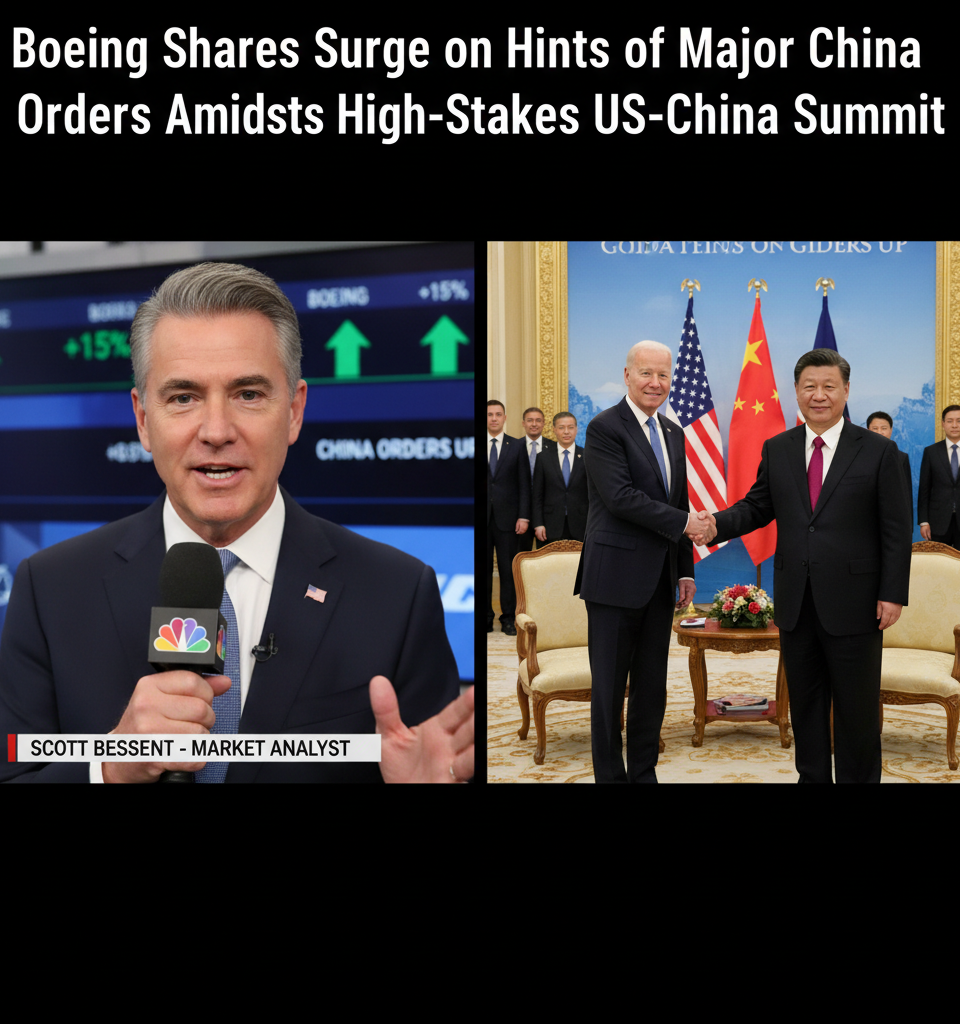
Shares of aerospace giant Boeing Co. (NYSE: BA) logged significant gains in early trading today after Scott Bessent, founder and CIO of Key Square Capital Management, hinted at impending "large" orders from China. Bessent's comments, made during an interview on CNBC's "Squawk Box," tied these prospective deals directly to a crucial summit between U.S. President Joe Biden and Chinese President Xi Jinping, suggesting a strategic move by Beijing to reduce trade tensions with Washington.
Context of Diplomatic Engagement
This development comes against a backdrop of complex and often strained U.S.-China economic relations. For several years, Chinese airlines have largely refrained from placing major orders with Boeing, instead favoring European competitor Airbus SE (NASDAQ: EADSY). This unofficial embargo by Beijing has been widely interpreted as a political maneuver, reflecting broader geopolitical tensions and trade disputes. The potential resumption of significant Boeing orders would, therefore, represent a meaningful diplomatic olive branch from China, aiming to mitigate friction and stabilize economic ties ahead of critical discussions between the two global powers.
Bessent's Insider Perspective
During his CNBC appearance, Bessent stated, "I think we're going to see some very large Boeing orders coming out of China as a way to reduce trade tensions with the United States." While he did not disclose specific figures or timelines, his remarks carry weight given his background and connections within financial and political circles. Bessent, who previously served as a top economic advisor to Donald Trump during his 2016 presidential campaign, possesses a unique vantage point on the intricacies of U.S.-China economic diplomacy. His prediction immediately resonated with investors, driving Boeing's stock up by over 4% in pre-market trading, although gains moderated slightly to around 2.5% during regular market hours, trading at approximately $208.50 per share.
Impact on Aerospace and Global Trade
For Boeing, securing substantial orders from China would be a transformative event. The Chinese market is a critical growth driver for the global aviation industry, historically accounting for roughly one-quarter of all aircraft deliveries. The prolonged absence of new Chinese orders has significantly impacted Boeing's delivery forecasts and market share, allowing Airbus to strengthen its foothold in the region. A renewed purchasing relationship would not only boost Boeing's order book and revenue but also demonstrate a potential shift in Beijing's strategy regarding trade leverage. This could set a precedent for other sectors currently affected by U.S.-China trade disputes.
Analyst Expectations and Market Reaction
Market analysts have long speculated about the eventual return of Chinese orders for Boeing, recognizing the mutual economic benefits and the limitations of an exclusive reliance on Airbus. However, the timing and political motivations have remained uncertain. Bessent's comments, while speculative, align with the notion that China often uses large-scale commercial orders as a tool in diplomatic negotiations. The market's immediate positive reaction underscores the importance investors place on the Chinese market for Boeing's future profitability and the broader implications for the aerospace supply chain.
Historical Precedent and Future Outlook
Historically, major U.S.-China summits have often been accompanied by significant trade announcements, particularly in high-value sectors like aerospace, where purchases can serve as tangible goodwill gestures. If Bessent's prediction materializes, these orders could focus on Boeing's popular 737 MAX series or larger wide-body aircraft like the 787 Dreamliner, which Chinese carriers are increasingly needing for international routes. These potential deals come at a crucial time for Boeing, which is working to ramp up production and clear its existing backlog while navigating ongoing supply chain challenges. A positive outcome from the Biden-Xi summit, particularly concerning trade, could pave the way for a more stable and predictable environment for multinational corporations operating between the two economic superpowers.
Broader Economic and Geopolitical Implications
The potential for significant Chinese aircraft orders extends beyond Boeing's financial performance. It signals a possible de-escalation of trade hostilities and a pragmatic approach by both nations to manage their complex relationship. Such a move could instill greater confidence in global markets, offering a glimmer of hope that economic cooperation can prevail over geopolitical friction. The coming weeks will be critical as details of the Biden-Xi meeting unfold, potentially confirming whether Bessent's insight was a harbinger of a new chapter in U.S.-China trade relations.