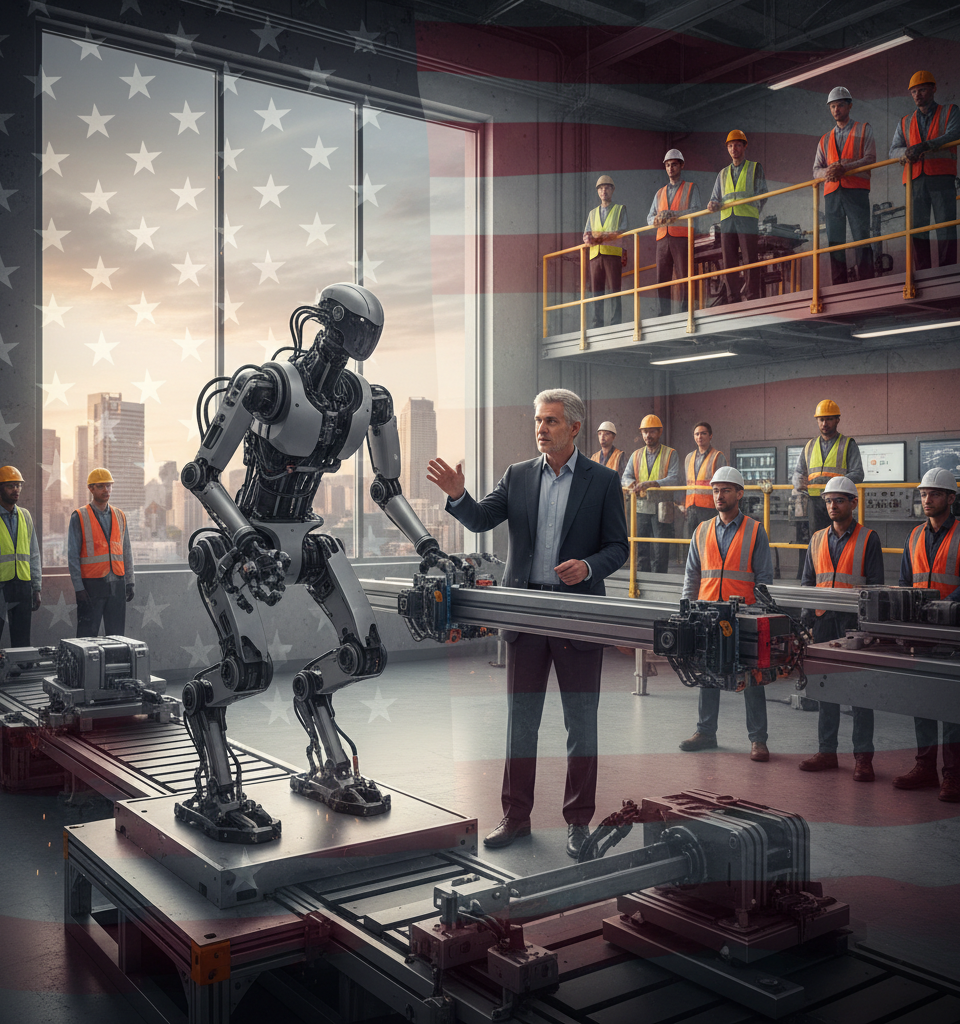
The United States stands at the precipice of its next major industrial transformation, a revolution projected to be spearheaded by advancements in robotics. This is the perspective articulated by the CEO of Boston Dynamics, who posits that while America has historically led global industrial leaps, the nation's next 250 years will fundamentally be built on a foundation of sophisticated robotic systems. This future, however, is not a foregone conclusion, as its realization is contingent upon a cohesive strategy involving governmental policy, industrial innovation, and workforce adaptation.
Historical Precedent and Future Potential
Historically, the U.S. has been a crucible for innovation, from the agricultural revolution to the dawn of the information age. Each successive industrial wave has not only reshaped the economy but also redefined the American way of life. The current trajectory suggests that robotics is the next frontier, promising unparalleled efficiencies, new industries, and solutions to complex societal challenges. This isn't merely about automating existing tasks but about enabling entirely new capabilities that were once confined to science fiction. The Boston Dynamics CEO’s assertion underscores the profound impact such a shift could have on national productivity, global competitiveness, and geopolitical influence.
Critical Barriers to Adoption
Despite the immense potential, significant hurdles stand in the way of this robotic-driven future. The CEO specifically highlighted the necessity for a synchronized effort across multiple sectors. From a governmental perspective, policy frameworks must evolve rapidly to support research and development, incentivize deployment, and address ethical considerations. Industry needs to commit to substantial investment in robotic technologies and infrastructure, moving beyond pilot programs to widespread integration. Crucially, the workforce requires comprehensive retraining and upskilling initiatives to adapt to the changing demands of an automated economy. Without these concerted actions, the U.S. risks lagging behind other nations that are aggressively pursuing similar technological agendas.
Economic and Societal Implications
Should the United States successfully navigate these challenges, the economic implications could be vast. The widespread adoption of robotics is expected to boost manufacturing output, enhance supply chain resilience, and enable the growth of advanced services. Furthermore, it could lead to the creation of high-skill, high-wage jobs in areas such as robotics engineering, AI development, and advanced maintenance. Socially, robots could play a pivotal role in fields like healthcare, logistics, and hazardous work environments, improving human safety and quality of life. However, concerns regarding job displacement and the equitable distribution of these new benefits will require proactive and thoughtful planning.
The Role of Key Stakeholders
The vision outlined by the Boston Dynamics CEO places a strong emphasis on collaboration. Washington’s role extends beyond funding research to creating a regulatory environment that fosters innovation while safeguarding societal interests. This includes intellectual property protection, data privacy regulations, and responsible AI development guidelines. Industry leaders, in turn, must drive investment in scaling robotic solutions and integrating them into diverse operational contexts. For workers, the imperative is to embrace continuous learning and skill development, shifting from roles susceptible to automation towards those that leverage human-robot collaboration and oversight.
Looking Ahead: A Call to Action
The path forward for America's industrial leadership in robotics is clear, albeit challenging. The Boston Dynamics CEO’s remarks serve as a critical call to action, urging immediate and coordinated efforts. The next few decades will be instrumental in determining whether the U.S. fully harnesses the transformative power of robotics or allows obstacles to impede progress. The future prosperity and global standing of the nation, according to this perspective, will be inextricably linked to its ability to embrace and integrate this next industrial revolution.
The coming years will undoubtedly see increasing dialogue and policy debates surrounding robotics, aiming to ensure that the U.S. remains at the forefront of technological innovation. The success of this endeavor will hinge on the agility and foresight of its leaders in government, industry, and education.