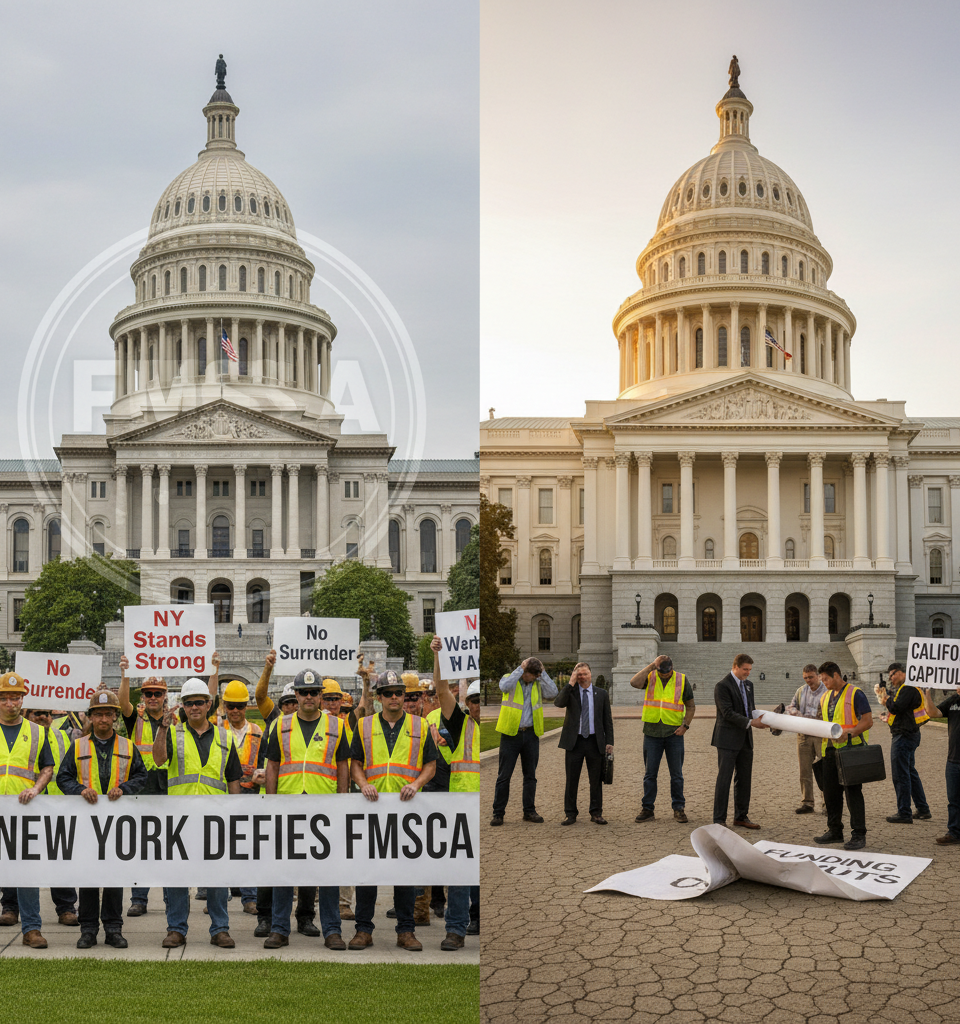
Washington D.C. / Albany, NY / Sacramento, CA – A brewing regulatory conflict pitting the Federal Motor Carrier Safety Administration (FMCSA) against two of the nation's largest states has unveiled starkly contrasting approaches to federal compliance. New York State is electing to defy FMCSA directives concerning Commercial Driver's License (CDL) verification, foregoing an estimated $73.5 million in federal highway funding. Meanwhile, California has acceded to the federal agency's demands, revoking thousands of CDLs to prevent an even more significant loss of over $200 million in critical infrastructure funds. This divergence underscores a significant power struggle between state sovereignty and federal oversight in the critical domain of commercial transportation safety. At the heart of the dispute is the FMCSA's insistence that states implement a more stringent, real-time verification process for CDL holders, specifically related to the Medical Examiner's Certification (MEC). The federal agency, citing safety concerns, mandates that states integrate medical certification information into their Commercial Driver's License Information System (CDLIS) databases in a timely and electronically verifiable manner. The FMCSA stipulated that states failing to meet these benchmarks by a specific deadline would face escalating penalties, beginning with a 5% reduction in certain federal highway allocations, potentially rising to 10% or more annually. New York, under the leadership of Governor Kathy Hochul's administration, has steadfastly maintained that its existing robust verification processes are sufficient and that the FMCSA's requirements impose an unnecessary and costly burden on state resources and CDL holders. The state's Department of Motor Vehicles (DMV) has argued that the current system effectively identifies and flags non-compliant drivers, ensuring public safety without the need for a complete overhaul. The $73.5 million in withheld funds represents a direct financial consequence of this defiance, a figure that could escalate in subsequent fiscal years if the impasse continues. This amount, while significant, appears to be a calculated risk for New York, which prioritizes its perceived regulatory autonomy. Conversely, California, facing a potential initial penalty of over $200 million and subsequent increases, chose a different path. The California Department of Motor Vehicles (DMV) announced it had revoked approximately 6,000 CDLs as of late last year to comply with FMCSA mandates. These revocations primarily affected drivers whose medical certifications were not properly updated or integrated into the state's system according to federal standards. The decision, though disruptive for thousands of commercial drivers and potentially for the state's bustling logistics sector, was deemed necessary to avoid a far greater financial detriment to California's extensive highway infrastructure projects, which are heavily reliant on federal funding. This regulatory enforcement action by the FMCSA highlights broader trends in federal-state relations, particularly in areas like transportation and public safety. States often chafe under what they perceive as unfunded mandates or overly prescriptive federal regulations. However, the allure of substantial federal funding, particularly for infrastructure, frequently compels compliance. The differing responses from New York and California serve as a case study, demonstrating both the willingness of states to challenge federal authority and the pragmatic necessity of adherence in the face of significant financial penalties impacting essential public services. Industry experts and transportation analysts are closely monitoring the situation. "New York's decision is a bold one, and it sets a precedent for how far states are willing to push back against federal regulatory overreach," commented Dr. Eleanor Vance, a transportation policy expert at the National Institute of Public Policy. "However, the long-term sustainability of forgoing such significant federal funds for infrastructure improvements remains a question. The potential for a 'domino effect,' where other states might consider non-compliance, is also a concern for the FMCSA." Looking ahead, the standoff between New York and the FMCSA could escalate. The FMCSA has indicated a willingness to impose further penalties, potentially increasing the percentage of withheld funds. New York, meanwhile, may explore legal avenues to challenge the FMCSA's authority or seek legislative relief in Congress. For California, the immediate crisis has been averted, but the implications of the mass CDL revocations on its logistics and supply chains, as well as the burden on affected drivers, will continue to unfold. The episode underscores the ongoing tension between federal standardization for safety and the practical realities and financial implications for individual states and their commercial driving communities.
CDL Showdown: New York Defies FMCSA, California Capitulates Amidst Funding Threats
Key Takeaways
Read this first — then go as deep as you need.
Discussion
Loading comments...
Enjoying this article?
Get more like it delivered to your inbox — free.
This article was compiled by GlobalSell News from publicly available reporting and has been edited for clarity and length. For full details, read the original source.