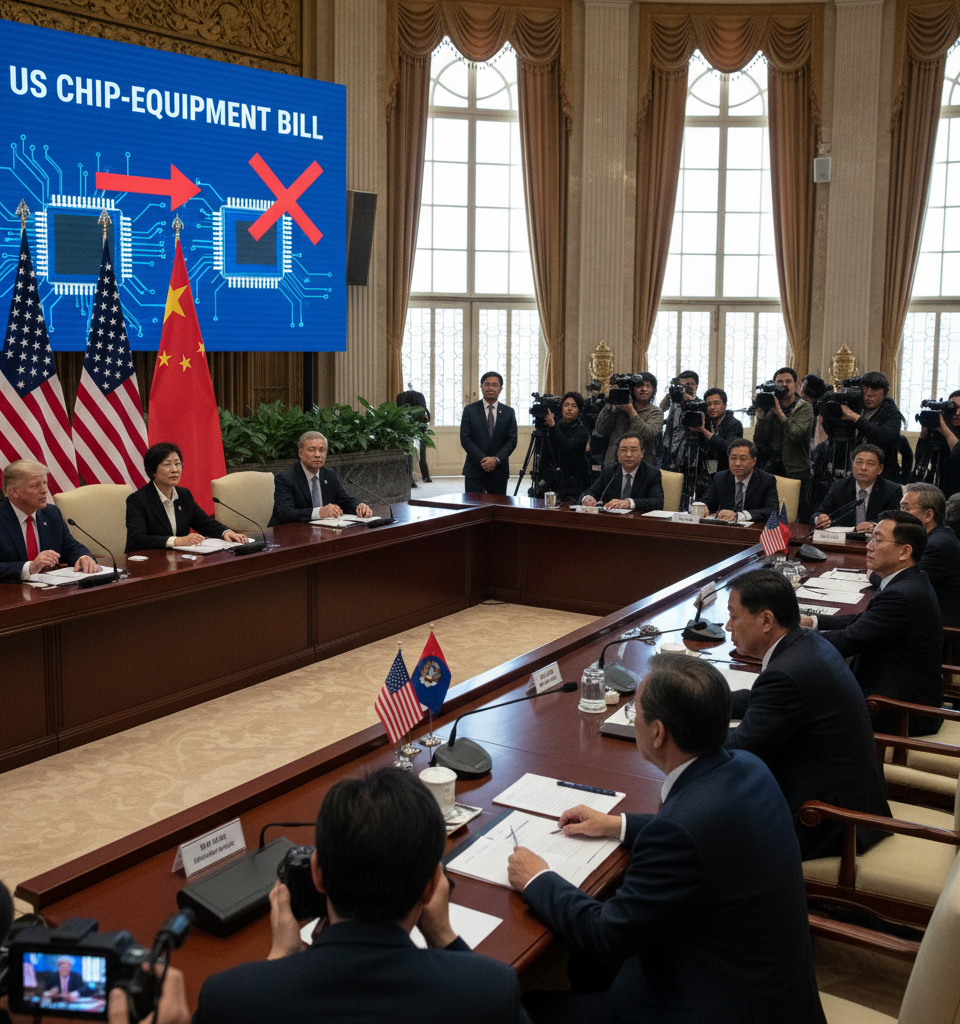
Beijing has sharply escalated its rhetoric against proposed U.S. legislation targeting semiconductor manufacturing equipment, voicing strong disapproval just as former President Donald Trump commenced his visit to the Chinese capital. The foreign ministry’s pointed critique of the Maintaining American Leadership in Technology, Communications, and Hardware (MATCH) Act underscores growing Sino-American friction over critical technology, with a 150-day deadline for Japan and the Netherlands to align with U.S. export controls being a central point of contention.
Geopolitical Tensions and Historical Context
This latest confrontation builds upon an increasingly fraught technological rivalry between the United States and China. The U.S. has consistently expressed concerns that China's advancements in critical technologies, particularly semiconductors, pose national security risks and could be leveraged for military modernization. Previous actions, such as restrictions on Huawei and SMIC, highlight a sustained effort by Washington to curb Beijing's access to advanced chip technology. China, conversely, views these measures as direct attempts to impede its economic and technological development, a sentiment frequently articulated through official channels.
Key Details of the MATCH Act
At the heart of China's recent criticism is the MATCH Act, which seeks to formalize and expand U.S. export controls on semiconductor manufacturing equipment. A pivotal element of the bill is its requirement for key technological allies, specifically Japan and the Netherlands, to implement similar restrictions within 150 days of the act's passage. Both nations are home to critical suppliers of semiconductor equipment, with companies like ASML (Netherlands) and Tokyo Electron (Japan) dominating essential segments of the supply chain. Beijing views this as an attempt to construct a technological blockade, coercing sovereign nations into adopting U.S. policy.
Industry and Market Impact
The ripple effects of such legislation are profound, particularly for the global semiconductor industry. Companies reliant on integrated global supply chains for manufacturing and distribution face significant uncertainty. Should Japan and the Netherlands comply fully, Chinese foundries could see severely restricted access to cutting-edge tools, potentially slowing their ability to produce advanced chips. This would not only affect China's domestic technology sector but also impact global companies that rely on Chinese manufacturing capabilities or supply components to the Chinese market. Market volatility in relevant sectors, including technology and manufacturing, is a likely outcome, with investors closely watching for definitive policy implementation and retaliatory measures.
Expert Perspectives
Analysts are largely in agreement that the MATCH Act represents a significant escalation in the U.S.-China tech war. Dr. Eleanor Vance, a senior fellow at the Center for Strategic and International Studies, noted, "The U.S. is clearly aiming to choke off China's access to foundational chip technology. The 150-day window puts immense pressure on Japan and the Netherlands, forcing them to choose between their economic ties with China and their strategic alliance with the United States." Others point out that such measures could inadvertently accelerate China's push for self-sufficiency in semiconductors, albeit at a potentially higher cost and longer timeline. The consensus suggests that while effective in the short term, the long-term implications for global technological innovation and cooperation are complex and potentially disruptive.
Broader Implications and International Relations
Beyond semiconductors, the diplomatic friction exacerbated by the MATCH Act has broader implications for international relations. It tests the resilience of alliances and the willingness of nations to align their economic interests with geopolitical objectives. China’s foreign ministry spokesperson emphasized that such unilateral actions disrupt global supply chains and are detrimental to international trade norms. The visit of former President Trump, known for his own tough stance on China trade, adds another layer of complexity, signaling that a bipartisan consensus on confronting China’s technological ambitions might endure in future U.S. administrations.
What's Next?
The immediate future will see intensified diplomatic efforts as Japan and the Netherlands weigh their options. Their decisions within the 150-day deadline will be critical in shaping the semiconductor landscape. China is expected to continue its vocal opposition and may explore retaliatory measures targeting U.S. interests or companies if the bill passes and is enforced. Furthermore, this situation is likely to galvanize China's domestic efforts in indigenous chip development, potentially leading to increased investment in R&D and manufacturing capabilities to reduce reliance on foreign technology. The global technology ecosystem is bracing for a period of significant recalibration and potential fragmentation.