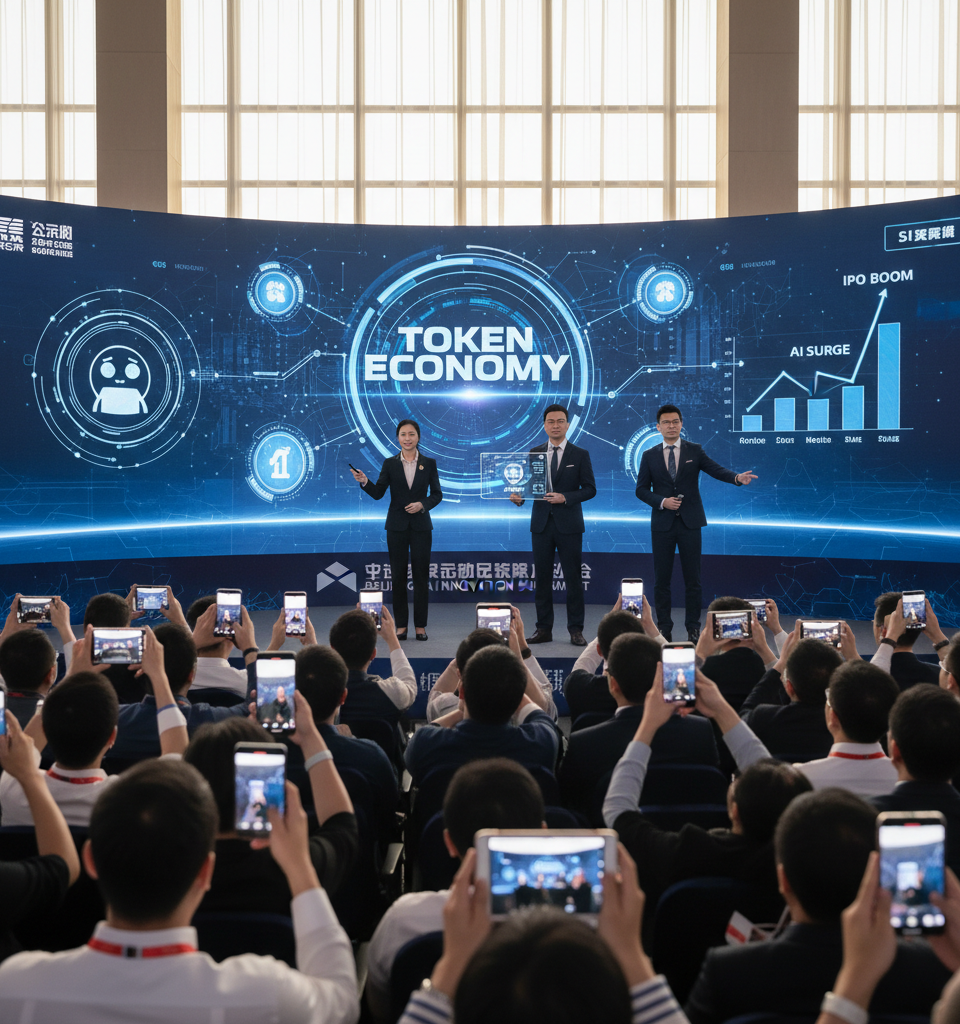
China's artificial intelligence sector is currently ablaze with activity, characterized by a series of highly anticipated initial public offerings (IPOs), a surging enthusiasm for sophisticated AI agents, and the emergence of a distinctive 'token economy.' This strategic pivot, driven by a foundational reliance on open-source AI models and tangible real-world applications, is a direct response to Beijing's overarching national AI ambitions. The dynamic expansion is, however, set against the persistent backdrop of stringent U.S. export controls, which undeniably cast a long shadow over the industry's development and access to critical advanced technologies.
Beijing's Strategic Vision: A 'Token Economy' Built on Open Source
This burgeoning narrative signifies a crucial juncture for China's technological sovereignty. The 'token economy' concept, as articulated by official state media and industry leaders, transcends mere cryptocurrency applications. Instead, it refers to a framework where digital assets and verifiable data are seamlessly integrated into AI-driven economic activities, fostering greater transparency, efficiency, and potentially, new business models. This grand vision is heavily underpinned by a nationwide emphasis on developing and leveraging open-source AI models, a strategic move designed to mitigate dependence on proprietary Western technologies and foster a more self-reliant domestic AI ecosystem. Local governments and leading tech giants are investing billions, with estimates suggesting over $15 billion allocated to AI research and development in 2023 alone.
Record IPOs and the AI Agent Revolution
The financial markets are clearly reflecting this AI fervor. Recent months have witnessed several Chinese AI firms launching hugely successful IPOs on domestic exchanges, often seeing their shares skyrocket by over 100% on their debut. These public offerings are not merely capital-raising exercises; they are indicators of robust investor confidence in China's AI capabilities, particularly within specialized domains like autonomous driving, intelligent manufacturing, and natural language processing. Concurrently, the industry is experiencing a 'craze' for AI agents – sophisticated software designed to autonomously perform tasks, learn from their environment, and interact intelligently. These agents are being deployed across vast sectors, from customer service automation to complex industrial optimization, demonstrating significant productivity gains and driving demand for advanced computational resources.
Navigating Geopolitical Headwinds: The Impact of U.S. Export Controls
Despite the internal momentum, the shadow of U.S. export controls looms large. Restrictions on the sale of advanced semiconductors, particularly high-end GPUs essential for training large language models (LLMs) and complex AI algorithms, continue to pose significant challenges. These controls have spurred an aggressive domestic push for chip independence, with Chinese semiconductor firms reportedly accelerating their R&D efforts. While breakthroughs have been reported in some areas, a complete catch-up in cutting-edge chip technology remains a multi-year endeavor. This situation has necessitated innovative approaches, including optimizing existing hardware and exploring novel algorithmic efficiencies, to sustain the pace of AI development.
Expert Analysis: A Dual-Track Development
Industry analysts, such as Dr. Ling Zhang from the Asia Technology Research Institute, suggest that China's AI development is now on a dual track. "On one hand, you have an unparalleled domestic market driving demand for practical AI applications and fostering fierce competition," Dr. Zhang notes. "On the other, the export controls are forcing an inward focus on foundational technologies, particularly in hardware and core models, which could ironically strengthen China's long-term self-sufficiency while creating short-term bottlenecks." This perspective highlights the complex interplay between market forces and geopolitical realities shaping the industry.
The Path Forward: Innovation, Integration, and Global Ambitions
Looking ahead, the Chinese AI sector is poised for continued rapid evolution. Upcoming developments include the potential for more comprehensive regulatory frameworks for data privacy and AI ethics, alongside further integration of AI agents into critical national infrastructure. The drive towards the 'token economy' will likely see pilot projects scaling up, with an emphasis on creating verifiable and incentivized AI ecosystems. China's long-term ambition remains to become a global leader in AI, not just in terms of research output but also in the practical application and economic impact of its technologies. The success of its unique 'token economy' model, alongside its ability to overcome hardware limitations, will be pivotal in determining the extent of this global influence.
Cybersecurity and Data Sovereignty Concerns
As China increasingly integrates AI into its national infrastructure and economy, issues of cybersecurity and data sovereignty are paramount. The 'token economy' model, while promising for transparency, also introduces new vectors for digital security threats. Beijing is expected to roll out stringent data management policies and invest heavily in cybersecurity measures to protect its burgeoning AI ecosystem from both internal vulnerabilities and external interference. The balance between fostering innovation and ensuring national security will be a critical tightrope walk for policymakers.
International Collaboration and Competition
While U.S. export controls have fostered a degree of technological self-reliance, China's AI industry still values international collaboration, particularly in fundamental research and ethical AI development. Strategic partnerships with non-U.S. entities in Europe and parts of Asia are being actively pursued to circumvent existing restrictions and broaden access to diverse expertise. However, the overarching theme remains one of intense competition, as both China and the U.S. vie for global AI dominance, influencing everything from talent acquisition to the establishment of international AI norms and standards. The coming years will likely witness an escalation of this strategic rivalry.