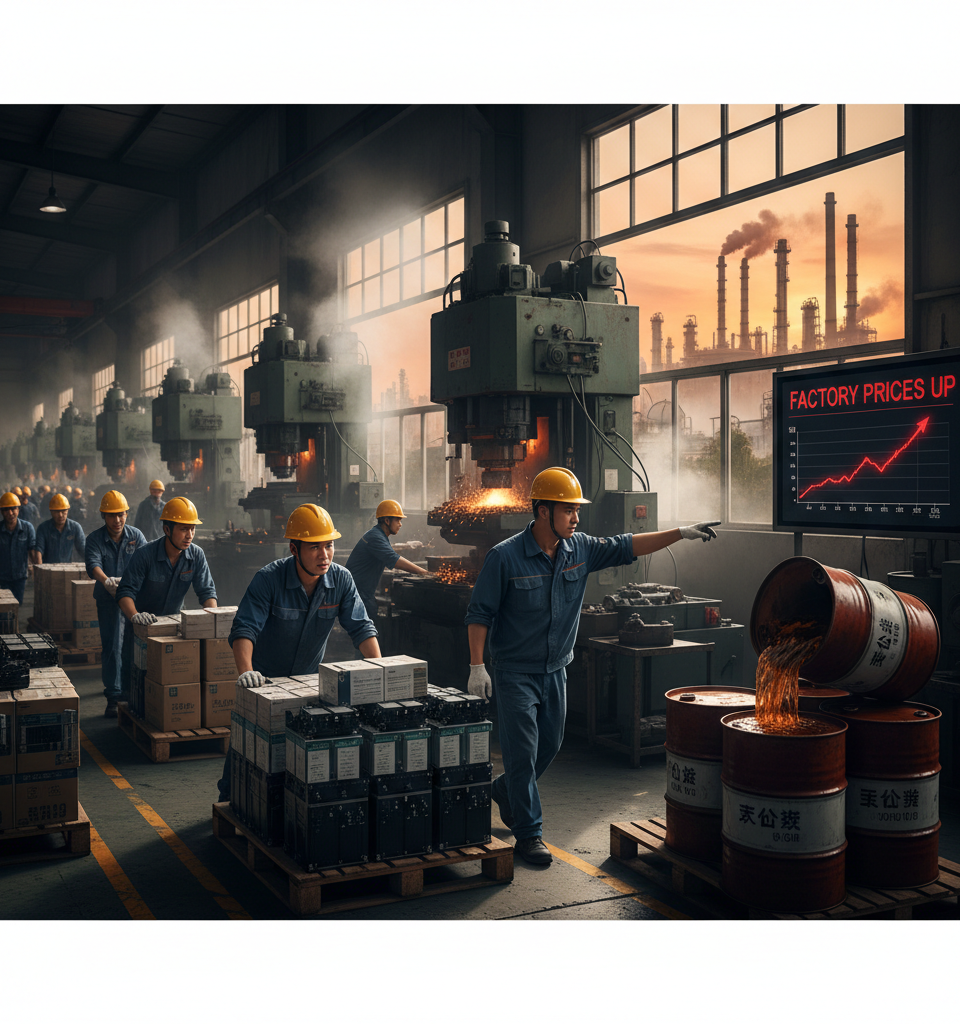
Beijing, China – China's industrial sector has emerged from a prolonged period of deflation, with factory gate prices recording an unexpected increase in the most recent reporting period. This pivotal shift, primarily propelled by a surge in global oil prices, marks the first positive growth in producer price index (PPI) in three years, exceeding economists' forecasts and raising concerns about potential inflationary spillovers across the global economy. The reversal signals a critical turning point for the Chinese economy, which has grappled with subdued demand and overcapacity for an extended duration.
A Historical Reversal: Ending Three Years of Deflation
The return to producer price growth is a significant development, contrasting sharply with the deflationary environment that has plagued China since early 2021. For years, businesses faced declining prices for their goods, squeezing profit margins and hindering investment. This protracted deflationary cycle had been a source of concern for policymakers, signaling weakness in domestic demand and posing risks of a broader economic slowdown. The current uptick, largely attributed to external factors like commodity price increases, offers a complex picture of recovery, distinct from a demand-driven resurgence.
The Oil Catalyst: Specifics Behind the Price Surge
Data released by the National Bureau of Statistics (NBS) revealed that the Producer Price Index (PPI) rose by 0.5% year-on-year, significantly outperforming a Reuters poll forecast of a 0.1% increase and reversing the previous month's 0.3% decline. This growth was overwhelmingly influenced by a dramatic 15% year-on-year increase in the price of crude oil and related products. This surge directly impacted the input costs for a wide array of Chinese industries, from manufacturing to energy production. While China's massive strategic petroleum reserves and diversified energy import sources provide a buffer, the sheer scale of the oil price hike has proven potent enough to move the needle on its overall PPI.
Broader Market Implications: From Supply Chains to Global Inflation
The resurgence in China's factory gate prices carries significant implications not just for its domestic economy but also for global supply chains and inflation. As the world's factory, an increase in Chinese export prices could translate into higher import costs for countries worldwide, potentially fueling inflationary pressures in consumer markets already grappling with cost-of-living crises. Industries heavily reliant on Chinese intermediates, from electronics to textiles, can expect to see their input costs rise. This could force companies to either absorb higher costs – impacting profitability – or pass them on to consumers, thereby contributing to global inflationary trends.
Expert Analysis: A Double-Edged Sword for China
Economists and market analysts offer a nuanced perspective on this development. Dr. Ling Wei, Chief Economist at Horizon Capital, observed, "While the end of producer deflation is ostensibly good news, signifying a potential uptick in industrial activity, its external commodity-driven nature means it's not purely a reflection of robust domestic demand. There's a risk of 'imported inflation' which could erode household purchasing power if not managed carefully." Other analysts have pointed out that while resource-intensive industries might see bolstered revenues, downstream manufacturers could face margin pressures if they cannot fully pass on increased input costs, potentially leading to varied recovery trajectories across sectors.
The Road Ahead: Navigating Inflationary Risks and Policy Responses
Looking forward, the trajectory of global commodity prices, particularly oil, will be a critical determinant for China's PPI. The People's Bank of China (PBOC) will face a delicate balancing act, needing to monitor both nascent inflationary pressures and the continued need for economic stimulus. Policymakers may need to consider measures to mitigate the impact of input cost inflation on key sectors, possibly through targeted subsidies or by strategic releases from reserves. The risk of sustained inflationary pressures could prompt a re-evaluation of monetary policy, potentially slowing the pace of further easing, which had been anticipated to support economic recovery. Businesses, both within China and globally, will be closely watching for how these dynamics unfold and how they might affect sourcing strategies and consumer pricing in the coming months.
Conclusion
The unexpected return to growth in China's factory gate prices marks a significant shift in its economic landscape, ending a three-year period of deflation. While driven primarily by external factors, particularly surging oil prices, this development has profound implications for domestic industry, global supply chains, and the broader inflation outlook. As China navigates this new economic terrain, the judicious management of inflationary risks will be paramount to ensuring a stable and sustainable recovery.