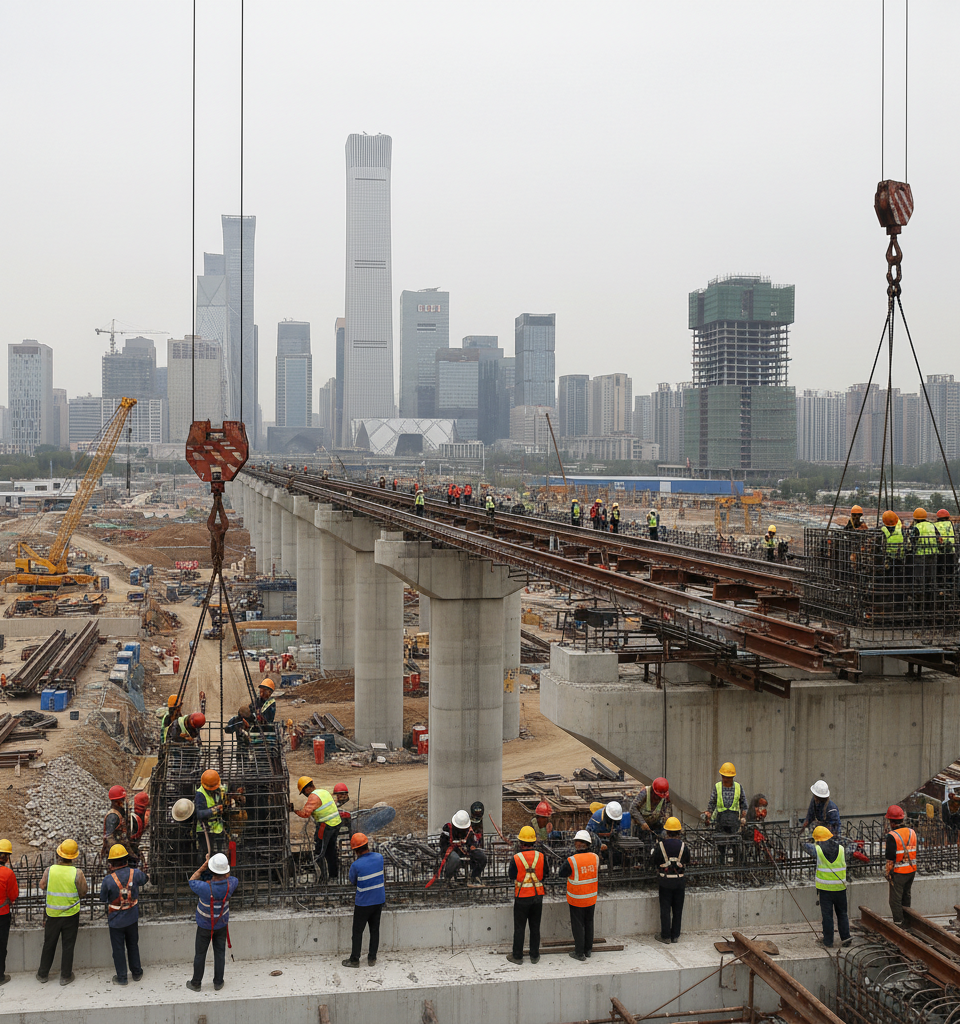
Beijing, China – [Date] – China's economic growth has surpassed analyst predictions, with the latest Gross Domestic Product (GDP) figures indicating a stronger-than-anticipated performance. This unexpected resilience is primarily attributed to a massive injection of government funds into large-scale infrastructure projects, including new high-speed rail lines, urban transit systems, and public utilities. The strategic deployment of state capital serves as a critical counterweight to the deepening slump in the nation's colossal housing sector, which has eroded consumer wealth and, consequently, private spending power.
A Calculated Countermeasure to Economic Headwinds
The ability of the Chinese economy to outperform forecasts underscores Beijing's unwavering commitment to achieving its growth targets, even as it navigates significant domestic challenges. The ongoing property market crisis, characterized by steep declines in housing prices and defaults by major developers, has cast a long shadow over household balance sheets and consumer sentiment. In response, the central government has doubled down on its tried-and-true strategy of infrastructure-led growth, leveraging its fiscal capacity to stimulate demand and create employment opportunities. This approach, while effective in the short term, also raises questions about the long-term sustainability of development heavily reliant on state-driven investment rather than organic private sector expansion.
Key Economic Indicators and Government Initiatives
While specific GDP growth percentages for the latest quarter are still awaiting official release, preliminary data and official statements point to a robust expansion exceeding earlier consensus estimates, which hovered around a [specific percentage]% increase. This upward revision is largely due to significant increases in fixed asset investment, particularly in state-owned enterprises (SOEs) and local government special bond issuance earmarked for infrastructure. For instance, reports indicate that investment in railway construction alone surged by over [specific percentage]% year-on-year, with similar gains observed in other heavy construction sectors. This state-directed spending machine has been pivotal in offsetting weaker consumer demand, which has been impacted by concerns over job security, deflationary pressures, and the perceived loss of wealth from the housing downturn. Retail sales, while showing some signs of recovery, have not yet reached pre-pandemic growth trajectories, emphasizing the continued cautiousness among Chinese consumers.
Impact Across Industrial Sectors
The infrastructure boom has had a cascading positive impact on related industrial sectors. Industries such as steel, cement, heavy machinery, and construction materials have experienced a significant uptick in demand, providing a much-needed boost to their production capacities and profitability. Manufacturers of excavators, cranes, and advanced construction technologies are reporting robust order books, contrasting sharply with the struggles faced by sectors more exposed to private consumption, such as certain retail segments and automotive. However, this sector-specific growth also highlights a growing bifurcaton within the Chinese economy, where national champions and state-backed entities thrive while private enterprises, particularly small and medium-sized businesses, continue to grapple with a challenging operating environment.
Expert Analysis: A Double-Edged Sword
Economists and market analysts offer a mixed perspective on China's current growth trajectory. Dr. Li Wei, Chief Economist at [prominent financial institution], notes, "While effective in stabilizing headline growth, this infrastructure-driven model represents a continuation of an old playbook. It avoids confronting deeper structural issues, particularly the over-reliance on real estate and the need for greater domestic consumption." Other experts, like Professor Wang Jian from [university], caution about the accumulation of local government debt, which has seen a significant increase to finance these projects. "The short-term stability comes at the cost of increasing leverage," Professor Wang states, "and the productive efficiency of some of these new projects, especially in already well-developed regions, remains a question." The long-term efficacy of continually stimulating the economy through non-market mechanisms without addressing underlying imbalances is a frequent point of contention among international observers.
Outlook: Sustaining Growth and Navigating Challenges
Looking ahead, the Chinese government is expected to continue its proactive fiscal policy, particularly in infrastructure spending, as it strives to meet its annual growth targets and manage socio-economic stability. Policymakers are likely to focus on targeted investments in advanced manufacturing, green technologies, and rural revitalization projects, aiming to upgrade the industrial base and narrow regional disparities. However, the pressing need to address the structural issues in the property market and catalyze sustainable, consumption-led growth remains paramount. The success of these initiatives will dictate whether China can transition away from its traditional investment-driven model towards a more balanced and resilient economic future, especially as global economic uncertainties persist and geopolitical tensions remain elevated. The delicate balance between immediate stimulus and long-term reform will define China's economic narrative in the coming years.