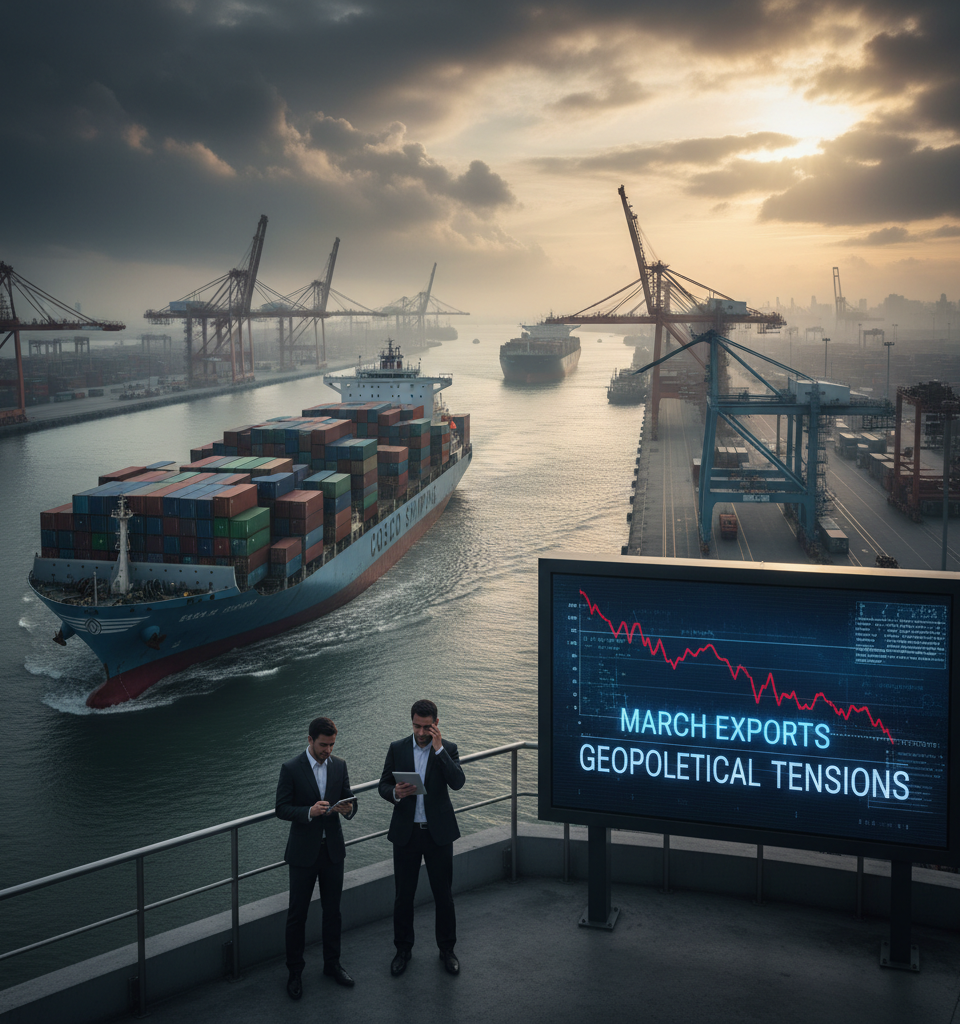
Beijing, China – April 12, 2024 – China's formidable export engine, a critical barometer of global trade health, experienced a significant slowdown in March, confounding market analysts and raising concerns about the interplay between geopolitical volatility and economic performance. The decelerated growth from the world's second-largest economy, with exports rising by a modest 2.3% year-on-year in dollar terms, sharply contrasted with the robust 7.1% increase in the first two months of 2024, falling short of the 3.8% consensus forecast by Reuters economists. This moderated expansion suggests that even a burgeoning boom in AI-driven technologies could not fully offset the broader challenges stemming from heightened geopolitical tensions, particularly the escalating conflict in Iran.
Contextualizing the Export Deceleration
The unexpected deceleration in China's export figures arrives at a precarious moment for the global economy. After a challenging 2023, where exports contracted by 4.6%, the early 2024 rebound had offered a glimmer of hope amidst persistent concerns about global demand and protectionist pressures. However, the March data indicates that this recovery remains fragile. The interconnectedness of global supply chains means that disruptions in one major region, such as the Middle East, can have ripple effects that undermine economic momentum elsewhere. China's manufacturing sector, a key driver of its export prowess, is increasingly sensitive to such external shocks, threatening to complicate Beijing's ambitious target for economic growth this year.
Key Factors and Data Points
While official figures did not explicitly detail the impact of geopolitical events on specific sectors, anecdotal evidence and market sentiment suggest a direct correlation. Shipping routes through the Middle East, particularly around the Strait of Hormuz, have become increasingly perilous, leading to higher insurance premiums, longer transit times, and rerouting decisions that inflate costs and reduce efficiency for Chinese exporters. Concurrently, data released by the General Administration of Customs shows that imports also rose by 2.6% year-on-year in March, resulting in a trade surplus of $58.55 billion, down from $60.31 billion in February. Crucially, the earlier export surge had been significantly propelled by robust demand for high-tech components and services essential for Artificial Intelligence development, including advanced semiconductors and data center equipment. While this sector continues to see growth, the overall momentum was insufficient to overcome the broader headwinds.
Industry and Market Impact
This slowdown is poised to reverberate across various industries. Global manufacturers and retailers reliant on 'Made in China' goods face potential delays and cost increases, which could translate into higher consumer prices in Western markets. Industries like consumer electronics, automotive parts, and textiles, which have deep ties to Chinese production, are likely to experience supply chain disruptions. Furthermore, commodity markets could see shifts as energy prices remain volatile due to the Iranian situation, impacting input costs for Chinese factories. The maritime shipping industry, already navigating complex geopolitical landscapes, will face continued pressure on routes and freight rates.
Expert Analysis and Outlook
Economists and trade analysts are dissecting the implications. Dr. Li Wei, Chief Economist at Huatai Securities, noted, "The March export data is a stark reminder that even as China pivots towards higher-value manufacturing and AI, it remains susceptible to the volatile global landscape. The geopolitical premiums embedded into trade are growing, and this will inevitably impact profit margins for exporters and potentially lead to some re-shoring or diversification away from heavily reliant supply chains." Another analyst from Capital Economics, Julian Evans-Pritchard, suggested, "While a single month's data doesn't dictate a trend, the confluence of weaker global demand signals and geopolitical strife points to a more challenging environment for Chinese trade than initially anticipated. Policymakers in Beijing may need to consider further stimulus measures to bolster domestic demand and partially offset external vulnerabilities."
The Path Ahead: Future Implications
Looking forward, the trajectory of China's trade balance will depend heavily on two critical factors: the easing or intensification of global geopolitical tensions, particularly in the Middle East, and the durability of demand for AI-related technology. Should tensions escalate further, the associated risks to shipping and global supply chains could deepen, potentially leading to more pronounced export contractions in the coming months. Conversely, a sustained global appetite for AI infrastructure and applications could yet provide a resilient backbone for China's export sector, albeit one that is now clearly exposed to external shocks. Beijing is expected to closely monitor these developments, potentially adjusting its trade policies and economic strategies to navigate this increasingly complex global environment, with potential implications for its relationship with key trading partners and its role in global governance.