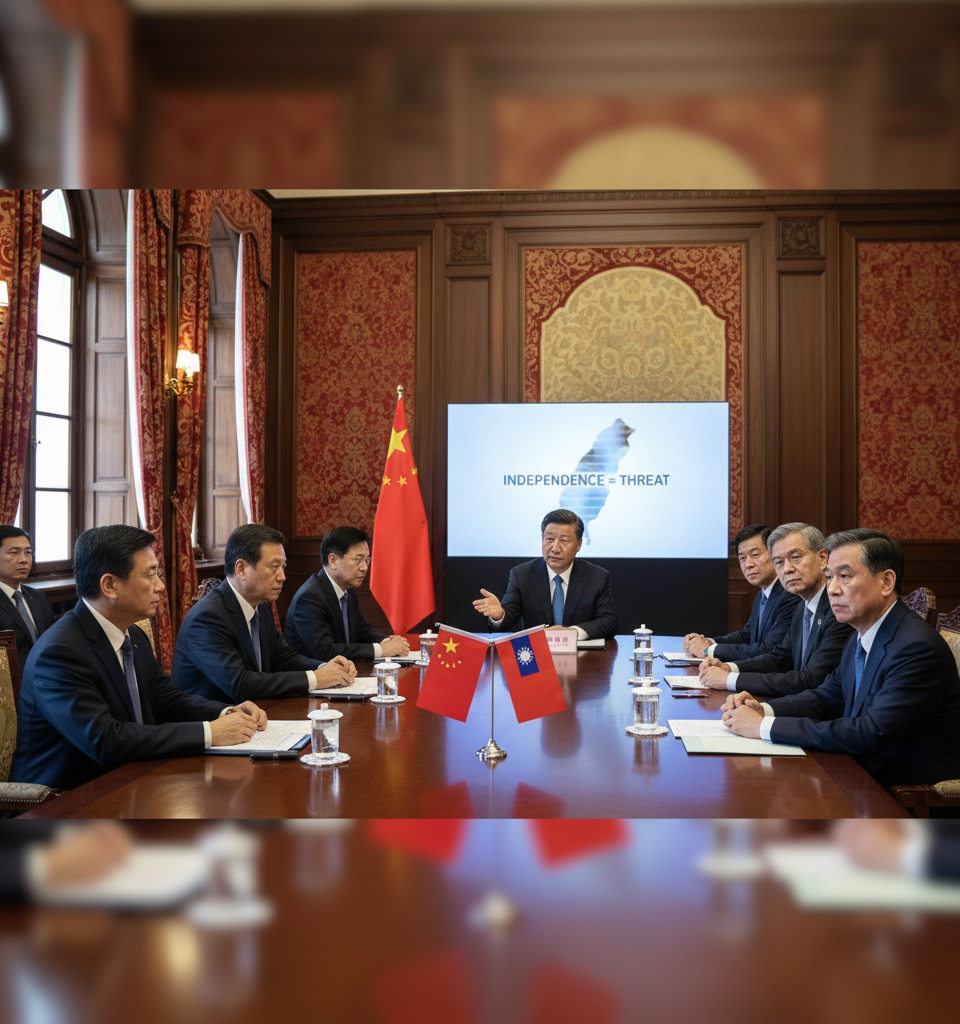
Beijing, China – May 19, 2026 – Chinese President Xi Jinping recently hosted the leader of Taiwan's principal opposition party in a landmark meeting in Beijing, signaling a renewed diplomatic push on cross-strait relations. This engagement, the first of its kind in a decade, comes at a critical juncture, preceding a high-stakes meeting between President Xi and U.S. President Donald Trump scheduled for later this month. The discussions in Beijing are also set against the backdrop of Taiwan's impending 2028 presidential election, an electoral cycle where the island's relationship with mainland China is anticipated to be a central and potentially divisive issue.
The discussions primarily centered on President Xi's reiteration of Beijing's firm stance against Taiwanese independence. This emphasis underscores China's long-standing position that Taiwan is an inalienable part of its territory and that any moves towards formal independence would be met with resolute opposition. The timing of these talks is particularly noteworthy, suggesting a strategic effort by Beijing to engage with segments of Taiwanese political leadership that may be perceived as more amenable to dialogue and a 'one China' framework, as the island nation gears up for its next democratic cycle.
Strategic Implications for Cross-Strait Relations
For Beijing, hosting Taiwan's main opposition leader provides an important platform to articulate its policy objectives directly and bypass the current ruling party which typically leans towards greater autonomy. This strategy could be aimed at influencing public opinion in Taiwan ahead of the 2028 election, potentially bolstering the prospects of parties that advocate for closer ties with the mainland or at least a more cautious approach to sovereignty declarations. The meeting itself, by its very occurrence, asserts China’s continued relevance and influence in Taiwan’s political landscape, regardless of which party is in power on the island.
From the perspective of Taiwan's opposition, engaging with Beijing offers an opportunity to demonstrate their capacity for diplomatic engagement and potentially present themselves as a stable, pragmatic alternative in managing the complex cross-strait dynamic. Such high-level interactions could be framed as essential for maintaining peace and economic stability, contrasting with accusations of potential provocations from more independence-leaning factions. However, balancing dialogue with Beijing against domestic political pressures and public sentiment regarding sovereignty will be a delicate act for the opposition leader.
Broader Geopolitical Context and U.S. Involvement
Adding another layer of complexity to these cross-strait discussions is the upcoming meeting between President Xi and U.S. President Trump. The United States has historically maintained a policy of 'strategic ambiguity' regarding Taiwan, providing defensive capabilities while not explicitly endorsing independence. Any shifts in the U.S. stance, or even pronouncements from the Xi-Trump summit, could profoundly impact the geopolitical calculus surrounding Taiwan. Beijing's engagement with the Taiwanese opposition could be seen as a pre-emptive measure to stabilize cross-strait relations before potentially challenging discussions with Washington.
The global community will be closely watching the outcomes of both the internal Chinese-Taiwanese dialogues and the subsequent U.S.-China summit. The stability of the Indo-Pacific region is intrinsically linked to the status of Taiwan, and any perceived escalation or de-escalation of tensions will have ripple effects across international markets and diplomatic channels. Trade relationships, technological supply chains, and regional security alliances are all sensitive to the evolving dynamics of cross-strait affairs.
The Road to Taiwan's 2028 Presidential Election
The 2028 presidential election in Taiwan is poised to be a defining moment for the island's future trajectory. With the main opposition leader engaging directly with Beijing, the issue of cross-strait relations is almost certainly going to be front and center in the electoral campaign. Voters will likely be presented with stark choices regarding Taiwan's national identity, economic future, and security posture. The incumbent ruling party will need to articulate a clear strategy for managing Beijing amidst these renewed diplomatic overtures to the opposition.
Analysts suggest that Beijing's move could be an attempt to apply indirect pressure on the current Taiwanese government and shape the narrative leading into the election. By fostering dialogue with the opposition, China aims to demonstrate that there are viable pathways for engagement within its 'one China' principle, potentially isolating more staunchly pro-independence voices. The coming months will undoubtedly see an intensification of political debate and strategic maneuvering, both domestically within Taiwan and internationally, as these critical diplomatic engagements unfold.