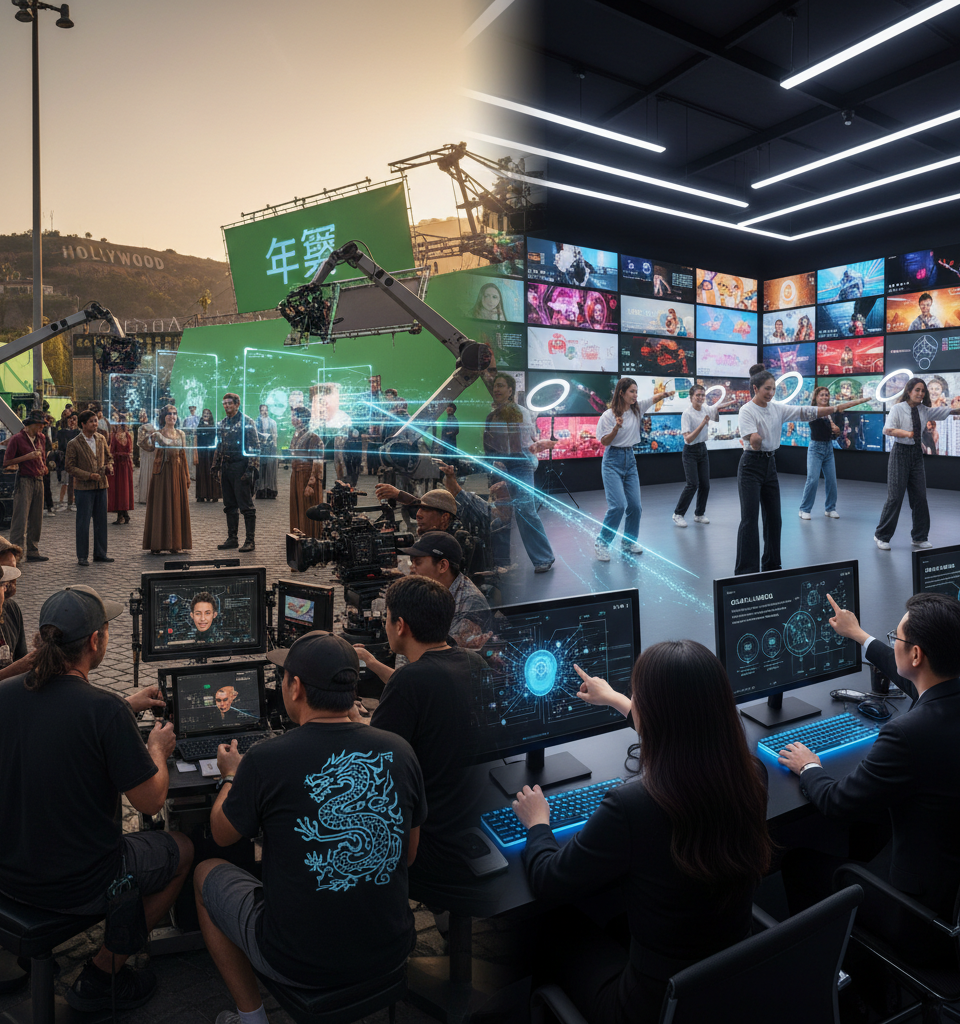
The global video production landscape is undergoing a profound transformation, driven largely by artificial intelligence technologies, a significant portion of which are developed in China. These AI-powered tools are enabling content creators, ranging from large Hollywood studios to individual short-form video producers, to generate visual content with unprecedented efficiency and reduced resource requirements, effectively democratizing access to sophisticated production capabilities.
The AI Revolution in Content Creation
Historically, video production demanded extensive crews, specialized equipment, and considerable financial investment. AI is dismantling these prerequisites. Companies are leveraging AI for tasks such as scriptwriting, virtual set design, character animation, voice synthesis, and even realistic digital actor generation. This automation not only accelerates production cycles but also significantly lowers costs, making high-quality video content more accessible across various platforms, including streaming services, social media, and advertising.
China's Strategic Position
China has strategically positioned itself as a leading innovator in AI, particularly within the computer vision and natural language processing domains crucial for video generation. Companies like Baidu, Alibaba, and Tencent, alongside numerous specialized AI startups, have invested heavily in research and development, producing advanced algorithms and platforms. These technologies are not only used domestically but are also increasingly integrated into global content creation pipelines, often through licensing agreements or indirect usage via third-party tools. For instance, Chinese AI models are frequently behind tools that offer text-to-video generation or sophisticated motion capture from standard 2D video feeds, dramatically simplifying complex animation.
Economic and Creative Implications
The economic implications are vast. The global AI market for media and entertainment is projected to reach approximately $12 billion by 2027, with significant growth driven by generative AI. This shift allows smaller studios and individual creators to compete with larger entities, fostering a more diverse content ecosystem. For larger studios, it means substantial cost savings on labor-intensive tasks, potentially freeing up resources for more creative endeavors or enabling higher production volumes. For example, a task that once required a team of animators for weeks can now be partially automated by AI in days, cutting costs by up to 70% in some instances.
Expert Perspectives on Influence and Ethics
Industry analysts and experts are closely monitoring this trend. Dr. Li Wei, a prominent AI ethics researcher, notes, “While the efficiency gains are undeniable, the reliance on foreign-developed AI, particularly from a geopolitical rival, raises questions about data sovereignty, intellectual property, and potential embedded biases.” Others highlight the need for clear attribution and ethical guidelines for AI-generated content, especially as realism reaches unprecedented levels. “The blurred lines between human and AI-created content present new challenges for authenticity and consumer trust,” comments Sarah Chen, a media technology consultant.
Industry Adoption and Market Penetration
The adoption is widespread, though sometimes subtle. Many popular video editing software and cloud-based creation platforms now incorporate AI features powered by underlying technologies that may have Chinese origins. For example, AI-powered upscaling, background removal, and automatic subtitling features — common in tools used by millions — often leverage advanced algorithms perfected by Chinese AI firms. This embedded reliance means that a significant portion of the video content consumed globally, from major film productions to viral social media clips, implicitly or explicitly uses Made-in-China AI.
The Road Ahead: Innovation and Regulation
The future will likely see continued innovation in AI-driven video generation, with advancements in realism, emotional intelligence of digital characters, and personalization of content. However, this growth will be intertwined with increasing scrutiny over ethical implications, copyright issues, and the geopolitical dimensions of technology development. Regulatory frameworks are anticipated to evolve globally, aiming to balance innovation with public trust and ethical use. The U.S. Copyright Office and other international bodies are already grappling with how to define ownership and originality in an era of AI co-creation, signaling a complex but inevitable legal and ethical integration of these powerful tools into the creative industries.