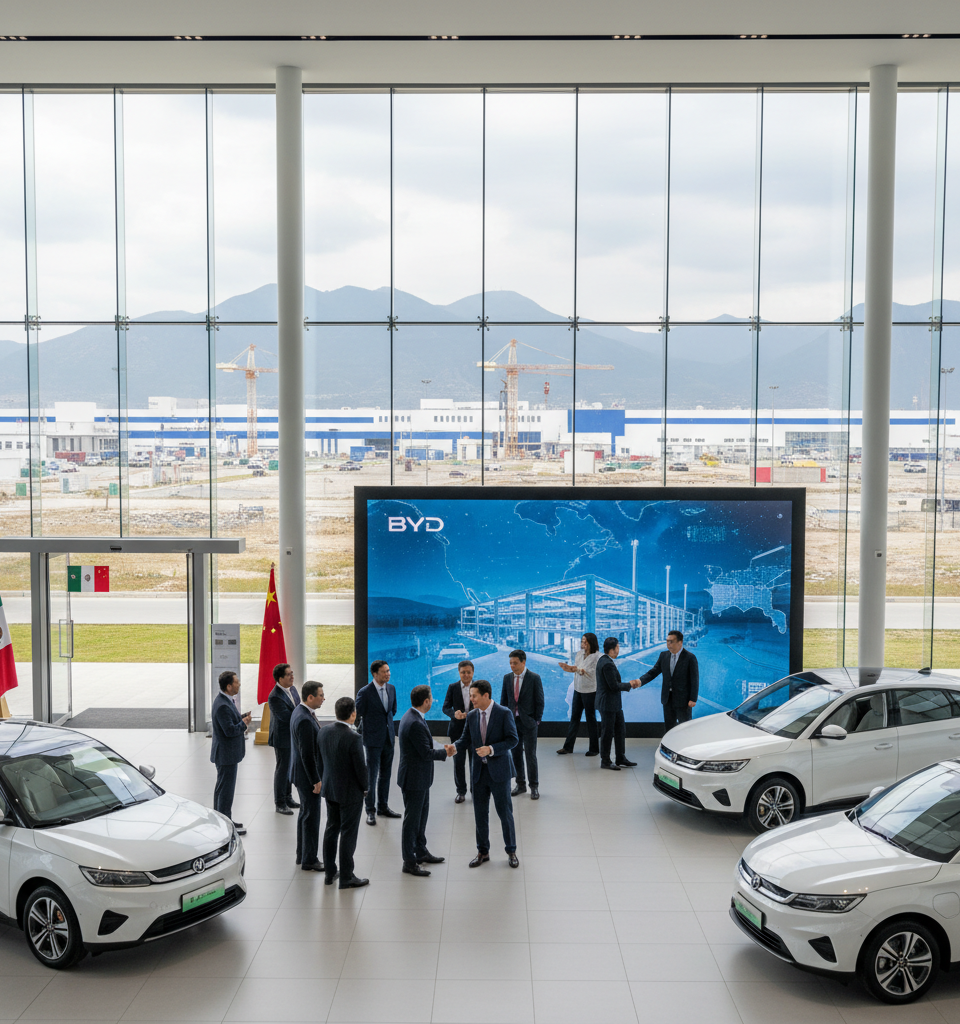
MONTERREY, MEXICO – A significant shift is underway in Mexico's automotive landscape, as Chinese automakers aggressively expand their market presence and investment, coinciding with a noticeable deceleration in certain U.S. export sectors. This strategic advancement by Chinese firms is reshaping regional trade dynamics, capitalizing on Mexico's burgeoning manufacturing capabilities and its strategic access to the broader North American market. The move comes as U.S. export resilience, a longstanding cornerstone of North American trade, faces new pressures, prompting a re-evaluation of established supply chains and partnerships.
The growing influence of Chinese automotive players in Mexico is a direct consequence of a confluence of factors, including escalating trade tensions between the U.S. and China, and Mexico's attractive position as a manufacturing hub with favorable trade agreements. Historically, Mexico has served as a critical production base for established North American and European automakers, leveraging NAFTA (now USMCA) to integrate into complex supply chains. However, Chinese companies are now challenging this status quo, establishing new assembly plants and distribution networks, not solely for export to the U.S. but also for domestic Mexican consumption and Latin American markets.
Key to this expansion are substantial investments by Chinese brands like BYD, Chery, and Great Wall Motors, which are reportedly exploring or actively establishing manufacturing facilities in Mexico. For instance, BYD, a leading electric vehicle manufacturer, has openly discussed plans for a plant in Mexico, aiming to produce up to 150,000 vehicles annually. This influx of Chinese capital and technology is injecting fresh competition into Mexico's automotive sector, traditionally dominated by marques from Detroit, Germany, and Japan. The impact is already visible in sales figures, with Chinese brands reportedly capturing an increasing percentage of the Mexican new car market, driven by competitive pricing and a growing range of EV options.
This trend poses both opportunities and challenges for the broader North American automotive industry. While it diversifies Mexico's industrial base and creates local jobs, it also introduces a new layer of competition for traditional automakers, especially in the burgeoning electric vehicle segment. The softening of U.S. exports further compounds this, indicating potential shifts in global demand or altered production strategies that may benefit alternative suppliers. For example, recent trade data has shown a slight moderation in certain finished goods exports from the U.S. to Mexico, possibly creating an opening for other players.
Industry analysts view this as a strategic long-term play by Chinese automakers to bypass potential tariffs and logistics hurdles associated with direct exports from China to the U.S. and to leverage Mexico's lower labor costs and geographic proximity. "Mexico offers a backdoor, or rather, a front door under new terms, for global automotive players looking to serve the North American market," stated Dr. Elena Rodriguez, an independent trade economist specializing in Latin American markets. "The significant investment in manufacturing capacity indicates a serious commitment from Chinese companies to establish a persistent presence, not just opportunistic sales." This dynamic is compelling traditional players to re-evaluate their own investment and production strategies within the region.
Looking ahead, the trajectory of Chinese automotive investment in Mexico is likely to accelerate, particularly as the global push towards electrification intensifies. Future implications include a potential reshaping of automotive supply chains across the continent, with increased fragmentation and diverse origination points for vehicles sold in the U.S. and Canada. This could also spur renewed discussions around trade policies and domestic content rules. Further developments are expected in infrastructure, such as the recent restart of OmniTRAX's Central Texas rail line, bolstered by a quarry deal, indicating a broader focus on enhancing logistical capabilities within key manufacturing and export corridors.
Simultaneously, the entry of companies like China’s Windrose with its first Class 8 EV delivery in the U.S. signals China's ambitions beyond passenger vehicles into the heavy-duty commercial sector. This diversification underscores a comprehensive strategy to penetrate various segments of the North American transport market. The combined effect of these movements paints a picture of a dynamic and increasingly competitive North American trade landscape, where Mexico is emerging as a crucial battleground for global industrial leadership and supply chain resilience.