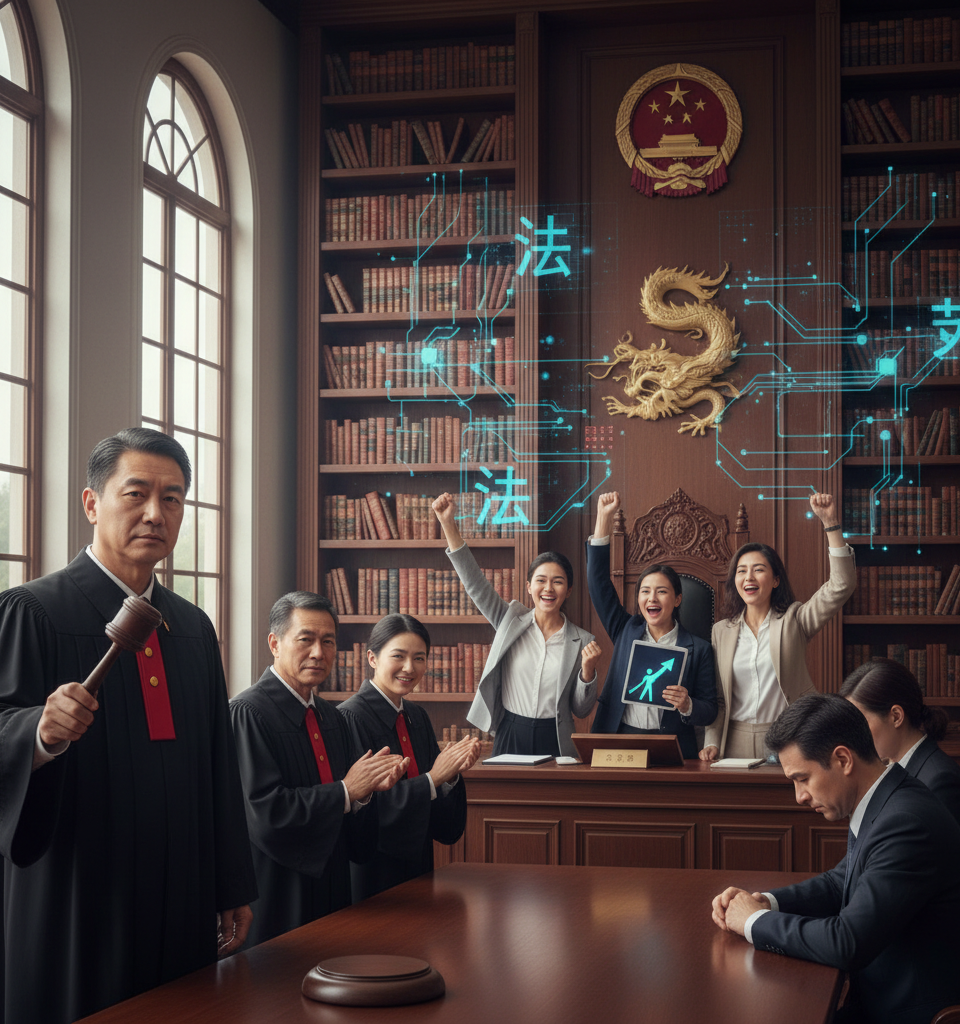
A court in Hangzhou, a prominent technology hub in eastern China, recently issued a groundbreaking ruling affirming that companies cannot legally dismiss employees solely on the basis of their jobs being automated by artificial intelligence. The decision, handed down this week, found a local tech firm acted unlawfully by attempting to demote a long-serving employee, identified only by his surname, Chen, and subsequently terminating his employment after he refused the lesser role, citing the integration of AI into his original responsibilities.
This judicial intervention arrives at a critical juncture as AI technologies rapidly advance, sparking anxieties worldwide about job displacement. The Hangzhou court's judgment provides significant legal clarity, emphasizing that employers bear a responsibility to manage the human impact of technological adoption rather than simply discarding affected workers. Globally, policymakers and labor organizations have been grappling with how to regulate the burgeoning AI sector to prevent widespread unemployment and ensure fair labor practices.
The case involved Mr. Chen, an employee with over a decade of service at the unnamed Hangzhou-based technology company. His role, which primarily involved data analysis and certain operational tasks, reportedly became largely redundant after the firm implemented an advanced AI system. Instead of retraining or reassigning Mr. Chen to a position commensurate with his experience and skills, the company offered him a significantly demoted role with reduced pay. Upon his refusal, citing the unfairness of the demotion, the company moved to terminate his contract. The court, after reviewing the evidence, determined that the company failed to provide reasonable alternatives or justifications for the dismissal that complied with existing labor laws, effectively ruling that AI integration does not automatically constitute a legal basis for termination.
The implications of this ruling stretch far beyond Hangzhou's city limits, reverberating through China's vast and rapidly evolving technology sector. It signals a potential shift in how Chinese companies, many of whom are at the forefront of AI development and deployment, will need to approach workforce management in an age of increasing automation. This precedent could force companies to invest more heavily in employee retraining and upskilling programs, or explore internal re-deployment strategies, rather than resorting to layoffs as a primary solution when AI takes over tasks. It also challenges the prevailing notion that technological efficiency automatically overrides worker protections.
Expert Perspective
Legal and labor experts are closely scrutinizing the Hangzhou decision, calling it a significant protective measure for workers. "This ruling sends a clear message that technological advancement, while encouraged, cannot be a carte blanche for infringing upon established labor rights," stated Dr. Li Wei, a professor of labor law at Peking University. "It underscores the principle that employers must demonstrate a genuine absence of suitable alternative roles, or offer adequate retraining, before considering dismissal due to automation. This is a progressive step that prioritizes human capital amidst rapid technological shifts." Analysts suggest that this could inspire similar legal challenges and policy considerations in other nations encountering similar workforce dilemmas.
Future Implications
The judgment is expected to catalyse discussions among Chinese lawmakers regarding more explicit regulations governing AI's impact on employment. While existing labor laws offer general protections, the specific challenges posed by AI-driven automation require nuanced interpretations and potentially new legislative frameworks. Companies are advised to proactive review their human resources policies, focusing on robust internal mobility programs, continuous learning initiatives, and transparent communication with employees about future technological integrations. Failure to adapt could expose firms to increased legal risks and reputational damage.
The Broader Context of AI and Employment
This case highlights the growing global tension between technological progress and employment stability. Reports from organizations like the World Economic Forum consistently project millions of jobs to be both created and displaced by AI in the coming decade. While some roles will disappear, new ones will emerge, emphasizing the critical need for reskilling and adaptability. The Hangzhou court's ruling places the onus squarely on employers to facilitate this transition humanely and legally, moving away from a purely capital-driven approach to automation towards one that also considers social equity and worker welfare. This sets a significant benchmark for how societies worldwide might manage the disruptive yet transformative power of artificial intelligence. The decision is likely to be cited in future labor disputes and policy debates as the world grapples with the 'future of work'.