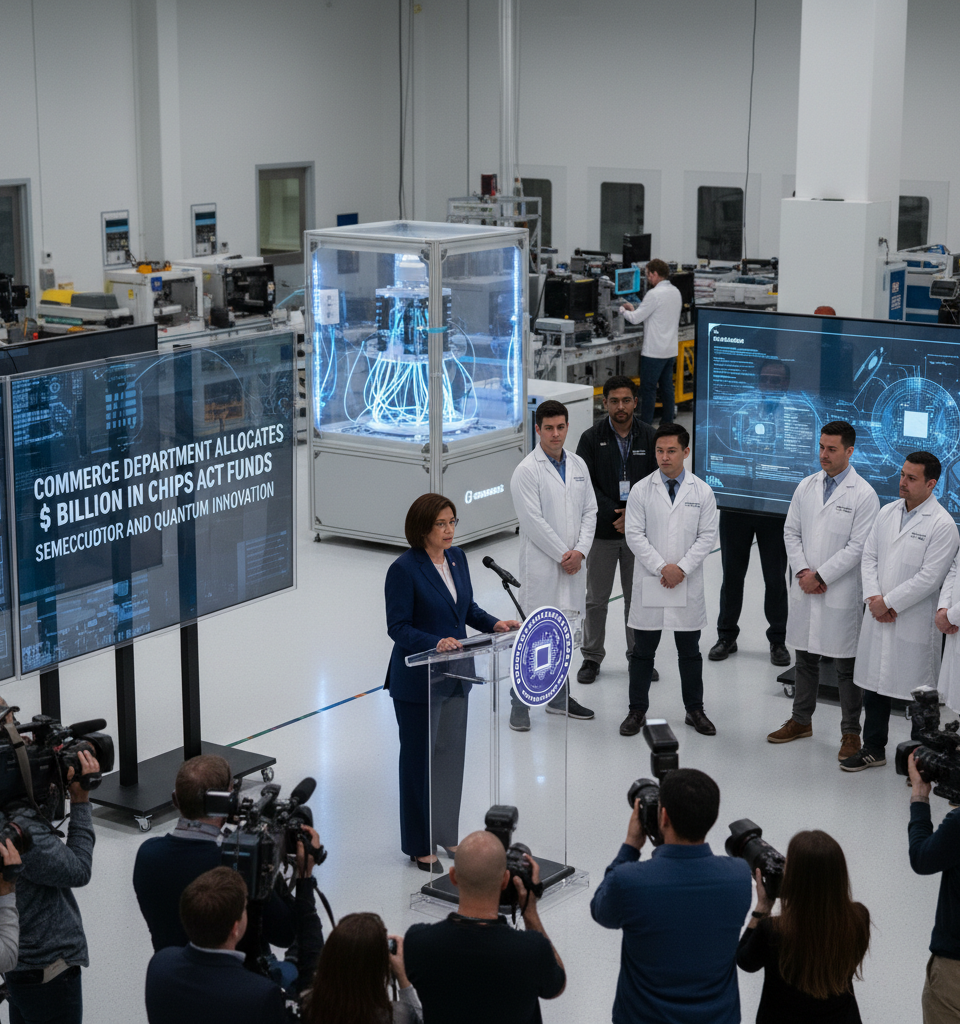
The U.S. Commerce Department has unveiled a substantial $2 billion funding initiative under the CHIPS and Science Act, designed to propel domestic innovation in both advanced semiconductor manufacturing and the foundational development of quantum computing. This strategic investment is earmarked to support key industry players GlobalFoundries and IBM, alongside seven emerging quantum computing companies, in their collective endeavor to achieve "utility-scale, fault-tolerant quantum computers."
This funding arrives amidst a global push to secure supply chains for advanced technologies and establish leadership in next-generation computing. The CHIPS and Science Act, enacted to bolster American competitiveness, particularly in semiconductor research and production, underscores a national commitment to reduce reliance on foreign manufacturing and foster breakthroughs in critical technological domains. The current allocation signifies a dual focus: strengthening existing semiconductor capabilities while simultaneously laying the groundwork for a future powered by quantum technology.
Specifically, the $2 billion in funds will be distributed to GlobalFoundries and IBM, two companies with established track records in microchip manufacturing and technological innovation, respectively. While the exact breakdown of the funding between these two giants and the seven quantum firms was not detailed in the announcement, the department emphasized the collective goal of accelerating the country's progress in both semiconductor fabrication and quantum research. The inclusion of seven quantum computing companies highlights a concerted effort to foster a diverse ecosystem of innovation in this nascent, but highly promising, field. The specified objective of developing "utility-scale, fault-tolerant quantum computers" points towards a long-term vision of practical, real-world applications for quantum technology, moving beyond theoretical exploration.
The broader industry impact of this funding is expected to be significant. For the semiconductor sector, this investment will contribute to enhancing domestic manufacturing capacity and research and development, potentially mitigating risks associated with global supply chain disruptions. For the quantum computing landscape, the injection of substantial capital into seven distinct companies could accelerate the pace of innovation, foster collaborations, and attract further private investment. It signals a strong governmental endorsement of quantum computing as a strategic national priority, potentially paving the way for the U.S. to solidify its position at the forefront of this transformative technology.
While the Commerce Department's announcement did not include specific expert commentary, industry analysts are likely to view this as a crucial step in operationalizing the CHIPS Act's goals. The emphasis on "fault-tolerant" quantum computers suggests a rigorous approach to development, recognizing the technical hurdles involved in making quantum systems robust and reliable for practical use. The combination of support for both established semiconductor firms and cutting-edge quantum startups suggests a balanced strategy to address immediate manufacturing needs while also investing in long-term technological leadership.
Looking ahead, the allocation of these funds is anticipated to kickstart a period of intensive research, development, and talent acquisition within the recipient companies. The progress of GlobalFoundries and IBM in their respective areas, often involving significant capital expenditure for new facilities or advanced equipment, will be closely monitored. Similarly, the advancements made by the seven quantum computing companies in achieving fault-tolerant systems will be a key indicator of the initiative's success. This funding is poised to be a catalyst for further innovation, potentially leading to new patents, advanced prototypes, and eventually, commercially viable quantum solutions, shaping the technological landscape for decades to come.