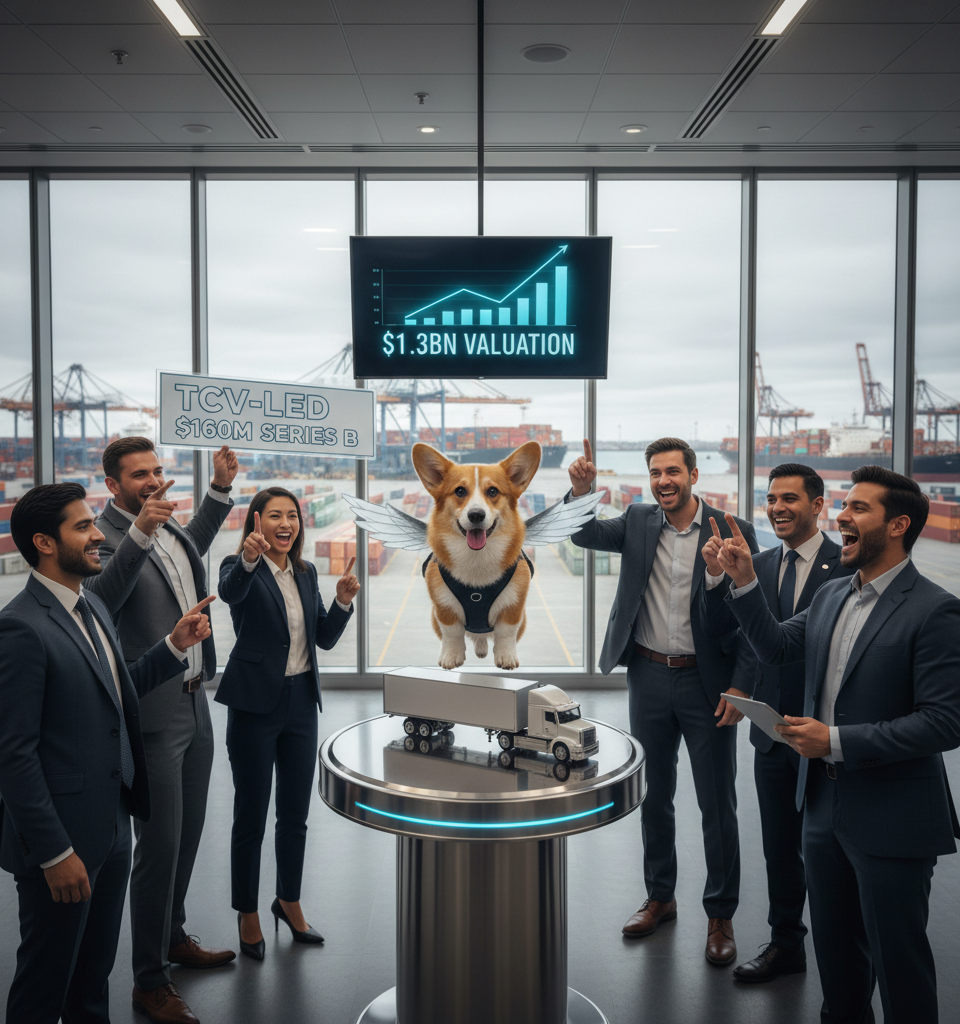
Corgi, the Y Combinator-backed, AI-native insurance carrier specializing in underwriting for startups, has achieved a remarkable valuation milestone, reaching $1.3 billion through a $160 million Series B funding round. This substantial investment, led by prominent growth equity firm TCV, comes a mere four months after the company's $630 million Series A closure in January. The capital infusion is strategically earmarked for broadening Corgi's market reach beyond its current focus on startups, with an immediate pivot towards the underserved and complex commercial trucking insurance sector.
This rapid ascent underscores a burgeoning confidence in Corgi's AI-driven underwriting capabilities and its business model. The company's prior Series A, which itself represented a significant vote of investor confidence, positioned Corgi as a formidable player in the InsurTech space. The accelerated timeline for this Series B round, effectively doubling the company's valuation in a short period, highlights the intense competition and demand for innovative solutions in the insurance industry, particularly those leveraging artificial intelligence for efficiency and accuracy.
Key to Corgi's strategy is its proprietary AI-native platform, which it claims can dramatically compress quoting and risk modeling processes. For instance, while traditional insurance underwriting for specialized sectors can take weeks or even months, Corgi asserts its technology can provide comprehensive risk assessments and quotes in a fraction of that time. This efficiency is critical for market segments like trucking, where immediate coverage and adaptable policies are highly valued. The $160 million in fresh capital will be deployed to scale these technological capabilities, attract top-tier talent, and navigate the intricate regulatory landscape of commercial auto insurance.
The implications of Corgi's move into the trucking insurance market are considerable. The sector is notorious for its high loss ratios, complex risk profiles, and susceptibility to economic fluctuations and evolving safety regulations. Existing carriers often struggle with outdated actuarial models and manual processes, leading to higher premiums and slower service. Corgi's AI-first approach has the potential to disrupt this dynamic by offering more granular risk assessment, potentially leading to fairer pricing, faster claim processing, and improved loss prevention strategies. This could benefit trucking companies, particularly smaller operators who often face prohibitive insurance costs.
Industry analysts view Corgi's valuation and strategic expansion as a signal of continued innovation within the InsurTech landscape. "Corgi's rapid growth demonstrates that investors are increasingly betting on AI-native solutions to tackle some of the insurance industry's most challenging segments," commented Sarah Jenkins, a leading InsurTech analyst. "Their success in the startup space provides a strong proof of concept, and their move into trucking indicates a validated and scalable AI model that can adapt to different and more complex risk environments." She added that the involvement of TCV, known for its investments in technology leaders, lends further credibility to Corgi's long-term prospects.
Looking ahead, Corgi's journey into trucking insurance will undoubtedly be a closely watched development. The company will need to demonstrate its ability to effectively scale its AI models across a much larger and more diverse risk pool, while also building out a robust claims handling infrastructure suitable for commercial vehicle incidents. If successful, Corgi could establish a new benchmark for efficiency and risk management in specialized commercial insurance. Future developments could include leveraging telematics data from trucking fleets to further refine their risk assessment models, potentially revolutionizing how commercial vehicle insurance is underwritten and managed across the globe.