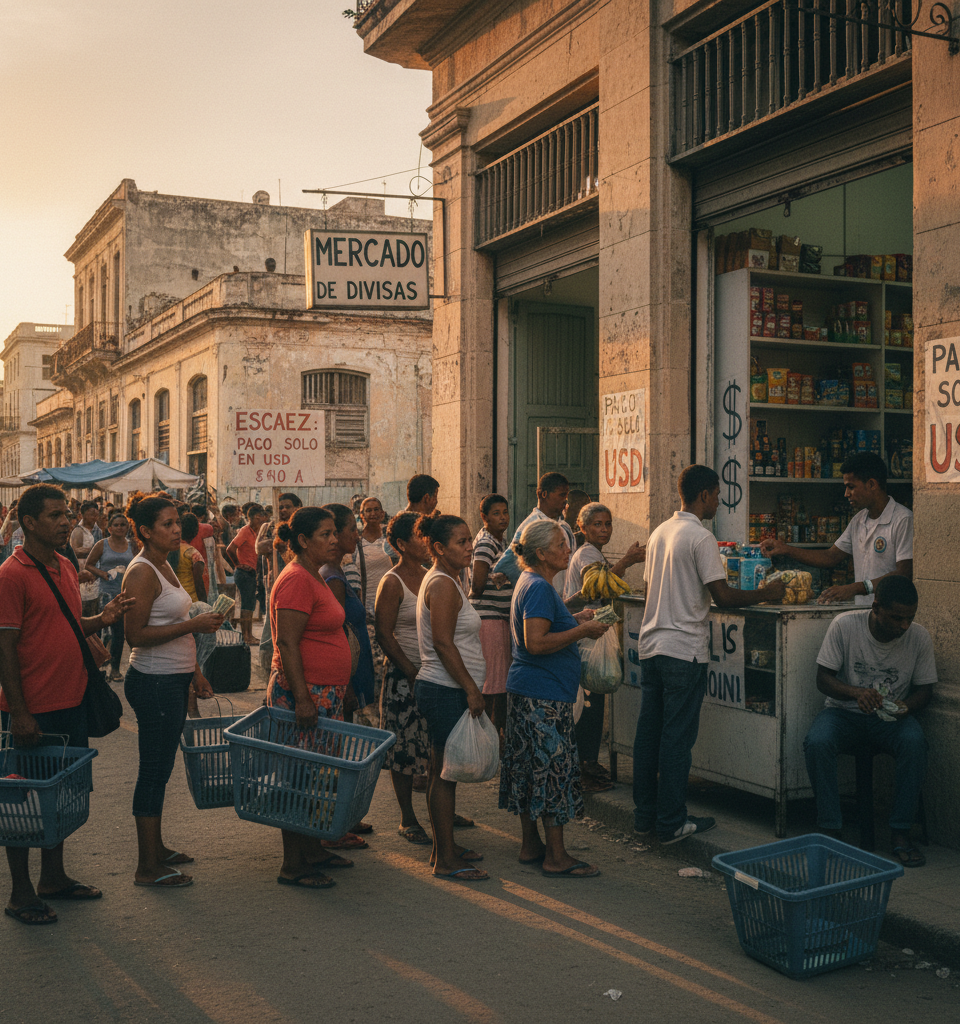
HAVANA – A growing segment of Cuba's essential consumer goods market is now transacting exclusively in US dollars, a stark indicator of the island nation's deteriorating economic conditions. From essential foodstuffs to hygiene products, items once purchased with Cuban pesos are increasingly found only in state-run dollar stores or on the black market, leaving many Cubans unable to afford daily necessities. This shift highlights a widening chasm between those with access to foreign currency and the vast majority dependent on a rapidly devaluing local currency and an insufficient ration book system.
Historical Context of Economic Hardship
Cuba has long grappled with economic challenges, exacerbated by the decades-long U.S. embargo and inefficiencies within its socialist economic model. The collapse of the Soviet Union in the early 1990s triggered the "Special Period," a severe economic crisis that saw widespread shortages and the introduction of the US dollar as a parallel currency. While the dollar was later withdrawn from circulation for a period, its recent re-emergence as the de facto currency for critical goods signals a return to, and in some ways an intensification of, that desperate era. The current crisis is compounded by the severe downturn in tourism due to the COVID-19 pandemic and tightened U.S. sanctions, crippling key revenue streams that traditionally brought in hard currency.
The Inadequacy of the Ration Book
For generations, the libreta de abastecimiento, or ration book, has been a cornerstone of Cuban life, providing citizens with subsidized basic goods. However, its effectiveness has plummeted to critical lows. "No Cuban can truly survive on the products from the ration book anymore," lamented one Havana resident. The quantity and variety of goods allocated through the ration system have steadily dwindled, failing to meet even the most basic nutritional or household needs. Items like cooking oil, chicken, milk, and even the iconic Cuban bread are now either sporadically available, rationed in minuscule amounts, or sold at exorbitant prices in the parallel dollar economy. The phrase "Everything is scarce here — everything — even that wretched bread" encapsulates the daily struggle faced by ordinary citizens.
Impact on Daily Life and Social Inequality
This dollarization of basic necessities is fueling unprecedented levels of social inequality. Those with relatives abroad sending remittances in dollars or access to the tourism sector are increasingly the only ones who can afford what is available. The average state salary, often equivalent to less than $50 a month, is woefully insufficient to purchase goods at dollar-denominated prices. This creates a two-tiered economy where access to food, medicine, and other essentials is determined by one's ability to acquire foreign currency, effectively marginalizing the majority of the population and exacerbating poverty. Black market activity, where goods are exchanged for dollars at inflated rates, has proliferated as a result.
Expert Economic Analysis
Economists view this development with grave concern, seeing it as a desperate measure by the Cuban government to capture foreign currency in a liquidity crunch. Dr. Ricardo Torres, a Cuban economist, noted that "the government is prioritizing hard currency generation over social equity, leading to a de facto abandonment of its commitment to universal access for basic goods." This strategy, while potentially bringing in much-needed foreign exchange for the state, simultaneously shrinks the purchasing power of the national currency and further erodes public trust. The move also signals a tacit admission that the state's centrally planned economy is failing to provide for its citizens in local currency.
Government Response and Future Implications
The Cuban government has framed the expansion of dollar-denominated stores (known as MLC stores, referring to "moneda libremente convertible" or freely convertible currency) as a necessary evil to keep the economy afloat and import essential goods. However, critics argue that it merely transfers the burden of sourcing foreign currency onto the populace. The long-term implications are dire: a potential for further social unrest, increased emigration, and a deepening of an economic crisis that shows no immediate signs of abating. Without significant economic reforms, debt restructuring, or a dramatic shift in international relations, the reliance on the US dollar for basic goods is likely to become more entrenched, pushing ever more Cubans to the brink of survival.
The current trajectory suggests a continued downward spiral for the majority of Cubans, with the nation's economic stability increasingly balancing on the availability and control of foreign currency, rather than robust domestic production or equitable distribution. The scarcity of goods, coupled with the erosion of the local currency's purchasing power, paints a grim picture for the island's future and its beleaguered population.