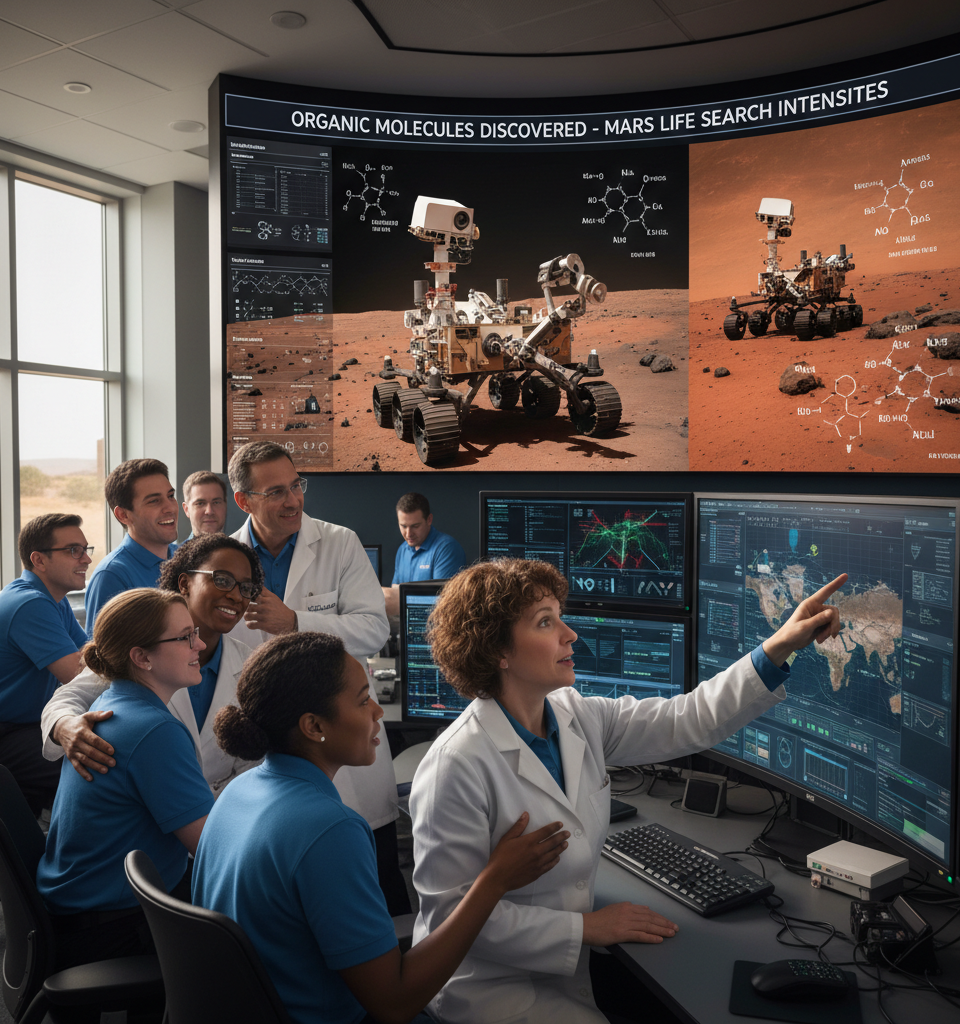
Groundbreaking Discovery in Gale Crater In a monumental step for astrobiology, NASA's
Curiosity rover has successfully identified and confirmed the presence of critical organic molecules — the fundamental chemical building blocks of life — preserved within ancient Martian sandstone. This pivotal discovery, detailed in a recent publication in Nature, marks the first confirmed instance of a novel wet chemistry experiment on another planet, yielding clear evidence of these complex compounds. The molecules were extracted from 3.5-billion-year-old clay-filled rocks located within the vast expanse of Mars' Gale Crater, specifically from an area known as Glen Torridon. This finding reignites hope and provides concrete data in humanity's enduring quest to understand if life ever existed beyond Earth.
The Enduring Quest: A Historical Perspective
For decades, the search for life on Mars has captivated scientists and the public alike, evolving from telescopic observations to sophisticated robotic missions. Previous missions, including Viking in the 1970s and Spirit and Opportunity more recently, hinted at the potential for past water and favorable conditions. However, definitive evidence of organic matter had remained elusive or ambiguous. This latest discovery from Curiosity significantly alters this narrative, providing unequivocal proof that Mars possessed, and still preserves, the chemical ingredients necessary for life. The identification of these specific organic molecules, which are essential for biological processes, moves the scientific community closer to understanding not just the potential for life, but the type of environments that could have fostered it billions of years ago when Mars was a warmer, wetter world.
Unveiling the Secrets of Martian Sandstone
The breakthrough was made possible by Curiosity's sophisticated Sample Analysis at Mars (SAM) mobile instrument suite, which conducted the unprecedented wet chemistry experiment. This method involved heating rock samples with a specialized solvent designed to release organic compounds from the mineral matrix, a technique never before performed on another planet. The 3.5-billion-year-old sandstone, rich in clays, proved to be an ideal preservation medium. Data from SAM indicated the presence of diverse organic molecules, including thiophenes, benzene, toluene, and small carbon chains like propane and butane. While these molecules can also form through non-biological processes, their presence in such ancient, water-affected sediments—and the method of their detection—is highly compelling. The Glen Torridon region, a former lake environment within Gale Crater, offered the perfect geological context for such preservation, suggesting a potentially habitable past.
Ramifications for Space Exploration and Commercial Ventures
This discovery has profound implications for the burgeoning space exploration industry and potential future commercial ventures. Confirmation of complex organic molecules provides crucial data for designing future life-detection missions, such as the Mars Sample Return campaign, by informing target selection and instrument development. Resource utilization on Mars for future human missions (In-Situ Resource Utilization or ISRU) could also be impacted, as understanding subsurface chemistry is vital for extracting water or other valuable resources. While directly unrelated to present-day resource extraction, the profound implications for understanding Mars' past environments underscore the value of continued scientific exploration, which often lays the groundwork for practical applications.
Expert Insights and Scientific Consensus
Leading astrobiologists and planetary scientists are hailing this finding as a significant milestone. Dr. Jennifer Eigenbrode, an astrobiologist at NASA's Goddard Space Flight Center and a co-author on similar research, emphasized the difficulty of finding these molecules, stating, "The challenge is that Martian soil is a harsh oxidant, and organics quickly break down." The specialized wet chemistry technique used by SAM was crucial in overcoming this challenge. Other experts note that while this isn't direct proof of life, it's overwhelmingly strong evidence for the ingredients of life being present and preserved. Dr. Paul Mahaffy, former Principal Investigator for the SAM suite, highlighted the rover's ability to 'sniff out' these ancient molecules, a testament to its engineering and scientific capabilities. The consensus is clear: these findings make it far more plausible that early Mars harbored conditions ripe for microbial life.
The Road Ahead: Perseverance and Beyond
The immediate future of Mars exploration will build directly on Curiosity's successes. NASA's Perseverance rover, currently exploring Jezero Crater, is equipped with even more advanced instruments and is actively collecting samples for eventual return to Earth. The Mars Sample Return mission, a joint effort between NASA and ESA, aims to bring these meticulously sealed Martian rock and soil samples back for detailed analysis in Earth-based laboratories. These returned samples will allow scientists to apply the most sophisticated analytical techniques, far exceeding what can be accomplished on Mars, to definitively search for biosignatures and further characterize the organic inventory. Such future analyses could provide the ultimate answer to whether Mars ever hosted life, thereby reshaping our understanding of life's prevalence in the universe.
Funding and Collaborative Efforts The
Curiosity mission, part of NASA's Mars Exploration Program, is funded through taxpayer dollars, with its total operational cost extending into billions of dollars over its lifespan. The development and operation of the SAM instrument alone represented a significant investment in cutting-edge technology. This research is a testament to international scientific collaboration, involving numerous institutions and scientists worldwide. The ongoing success of the rover and its scientific instruments continues to justify the substantial financial and intellectual investment, positioning it as one of humanity's most successful deep space endeavors. The data gleaned from Curiosity will continue to inform and inspire future missions for decades to come, offering unparalleled insights into the Red Planet's complex history and its potential for fostering life.