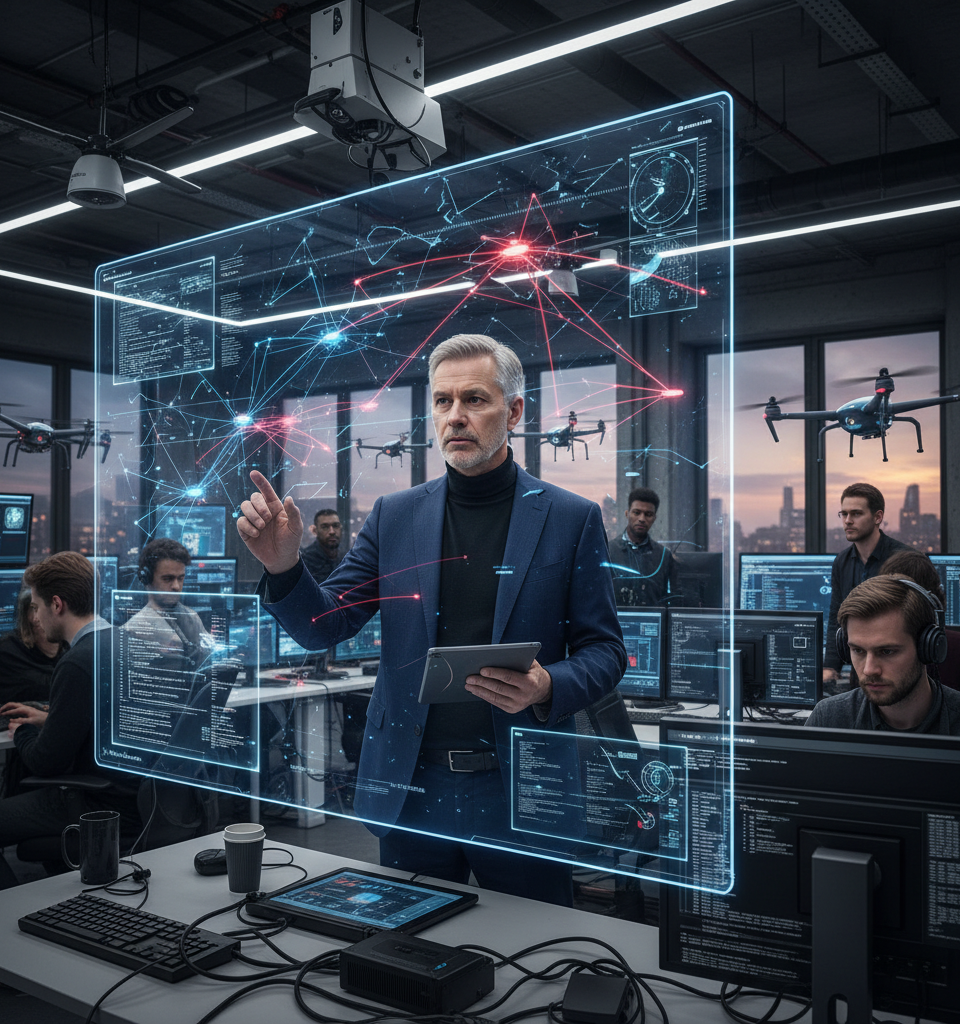
Helsinki, Finland – October 26, 2023 – For over three decades, the name Mikko Hyppönen has been synonymous with the fight against digital threats, from early computer viruses to sophisticated malware. Now, in a significant pivot first revealed to TechCrunch, the internationally recognized Chief Research Officer at WithSecure (formerly F-Secure) is dedicating his formidable expertise to a new, tangible menace: autonomous drones. This strategic reorientation reflects a growing global concern about the weaponization of uncrewed aerial vehicles (UAVs) and the urgent need for robust defensive countermeasures against what Hyppönen terms 'killer drones.'
Decades of Digital Warfare: A Foundation for Future Fights
Hyppönen's career has been a chronicle of cybersecurity's evolution. Beginning in the late 1980s, he has witnessed and actively combated the birth and proliferation of nearly every major digital threat, including the infamous Morris worm, Melissa, Code Red, and Stuxnet. His insights have shaped global understanding of cyber warfare, national security, and individual privacy in the digital age. This deep historical perspective provides a critical lens through which he now views the emerging drone threat, understanding that the principles of offense and defense, whether digital or physical, often echo similar patterns of innovation and counter-innovation. His pivot is not merely a change of focus but an application of hard-won knowledge to a tangible, kinetic problem set.
The Unfolding Threat: Autonomous Drones and Ethical Dilemmas
Hyppönen's shift is driven by the alarming progression of drone technology, particularly the development of fully autonomous systems capable of target identification and engagement without human intervention. While drones have proven invaluable in numerous civilian and military applications, from logistics and reconnaissance to search and rescue, their potential for weaponization presents profound ethical, legal, and operational challenges. The ability of a swarm of AI-powered drones to independently select and neutralize targets raises unprecedented questions about accountability, proportionality, and the very nature of conflict. As Hyppönen explained to TechCrunch, "We're moving from a world of remote-controlled tools to fully autonomous weapons, and the societal implications are massive. Someone has to build the systems to stop them."
Industry Response and Market Projections
This burgeoning threat has ignited a new sector within the defense and security industries: counter-drone technology. The global anti-drone market, valued at approximately $1.5 billion in 2022, is projected to surge to over $9 billion by 2030, exhibiting a compound annual growth rate (CAGR) of nearly 25%. This growth is fueled by increasing military expenditure on drone defense, the rising frequency of unauthorized drone intrusions in civilian airspace, and the critical need for protecting infrastructure, events, and personnel. Key players are developing diverse solutions, ranging from jamming technologies and kinetic interceptors to sophisticated AI-driven detection and neutralization platforms.
Expert Consensus: A Critical and Complex Problem
Security analysts and defense experts largely concur with Hyppönen's assessment of the urgency. Dr. Sarah White, a specialist in AI ethics and autonomous weapons systems, commented, "Hyppönen's transition highlights a critical convergence point between cyber and kinetic threats. The vulnerabilities are no longer just in software, but in hardware, communication protocols, and even the air around us. We need interdisciplinary solutions to address this multi-faceted problem." Many acknowledge that the challenge extends beyond mere technological countermeasures, encompassing international treaty agreements, ethical guidelines for AI development, and a re-evaluation of military doctrines.
Regulatory Lacunas and Future Implications
The rapid evolution of drone technology has largely outpaced regulatory frameworks. International efforts to establish norms around autonomous weapons, often referred to as 'killer robots,' are ongoing but fragmented. The implications of widespread autonomous drone deployment are far-reaching, potentially democratizing warfare, lowering the threshold for conflict, and introducing unprecedented levels of unpredictability. Hyppönen's work is anticipated to delve into disrupting drone communications, exploiting software vulnerabilities in their control systems, and developing advanced detection and identification capabilities, mirroring his past success against malware but applied to a physical domain.
The Path Forward: A Call for Innovation and Collaboration
Hyppönen's pivot serves as a potent reminder that the adversaries, whether abstract code or physical machines, are constantly evolving. His new mission underscores the need for continuous innovation, robust research and development, and unprecedented collaboration between governments, industry, and academia to safeguard against these emerging threats. The future of security will increasingly depend on mastering the intersection of cyber and physical domains, and the lessons learned in decades of fighting digital pestilence may yet prove crucial in defending against the specter of autonomous aerial warfare. His work promises to be a critical contribution to an increasingly complex security landscape.