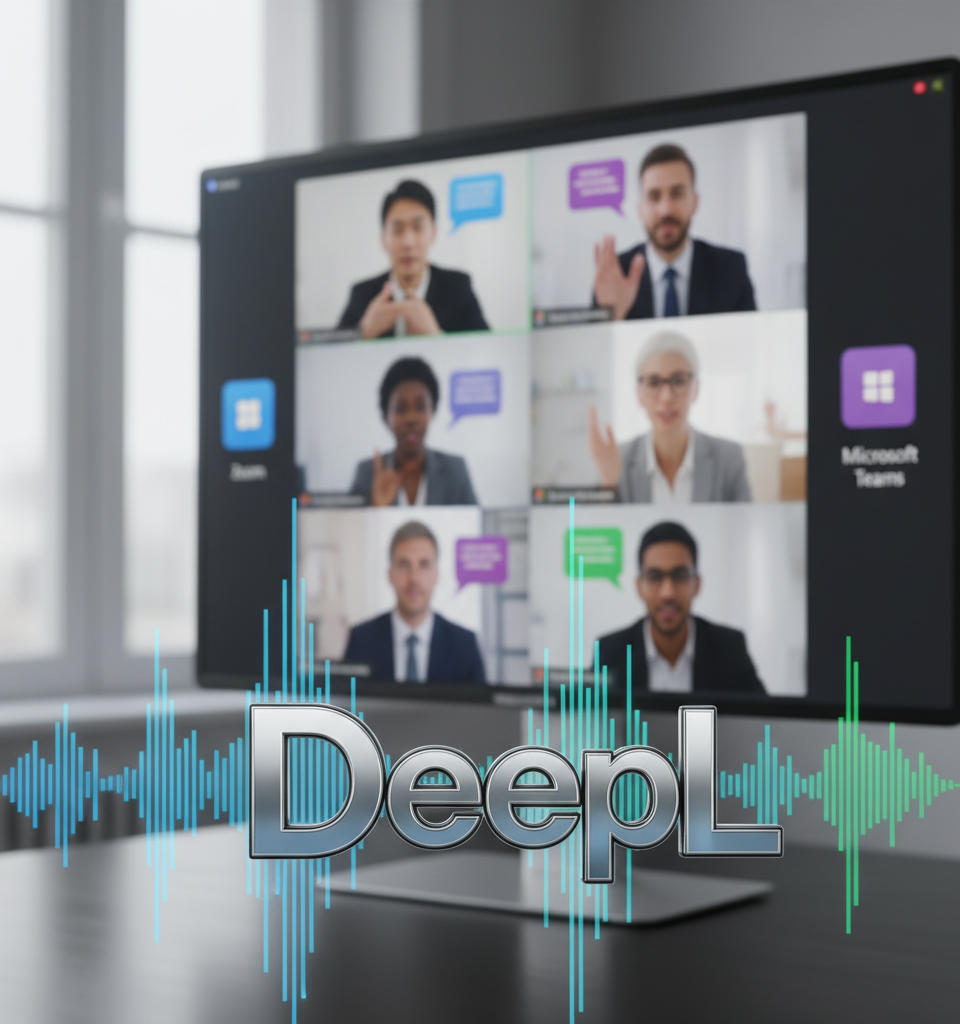
Düsseldorf, Germany – DeepL, the AI company renowned for its sophisticated neural machine text translation services, has officially announced its strategic expansion into voice translation. This pivotal move signals DeepL's ambition to transcend its current text-based offerings, with a clear focus on enabling real-time, multilingual communication within leading video conferencing platforms such as Zoom and Microsoft Teams. The initiative aims to break down language barriers in virtual meetings, a critical need identified in today's increasingly globalized and remote-first professional landscape.
Context and Strategic Rationale
DeepL's foray into voice translation is a natural progression for a company that has consistently pushed the boundaries of AI-driven language processing. Since its inception, DeepL has distinguished itself from competitors like Google Translate and Microsoft Translator through its nuanced understanding of context and idiomatic expressions, often yielding more natural-sounding translations. The COVID-19 pandemic dramatically accelerated the adoption of virtual meetings, exposing a significant gap in seamless cross-language communication. While some platforms offer basic translation features, none have achieved the fluidity and accuracy required for truly natural interaction. DeepL's established reputation for quality positions it uniquely to address this market deficiency, aligning with a broader industry trend towards more immersive and inclusive communication tools.
Key Technical Details and Integration Plans
DeepL plans to leverage its deep learning expertise to develop sophisticated speech-to-text, neural machine translation, and text-to-speech pipelines. The challenge lies not only in accurate transcription and translation but also in maintaining voice naturalness, handling interruptions, and minimizing latency to facilitate genuine real-time conversation. While specific timelines for full integration with Zoom and Microsoft Teams have not been disclosed, DeepL's announcement clearly indicates a direct pathway to these platforms, likely through API partnerships or plugin development. This would allow users to select their preferred input and output languages, with DeepL's AI handling the complex linguistic conversions in the background. The company has hinted at potential beta tests later this year, focusing initially on a core set of widely spoken languages before expanding its linguistic repertoire.
Industry and Market Impact
This strategic pivot by DeepL is poised to send ripples across several sectors. For the conferencing software market, it represents a significant value-add, potentially making platforms more indispensable for international businesses. The global market for speech and voice recognition, valued at approximately $15.3 billion in 2023, is projected to reach over $50 billion by 2030, according to recent market reports. DeepL's entry could carve out a substantial share within the translation segment of this market. Furthermore, it could intensify competition with established players and emerging startups in the real-time translation space, driving further innovation in accuracy, speed, and linguistic breadth. Businesses operating across borders, educational institutions with diverse student bodies, and even government agencies could significantly benefit from enhanced multilingual communication capabilities.
Expert Perspectives
Industry analysts view DeepL's move as strategically sound, given its strong brand reputation for translation quality. Dr. Anya Sharma, a lead AI researcher at a prominent tech consultancy, commented, "DeepL's advantage has always been its sophisticated neural networks producing highly contextual and fluent translations. If they can replicate that level of quality in a real-time voice environment, it will be a game-changer. The challenge will be latency and handling the nuances of spoken language, including accents and colloquialisms." Others point out the immense computational power and data required to train such models effectively, suggesting that DeepL's substantial investment in R&D and infrastructure will be critical for success.
Future Implications and Development Roadmap
Looking ahead, DeepL's success in real-time voice translation could unlock a plethora of other applications. Beyond meeting tools, think of enhanced customer support systems, seamless international travel experiences, or even more immersive educational platforms. The company's long-term vision likely includes expanding beyond direct human-to-human translation to potentially integrating with AI assistants and even robotic interfaces, creating truly universal language access. Upcoming developments will likely involve extensive user testing, iterative model refinements based on real-world usage, and securing robust partnerships with major conferencing solution providers. The journey ahead for DeepL is complex, but its foundational expertise positions it uniquely to redefine how the world communicates across linguistic divides.