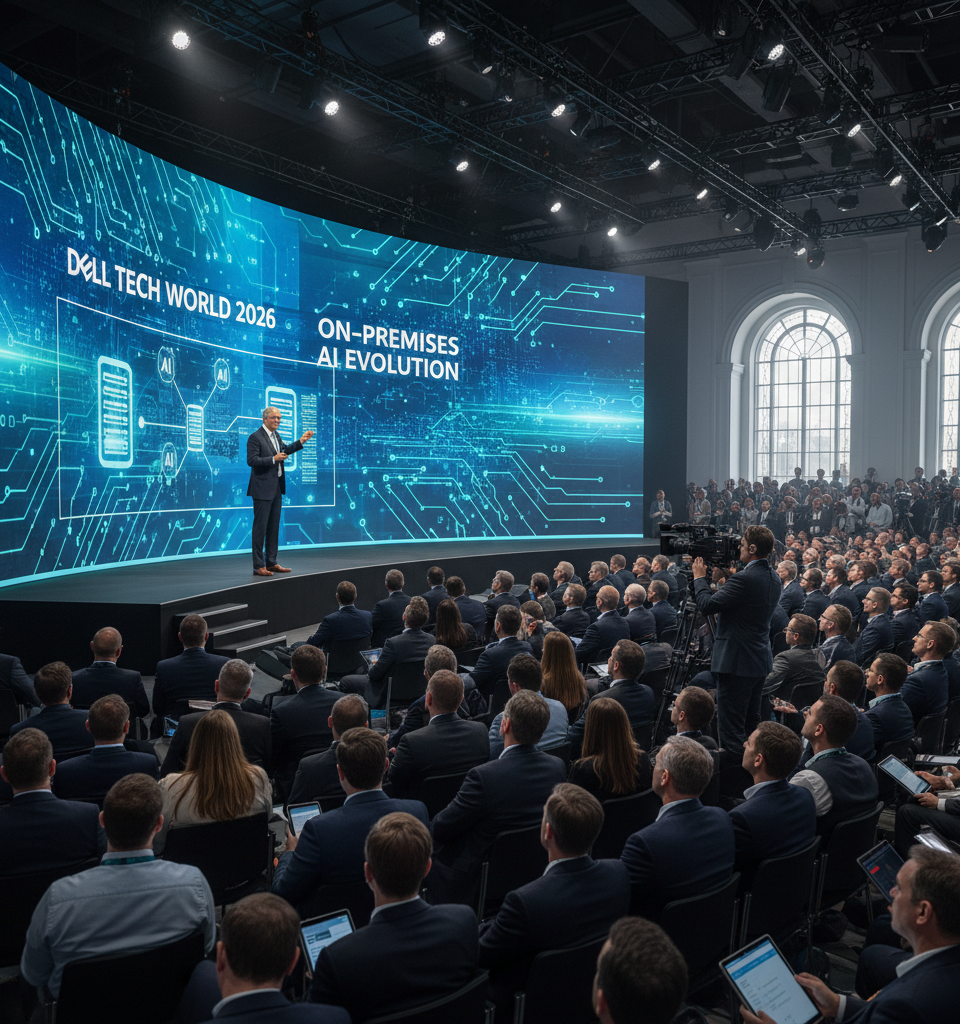
Las Vegas, NV – Dell Technologies' annual Dell Tech World conference, held recently in Las Vegas, signaled a pivotal moment in enterprise AI strategy, with a dominant theme emerging: the return to – or rather, the strategic integration of – on-premises solutions for artificial intelligence workloads within hybrid infrastructure models. The underlying message from industry leaders and Dell executives alike was clear: as generalized AI becomes a bedrock of business operations, its deployment demands a more controlled, cost-effective, and secure environment than exclusively cloud-based solutions can always provide.
The emphasis on hybrid infrastructure for AI workloads at Dell Tech World 2026 stems from several critical factors now impacting businesses globally. Foremost among these are the escalating costs associated with continuous cloud-based AI processing, which can become prohibitive for large-scale, always-on AI deployments. Simultaneously, an increasingly complex global regulatory landscape is imposing stringent data sovereignty requirements, compelling organizations to maintain sensitive AI data and models within specific geographical boundaries. Furthermore, the rapid proliferation and adoption of sophisticated AI agents across various business functions are necessitating robust, low-latency, and secure compute environments that on-premises and edge deployments can uniquely offer.
Key discussions during the conference highlighted how Dell is positioning its portfolio to support this transition. While specific product announcements were not detailed in the summary, the focus was firmly on the architectural implications, suggesting new or enhanced solutions designed to seamlessly integrate AI training and inference capabilities from the data center to the edge. This strategy aims to provide enterprises with greater control over their AI deployments, optimizing for performance, cost, and compliance without sacrificing the agility often associated with cloud environments.
This strategic pivot represents a significant re-evaluation of the purely cloud-centric narratives that have dominated the early phases of AI adoption. Industry analysts attending Dell Tech World noted that this shift reflects a maturing AI market where foundational enterprise challenges – rather than just pure compute power – are dictating infrastructure choices. The move towards hybrid AI acknowledges that different AI workloads have different requirements, and a one-size-fits-all approach is rarely the most efficient or secure.
The implications for the broader technology market are substantial. Cloud providers, while continuing to offer powerful AI services, may find enterprises increasingly opting for a balanced approach, offloading specific, high-volume, or sensitive operations to private clouds or on-premises solutions. This could catalyze innovation in hybrid cloud management platforms and orchestrations tools, as companies seek to manage disparate AI resources cohesively. Hardware manufacturers, particularly those specializing in AI-optimized servers, storage, and networking, stand to benefit from renewed enterprise investment in their own data centers.
Looking ahead, the discourse from Dell Tech World 2026 suggests that the evolution of enterprise AI will be characterized by greater complexity and more nuanced architectural decisions. Organizations are expected to meticulously evaluate where their AI workloads reside based on a triad of factors: cost efficiency, regulatory compliance, and performance requirements, especially as the density and criticality of AI agent deployments increase. The conference has set a clear direction, indicating that future enterprise AI strategies will hinge on the intelligent orchestration of resources across a dynamic and distributed hybrid fabric, blending the best of on-premises control and cloud elasticity to unlock the full potential of artificial intelligence.