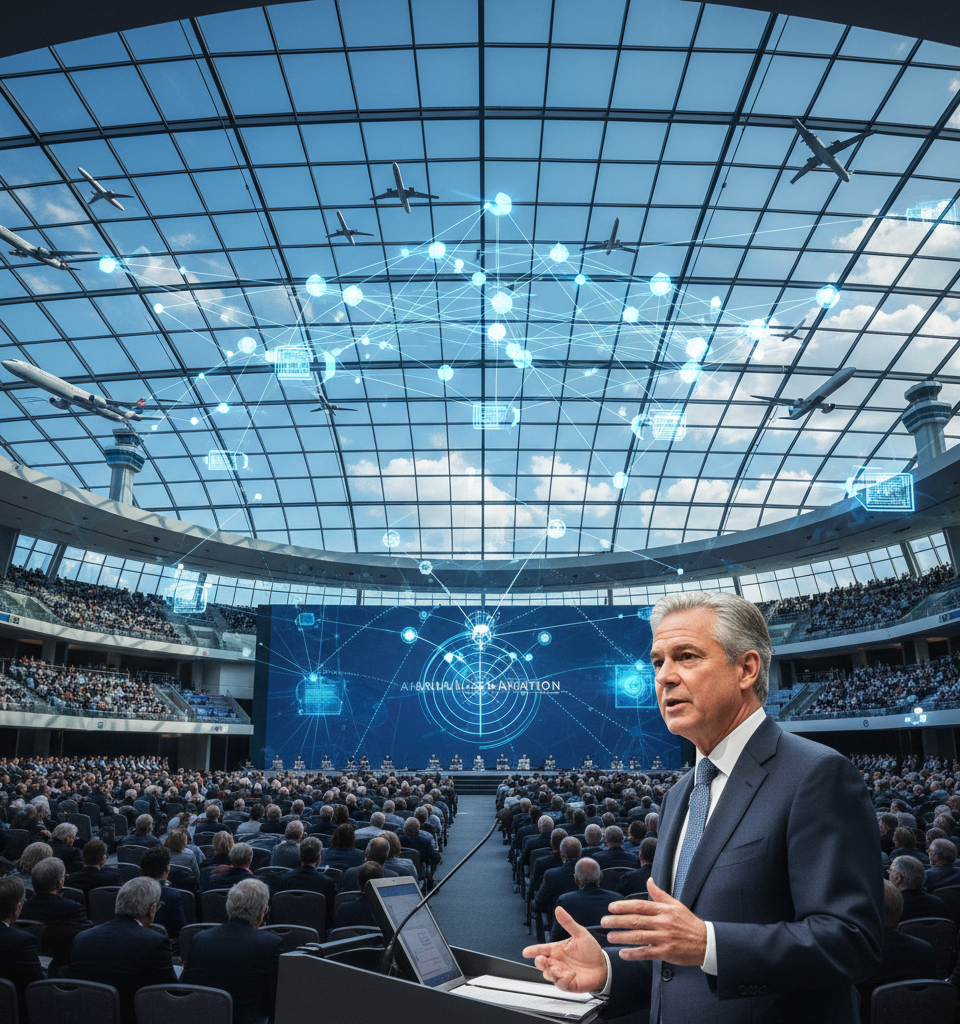
**Atlanta, GA – ** – In a significant declaration that reframes the role of artificial intelligence in the aviation sector, Delta Air Lines CEO Ed Bastian has publicly identified air traffic control (ATC) as the single largest opportunity for AI integration, rather than passenger-facing services or in-flight operations. Speaking recently, Bastian underscored the urgent need for modernization, pointing out the paradoxical reality that flight durations on key routes, such as Atlanta to New York, have increased since the 1950s, largely due to systemic inefficiencies within the current air traffic management infrastructure.
The Lingering Legacy of Outdated Systems
Bastian's remarks shed light on a critical inefficiency plaguing the aviation industry: an air traffic control system that, for all its technological advancements, struggles to keep pace with the exponential growth in air travel. The current system, often reliant on decades-old radar technology and manual coordination, creates significant bottlenecks, leading to widespread delays, increased fuel consumption, and heightened emissions. This 'time warp' in air travel, where modern aircraft fly slower due to ground-based constraints, represents a multi-billion dollar problem for airlines globally, impacting both operational costs and customer satisfaction.
AI as the Catalyst for Efficiency and Sustainability
According to Bastian, AI's analytical prowess and predictive capabilities offer a compelling solution to these deeply entrenched issues. By leveraging AI, air traffic control systems could move beyond reactive management to proactive optimization. This would involve real-time data analysis of weather patterns, aircraft positions, flight plans, and airport capacities to dynamically adjust flight paths, optimize descent and ascent angles, and minimize holding patterns. The potential benefits are vast: reduced flight times, significant fuel savings which could translate into hundreds of millions of dollars annually for major carriers, and a substantial decrease in the industry's carbon footprint.
Industry-Wide Implications and Economic Impact
The adoption of AI in air traffic management would represent a paradigm shift for the entire aviation ecosystem. For airlines, it promises increased on-time performance, lower operating expenses, and enhanced profitability. For passengers, it means fewer delays and more reliable travel. Economically, a more efficient air traffic system could unlock greater capacity in crowded airspace, facilitating further growth in air travel and trade. Analysts suggest that even a fractional improvement in ATC efficiency could yield billions in economic value across the global supply chain, benefiting everything from logistics to tourism.
Expert Perspectives on the Path Forward
Aviation experts and technology analysts largely concur with Bastian's assessment. Dr. John Smith, an aerospace engineering professor, notes, "The current ATC system is a testament to human ingenuity but has hit its natural limits. AI provides the computational power to manage the complexity of modern airspace in a way humans simply cannot – processing millions of data points per second to make optimal routing decisions." However, experts also caution that the integration of AI into such a critical safety system will require rigorous testing, robust cybersecurity measures, and significant investment in infrastructure and personnel training. Regulatory bodies like the FAA will play a pivotal role in establishing standards and certification processes.
Overcoming Hurdles and Charting the Future
The path to an AI-powered air traffic control system is not without its challenges. It demands substantial federal investment, international collaboration for harmonized standards, and a cultural shift within ATC organizations. Nonetheless, the momentum is building. Several pilot programs are already exploring AI applications in areas like predictive maintenance for ATC equipment and real-time conflict detection. The coming decade is expected to see a gradual rollout of AI-assisted tools, with a long-term vision of a fully integrated, intelligent air traffic management system capable of safely handling significantly higher traffic volumes. Bastian's vision signals a future where AI isn't just a luxury, but an indispensable tool for the operational backbone of global air travel, making flying faster, safer, and more sustainable for generations to come.