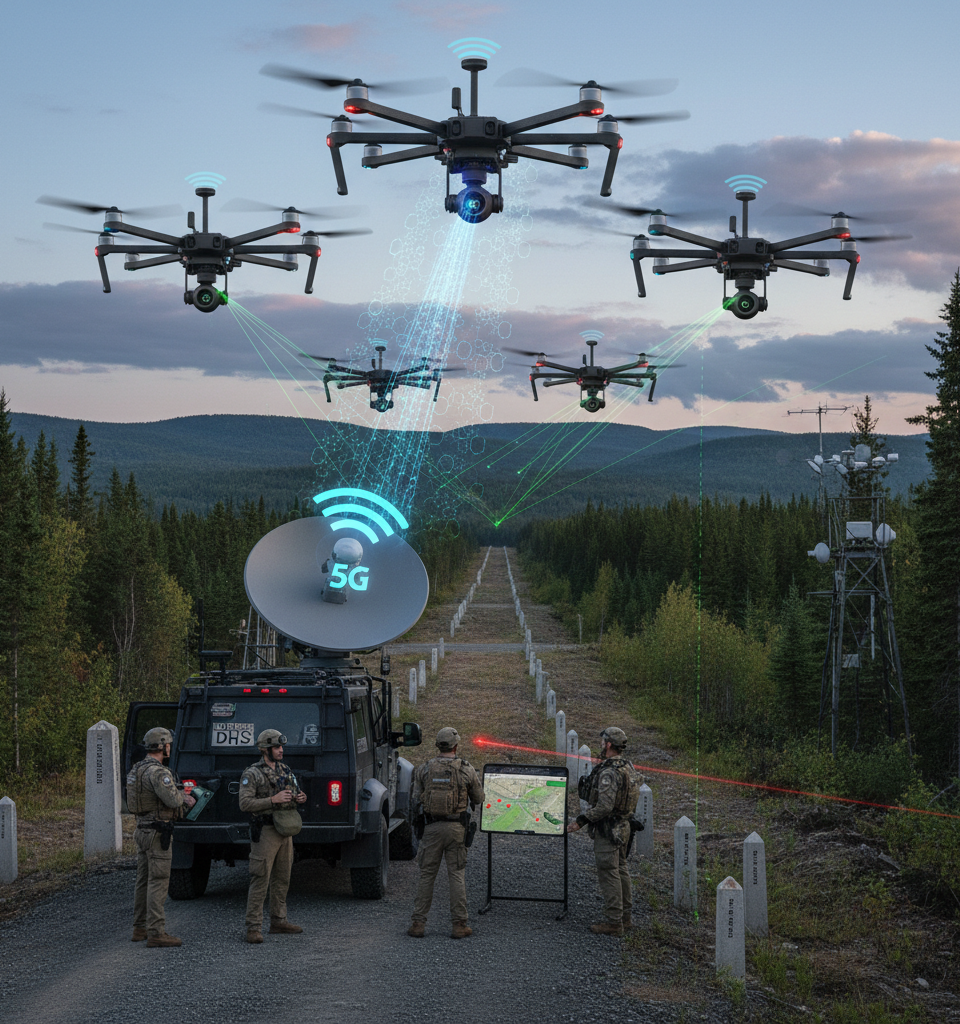
The Department of Homeland Security (DHS) is gearing up to deploy a sophisticated network of autonomous drones and ground vehicles along the US-Canada border in an experimental program slated for this fall. This initiative, part of a bilateral effort, will leverage 5G connectivity to transmit what the DHS describes as "battlefield intelligence," a move poised to dramatically alter surveillance capabilities and operational efficiency at the northern frontier. The project represents a considerable leap forward in integrating advanced robotic and communication technologies into national security protocols.
Context and Strategic Imperative
This deployment comes amidst increasing pressure on border security agencies to enhance situational awareness and respond more effectively to cross-border activities, ranging from illicit trafficking to potential security threats. While the US-Mexico border often garners more headlines, the vast and often remote US-Canada border, stretching over 5,500 miles, presents unique challenges in monitoring and interdiction. Traditional methods of patrolling such extensive terrain are resource-intensive and often limited in scope. The adoption of autonomous systems, therefore, is not merely a technological upgrade but a strategic imperative to gain broader, continuous, and real-time oversight of critical areas. This experiment builds upon existing, albeit less autonomous, aerial surveillance programs and signals a potential paradigm shift in border management.
Operational Details and Technological Edge
Key to this experiment is the seamless integration of 5G technology, which promises high bandwidth and low latency, crucial for transmitting vast amounts of sensor data and real-time video feeds from autonomous platforms. The drones and ground vehicles will be equipped with an array of sensors, including thermal imaging, high-resolution cameras, and potentially other detection technologies, designed to identify anomalies and track movement across rugged terrain. While specific vendors have not been publicly disclosed, the program is expected to involve leading defense and telecommunications contractors specializing in unmanned systems and secure communication networks.
This system aims to create a persistent surveillance layer, effectively extending the reach of human agents and providing actionable intelligence remotely to command centers, thereby optimizing resource allocation for ground patrols.
Industry Impact and Market Dynamics
The DHS's venture into autonomous border security heralds significant implications for the defense technology and telecommunications sectors. Companies specializing in unmanned aerial systems (UAS), AI-driven analytics, and 5G infrastructure stand to benefit from increased demand and potentially lucrative government contracts. This initiative could drive further innovation in resilient communication networks capable of operating in challenging, remote environments. Furthermore, it sets a precedent for other government agencies, and even international partners, to adopt similar advanced surveillance technologies. The market for border security technology, already robust, is projected to see accelerated growth, with particular emphasis on integrated autonomous solutions and secure data transmission platforms.
Expert Perspectives on Efficacy and Concerns
Security analysts and technology experts offer a mixed perspective on this development. Proponents laud the potential for enhanced efficiency, expanded coverage, and reduced risk to human personnel. Dr.
Evelyn Reed, a senior fellow at the Center for Strategic Studies, noted, "This use of autonomous systems represents a cutting-edge approach to national security, offering unprecedented situational awareness. " However, ethical considerations, including concerns about privacy, data security, and the potential for automation bias, have been raised. Civil liberties groups have voiced apprehension regarding the scope of surveillance and the potential for mission creep.
Experts also stress the importance of robust cybersecurity protocols to prevent system breaches and the need for clear oversight mechanisms regarding data collection and retention.
Future Outlook and Broader Implications
Looking ahead, the success of this fall experiment could pave the way for a broader deployment of autonomous surveillance systems across various US borders and potentially within other critical infrastructure protection initiatives. The data gathered during this pilot program will be crucial in evaluating the effectiveness, reliability, and cost-efficiency of such technology. Furthermore, this move contributes to the ongoing debate about the role of artificial intelligence and automation in national security, prompting discussions about policy frameworks, international cooperation on cross-border data sharing, and the continuous evolution of our understanding of privacy in an increasingly monitored world.
The DHS's initiative on the US-Canada border is more than just a technological test; it is a preview of the future of border security, integrating advanced robotics and communication networks to create an unprecedented layer of awareness and control.