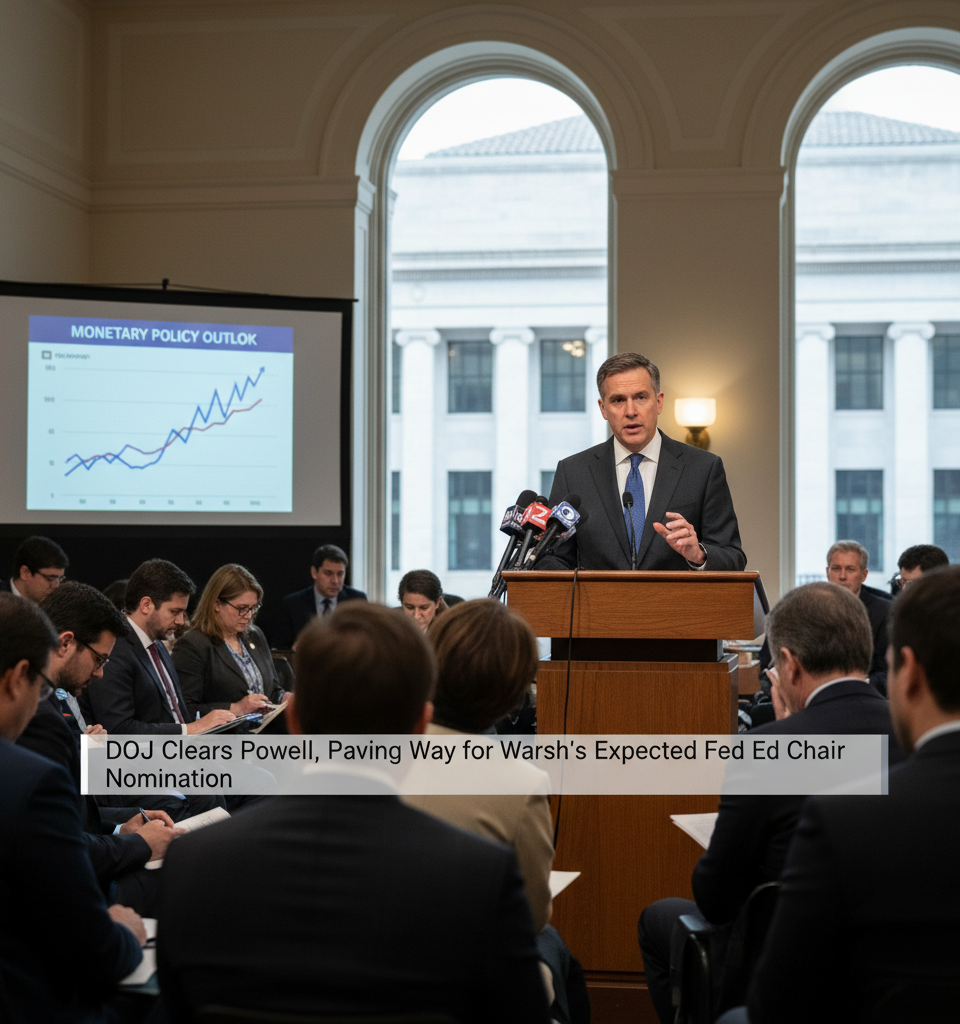
S. Department of Justice (DOJ) formally announced on Friday its decision to close a criminal investigation into current Federal Reserve Chair Jerome Powell, effectively eliminating a key barrier that had complicated the potential transition of leadership at the nation's central bank. This pivotal decision has instantaneously cleared the path for Kevin Warsh, a former Federal Reserve governor, to potentially assume the highly influential role, significantly easing his anticipated Senate confirmation process.
The probe, details of which had been largely kept under wraps, had cast a shadow over Powell’s tenure and the broader political landscape surrounding the Fed’s future leadership.
Context and Background
This development marks a crucial turning point in the ongoing saga of Federal Reserve leadership, a position with profound implications for global financial markets and the U.S. economy. The historical precedent for such an investigation into a sitting Fed Chair is exceedingly rare, underscoring the gravity and unusual nature of the situation. While the specific allegations leading to the DOJ probe were not publicly detailed, their existence had created an environment of uncertainty, deferring any definitive decisions regarding the next Fed Chair. The Federal Reserve, celebrating its 110th anniversary this year, has historically prided itself on its independence and stability, making any form of external investigation into its leadership a matter of intense scrutiny and concern.
Key Details and Implications
Sources close to the DOJ indicated that the investigation, which began several months prior, found insufficient evidence to proceed with charges against Powell. This conclusion was communicated to the relevant Senate committees shortly after the announcement, allowing for a swifter progression of nomination proceedings. While neither Powell nor the DOJ have issued detailed statements on the nature of the inquiry, the brevity of the announcement suggests a clear and unequivocal cessation of the investigation. The market's immediate reaction was a slight uplift in financial futures, reflecting reduced uncertainty. Kevin Warsh, known for his hawkish monetary policy views and his tenure on the Fed's Board of Governors from 2006 to 2011, is now widely considered the front-runner. His candidacy has been championed by certain political factions advocating for a more stringent approach to inflation control, potentially diverging from the more accommodative stances seen in recent years.
Industry and Market Impact
The prospect of Warsh’s appointment has already begun to ripple through financial markets, particularly in bond yields and currency valuations. Analysts anticipate that a Warsh-led Fed would likely adopt a more aggressive stance on interest rate hikes, potentially leading to higher borrowing costs for businesses and consumers. The dollar strengthened marginally against a basket of major currencies following the news, as investors priced in the likelihood of a more hawkish Fed. Equity markets, while showing initial positive sentiment due to reduced uncertainty, will be closely watching for Warsh's prospective commentary on quantitative tightening and inflation targets. Large financial institutions are already recalibrating their monetary policy models to account for a possible shift in the Fed's long-term strategy.
Expert Perspective Economists and market strategists are largely in agreement that
Warsh's confirmation would signal a notable shift in the Fed's operational philosophy. "This clears a major political logjam and introduces greater policy certainty, even if that certainty points towards a tighter monetary policy," stated Dr. Eliza Thorne, chief economist at Global Financial Insights. "Warsh's track record suggests a strong commitment to price stability, potentially at the expense of employment goals in the short term." Other analysts highlighted the importance of his prior experience during the 2008 financial crisis, suggesting he brings a pragmatic, crisis-tested perspective to the role. However, some progressive economists have voiced concerns that an overemphasis on inflation control could stifle economic growth and employment recovery.
What's Next With the
DOJ probe concluded, the next critical step is the formal nomination from the White House, which is now expected to accelerate. Following nomination, Warsh will face a rigorous Senate confirmation hearing, likely before the Senate Banking Committee. This hearing will provide the first public platform for Warsh to articulate his economic philosophy, his approach to monetary policy, and his strategic vision for the Federal Reserve. Observers anticipate intense questioning on his views regarding inflation, unemployment, financial regulation, and the Fed's role in a challenging global economic environment. The confirmation process could still take several weeks, but without the shadow of the DOJ investigation, its outcome now appears far more predictable, setting the stage for a new era at the nation's central bank.