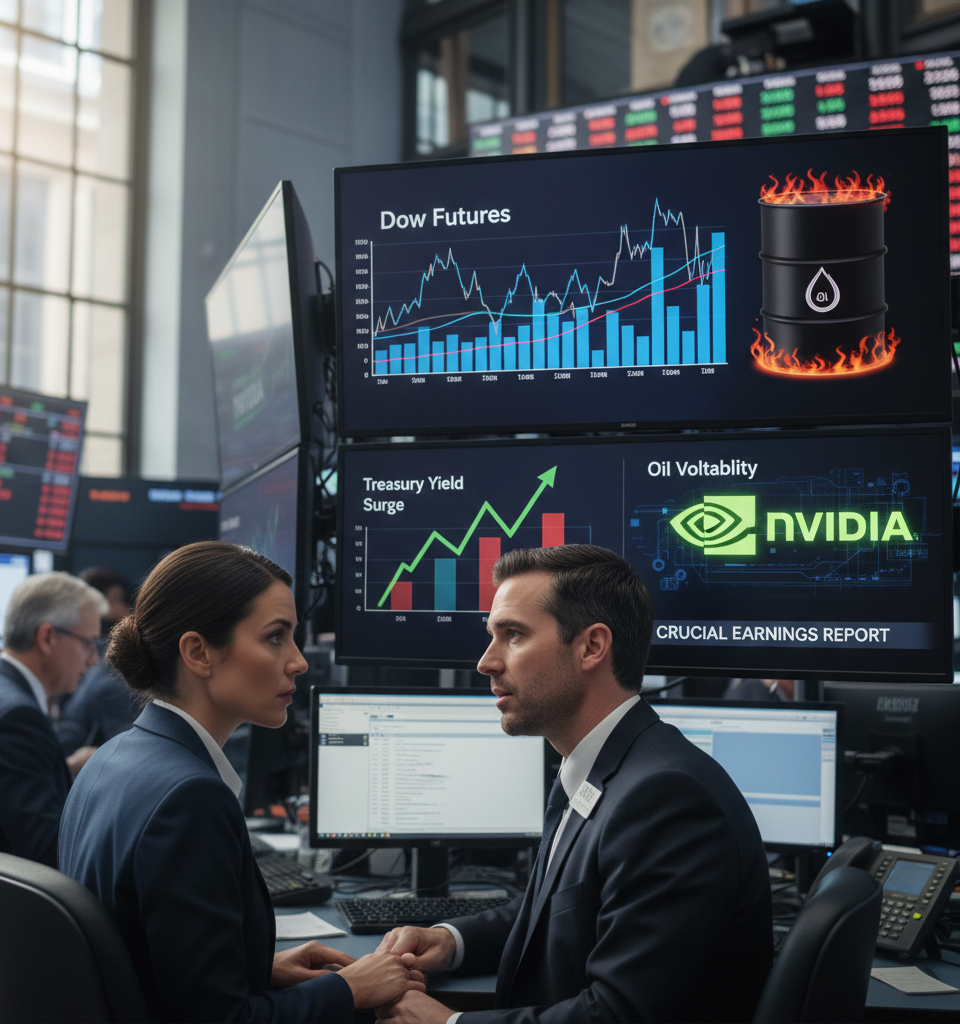
Global financial markets are bracing for a period of heightened volatility as Dow Jones Industrial Average futures edged lower in pre-market trading, reflecting investor anxiety over surging Treasury yields and the unpredictable trajectory of oil prices. This confluence of macroeconomic factors sets a challenging backdrop as the market eagerly awaits the highly anticipated earnings report from Nvidia, a bellwether for the semiconductor industry and the rapidly expanding artificial intelligence revolution.
The current market unease stems largely from the hawkish signals emanating from central banks, particularly concerning inflation and interest rate policy. S. Treasury note has been on an upward climb, recently surpassing key psychological thresholds as investors anticipate continued monetary tightening to combat persistent inflationary pressures.
This rise in borrowing costs makes equities less attractive, particularly growth stocks, and can stifle corporate investment. Simultaneously, crude oil prices have experienced significant swings, driven by geopolitical tensions, supply chain disruptions, and shifting demand forecasts, adding another layer of uncertainty to the economic outlook. Historically, periods of rising yields and oil price volatility have often preceded broader market corrections, prompting a cautious stance among institutional investors.
Key details underpinning this market dynamic include the latest Consumer Price Index (CPI) report, which showed inflation remaining stubbornly elevated, reinforcing the Federal Reserve's commitment to its current monetary policy path. Analysts are closely watching the 10-year Treasury yield, which recently touched its highest levels in several months, indicating a perceived increase in the risk-free rate of return and a potential re-evaluation of asset valuations across the board. Furthermore, recent OPEC+ production decisions and the ongoing conflict in Eastern Europe continue to exert upward pressure on energy markets, with West Texas Intermediate (WTI) crude fluctuating around the $85-$90 per barrel range.
The upcoming Nvidia report, expected later this week, is not merely about one company's performance; it's a litmus test for the enduring strength of the AI spending boom and its potential to offset broader economic headwinds.
The ripple effects of these developments are profound across various industries. Higher borrowing costs translate into increased operational expenses for businesses, potentially compressing profit margins and slowing expansion plans. For technology companies, particularly those reliant on venture capital or heavy R&D investment, a rising rate environment can make funding more expensive and valuations harder to justify.
The energy sector, while benefiting from higher oil prices, faces scrutiny over its long-term investment strategies amidst global decarbonization efforts. Financial institutions, on the other hand, might see improved net interest margins from higher rates, but concerns about loan defaults in a slowing economy could temper enthusiasm. The performance of Nvidia, a critical supplier for data centers and AI development, will offer insights into the capital expenditure trends of major tech giants and the resilience of enterprise AI adoption.
Market strategists and economic analysts are divided on the immediate future. Some anticipate a necessary market correction, arguing that current valuations in certain sectors, particularly tech, have been inflated by years of low interest rates. Others remain optimistic, pointing to robust corporate earnings and continued innovation in areas like artificial intelligence as potential drivers for sustained growth. "The market is currently navigating a very delicate balance between inflation concerns and corporate fundamentals," notes Dr. Evelyn Reed, Chief Market Strategist at Global Asset Management. "Nvidia's earnings will provide a crucial data point as to whether the AI growth narrative can truly stand independent of broader macroeconomic pressures." She adds that clarity on central bank policies will be paramount in the coming weeks.
Looking ahead, investors will be dissecting every word from central bank officials for clues on future interest rate hikes and quantitative tightening. The upcoming jobs report will also be a critical indicator of economic health and inflationary pressures. Furthermore, the geopolitical landscape, particularly concerning energy-producing regions, will continue to play a significant role in shaping oil price dynamics.
For the tech sector, beyond Nvidia, the earnings reports from other major semiconductor companies and cloud service providers will offer additional insights into the sustainability of current growth trends. The market remains in a wait-and-see mode, with little expectation of a dramatic shift until more definitive economic data emerges and the path of monetary policy becomes clearer. The interplay of these forces will determine whether the current market jitters evolve into a sustained downturn or merely a temporary recalibration.