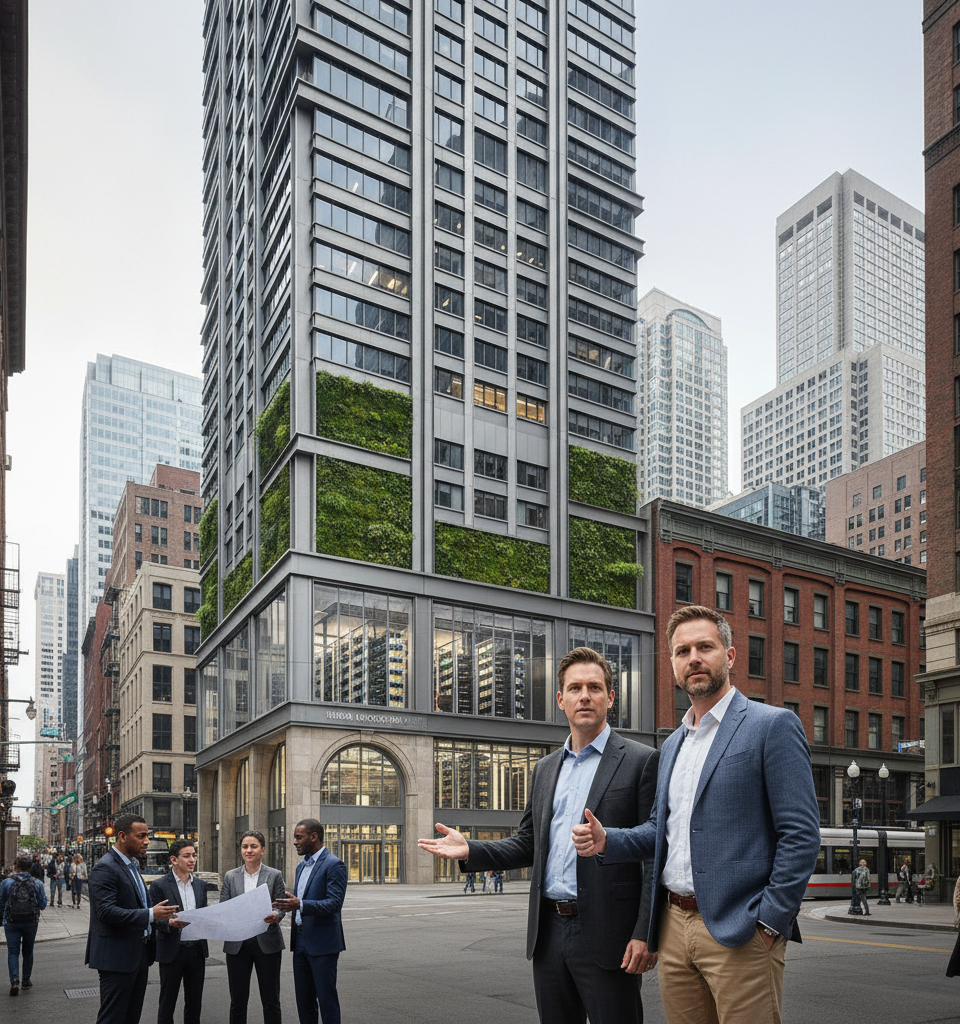
A new urban development paradigm is taking shape across the United States, as tech entrepreneurs Daniel English and Jay Rappaport, co-founders of real estate platform Legacy Investing, spearhead a movement to convert dormant downtown commercial properties into state-of-the-art data centers. S. anticipated to double by 2030—and the pervasive issue of an oversupply of obsolete real estate blighting many American city centers.
The Genesis of an Urban Solution
The initiative by English and Rappaport builds on a compelling confluence of market forces. Post-pandemic shifts in work patterns have left a significant vacancy rate in central business districts, with office buildings and retail spaces struggling to attract tenants. Concurrently, the exponential growth of artificial intelligence, cloud computing, and digital services has created an insatiable appetite for data processing and storage capabilities. Legacy Investing's proposition is to harness the existing robust infrastructure of downtown areas—including readily available power grids, fiber optic networks, and public transportation—to create urban data hubs, thereby breathing new economic life into struggling urban cores.
Key Strategic Imperatives and Project Details Legacy
Investing's model focuses on identifying and retrofitting underperforming assets such as aged office buildings, department stores, and even parking structures. Their vision emphasizes not just functionality but also aesthetics, aiming for 'beautiful data centers' that seamlessly integrate into the urban fabric rather than being isolated, industrial complexes. The technical specifications for these conversions are stringent, requiring significant investment in cooling systems, power redundancy, and specialized security. Initial projects are reportedly underway in several mid-sized U.S. cities, though specific locations remain proprietary due to competitive sensitivities. The firm projects an average investment of tens of millions of dollars per facility, dependent on the building's size and pre-existing infrastructure.
Broader Market Implications and Economic Revitalization
The implications of this trend extend beyond just infrastructure development. Redeveloping downtown properties into data centers could ignite a substantial economic ripple effect. It offers a new asset class for real estate investors and provides a stable, long-term revenue stream for municipal governments through property taxes and potentially new job creation, albeit a smaller workforce than traditional commercial centers. Furthermore, it recycles existing building stock, promoting sustainability by reducing the need for new construction on greenfield sites and minimizing urban sprawl. This strategy could also act as an anchor for supplementary businesses, including specialized maintenance services, cybersecurity firms, and renewable energy providers focusing on data center power solutions.
Expert Perspectives on the Data Center Boom
Industry analysts are largely optimistic about this innovative approach. Dr. Emily Carter, a senior economist specializing in urban development, notes, "The conversion of underutilized downtown real estate into data centers represents a paradigm shift in urban revitalization. It's a pragmatic solution that aligns economic demand with existing urban assets, offering a sustainable path forward for cities grappling with high vacancy rates." She cautions, however, that success hinges on careful planning concerning power supply, zoning regulations, and community integration. Tech infrastructure experts like Michael Chen from DataCenterDynamics further emphasize the critical need for robust power grids and fiber connectivity, which many downtowns already possess, making them attractive candidates despite initial conversion costs.
The Road Ahead: Challenges and Future Outlook
While promising, the path to widespread adoption of urban data centers isn't without its challenges. Foremost among these are the significant upfront capital investments required for retrofitting, the complexities of urban zoning, and securing adequate, reliable power in densely populated areas. Noise abatement from cooling systems and concerns about energy consumption in urban environments will also need careful management. Nonetheless, Legacy Investing and similar ventures are actively exploring partnerships with utility companies and local governments to streamline these processes. Looking ahead, successful pilot projects could pave the way for this model to become a standard solution for urban renewal, fundamentally reshaping the geography of digital infrastructure and providing a sustainable future for many struggling U.S. downtowns. The next five to ten years will be crucial in determining the scalability and long-term societal impact of this bold urban-tech experiment.