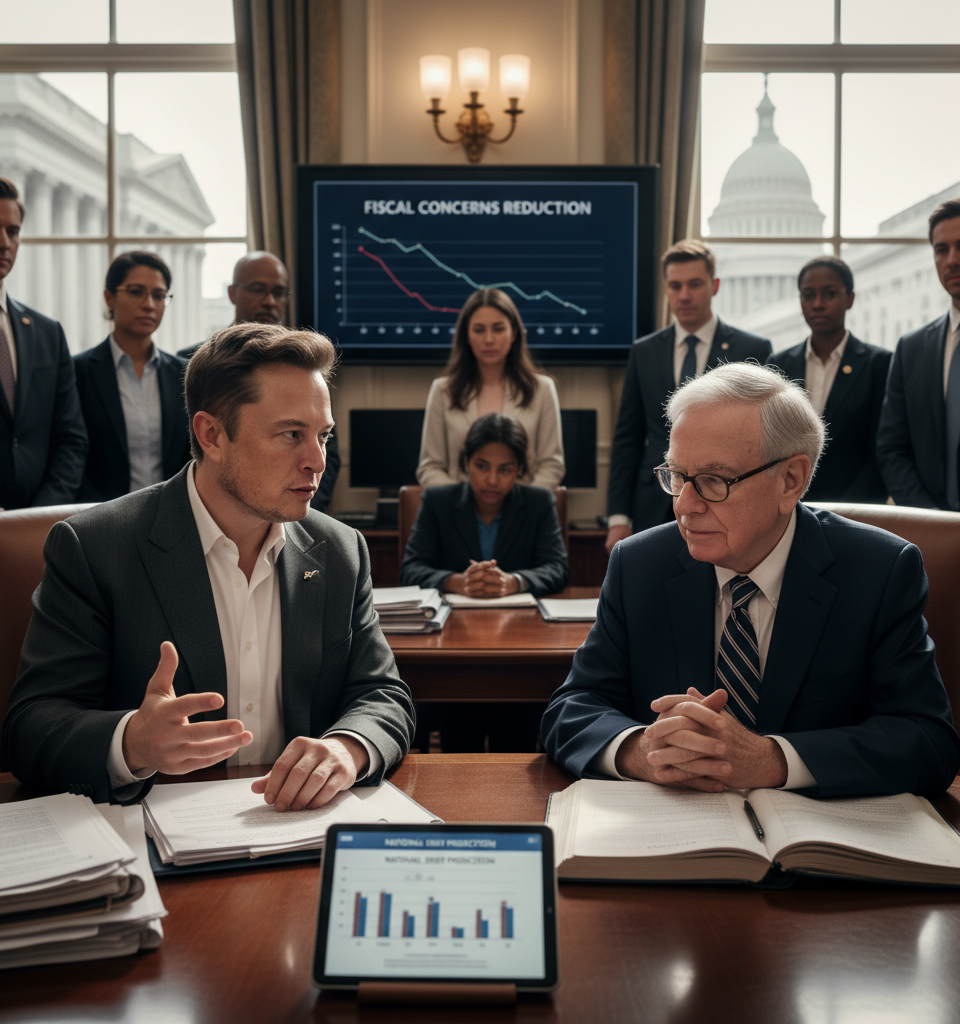
In a significant development that underscores anxieties over the United States' mounting fiscal challenges, billionaire entrepreneur Elon Musk recently endorsed Warren Buffett's long-standing proposal for rapidly reducing the national debt. Musk, CEO of Tesla and X, added his influential voice to a growing chorus of financial leaders advocating for a strategy aimed at lowering the national deficit to 3% of the country's Gross Domestic Product (GDP). His public backing, conveyed through social media this week, brings renewed attention to a plan that prioritizes a streamlined, impactful approach to fiscal responsibility and highlights a bipartisan concern over America's financial future.
The Urgency of Fiscal Responsibility
The call for decisive action on the national debt is not new, but renewed endorsements from figures like Musk and Buffett inject considerable momentum into the conversation. The United States national debt currently exceeds $34.5 trillion, a figure that continues to climb, exacerbated by a persistent deficit. The deficit-to-GDP ratio, a key indicator of a nation's fiscal health, has been a central point of contention for economists and policymakers. Maintaining a manageable debt level is crucial for long-term economic stability, impacting everything from interest rates and inflation to the nation's capacity to respond to future crises. Historical context shows that consistently high deficits can lead to diminished investor confidence and increased borrowing costs, thus creating a self-reinforcing cycle of debt.
Buffett's Famed "Five-Minute Plan"
Warren Buffett's "five-minute plan" for deficit reduction, first articulated years ago, is deceptively simple and powerful. It proposes linking congressional salaries to the national deficit, specifically penalizing members of Congress if the deficit-to-GDP ratio exceeds 3%. The core idea is to create a direct financial incentive for policymakers to prioritize fiscal discipline, making the consequences of inaction immediately personal and tangible. Although the plan does not dictate how to achieve the 3% target, it strategically shifts the accountability squarely onto those empowered to make spending and taxation decisions. Musk's endorsement, delivered with his characteristic brevity, "This is the way," signals his belief in the plan's directness and potential efficacy.
Impact on the Broader Economic Landscape
Musk's endorsement amplifies the concerns of a significant segment of the business and financial community. The explicit support of a high-profile technology leader like Musk, coupled with the gravitas of an investment legend like Buffett, sends a clear signal to markets and policymakers alike. It suggests that concerns over national solvency are not confined to traditional economic circles but are permeating diverse sectors of the economy. This growing consensus could pressure legislative bodies to seriously consider proposals that might otherwise face political resistance. Reduced deficit spending could entail cuts to government programs or increases in taxation, decisions that have broad implications for various industries, from defense contractors to social services.
Expert Perspectives on Implementation and Feasibility
Economists have long debated the merits and practicality of such incentive-based systems for fiscal policy. While many laud the spirit of accountability, some criticize the potential for unintended consequences or political maneuvering. "While such a direct financial incentive could focus congressional minds, the actual mechanisms for reducing a multi-trillion-dollar deficit are far more complex than a simple 'five-minute' decision," noted Dr.
Eleanor Vance, a senior economist at the Brookings Institute, in a recent interview. "It highlights the problem, but doesn't prescribe the solution itself. " Other analysts suggest that while the plan offers a powerful motivational tool, it requires accompanying specific policy proposals for spending cuts or tax reforms to be truly effective.
The key challenge lies in translating a compelling, symbolic incentive into concrete, bipartisan legislative action.
Looking Ahead: A Call for Action
The renewed attention brought by Musk's endorsement could galvanize public opinion and pressure lawmakers to confront the national debt with greater urgency. The conversation around the national debt is expected to intensify as the country approaches future budget cycles and debt ceiling debates. While details on how Congress might implement such a plan remain speculative, the sheer weight of these endorsements suggests that the issue of fiscal responsibility will remain a front-and-center topic. Future developments will likely involve continued advocacy from business leaders and potentially legislative proposals aimed at fiscal consolidation, whether directly mirroring Buffett's plan or incorporating elements of its accountability-driven philosophy.
Ultimately, the convergence of voices from the technology and finance sectors underscores a unified concern: the long-term health of the U.S. economy depends on addressing the national debt. The question now moves from if action is needed to how it will be achieved, and whether policymakers can overcome partisan divides to implement effective and sustainable solutions.