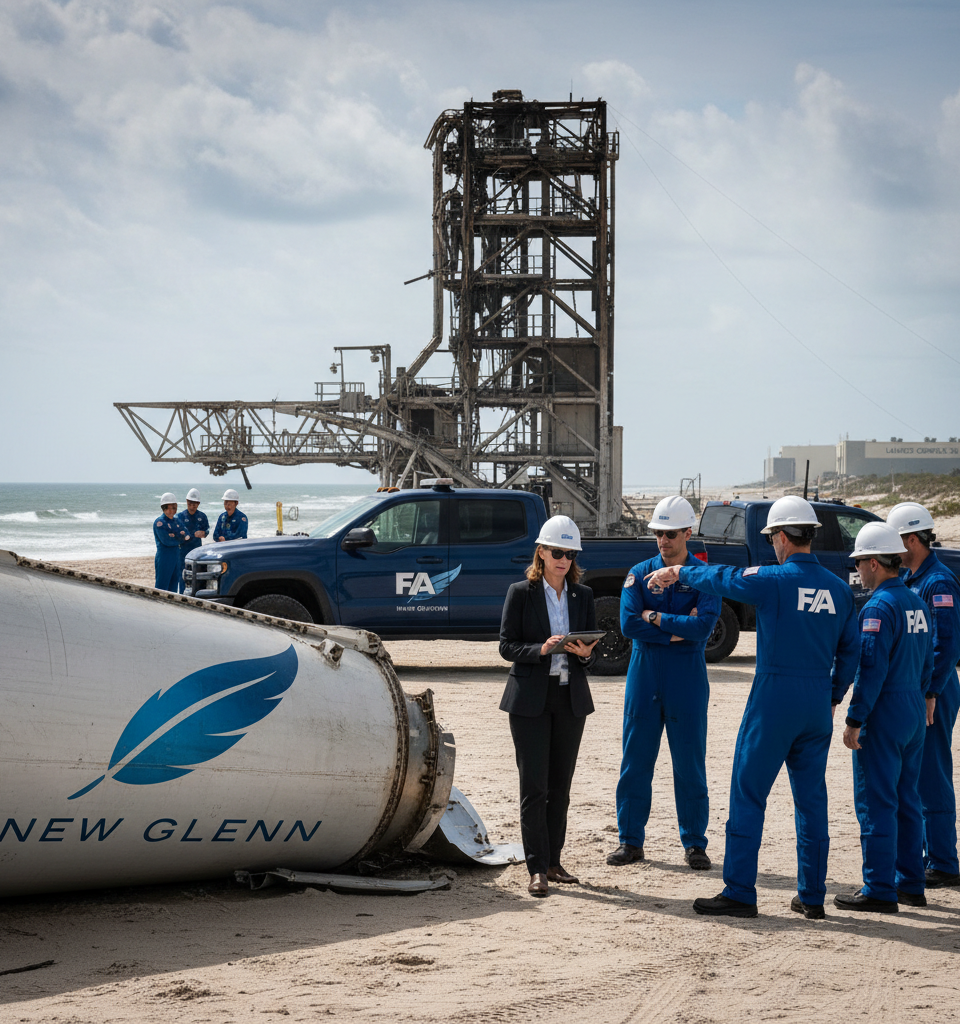
Washington D.C. – The Federal Aviation Administration (FAA) has issued a directive ordering Blue Origin to ground its much-anticipated New Glenn heavy-lift rocket, initiating a full investigation into a recent anomaly involving the rocket's upper stage. This decisive action follows an undisclosed incident during testing, which has cast a significant shadow over the Jeff Bezos-founded company's multi-billion dollar efforts to enter the competitive space launch market. The FAA's mandate ensures that the New Glenn will remain earthbound until a comprehensive understanding of the mishap's root cause is achieved and corrective measures are implemented.
Context: Blue Origin's Quest for Space Domination
Blue Origin, established in 2000, has long positioned itself as a major contender in the private space sector, developing a range of rockets and spacecraft. The New Glenn, named after astronaut John Glenn, is the company's flagship orbital launch vehicle, designed to carry heavy payloads to various orbits, including geostationary transfer orbit and beyond. Its development represents a substantial investment and is seen as a critical component of Blue Origin's long-term strategy, encompassing lunar landers and space stations. The maiden flight of New Glenn has faced multiple delays, making this latest setback particularly impactful for Blue Origin's shareholders and partners.
Key Details: Unveiling the Anomaly
While Blue Origin has remained tight-lipped regarding the precise nature of the upper stage anomaly, sources familiar with the situation indicate that the incident occurred during a critical test sequence. The FAA's involvement signifies a serious event that warranted regulatory intervention to ensure public safety and the integrity of future launch operations. The investigation will undoubtedly scrutinize various aspects of the upper stage's design, manufacturing, and testing protocols, including its BE-3U engines, propellant systems, and structural integrity. A transparent and thorough review is paramount for rebuilding confidence in the program.
Industry Impact: A Shifting Launch Landscape
The grounding of the New Glenn has immediate repercussions for the burgeoning commercial space launch industry. With competitors like SpaceX continually pushing boundaries in terms of launch frequency and cost-effectiveness, Blue Origin's delays could further entrench its rival's dominance. Customers who have booked payloads on New Glenn, including government agencies and commercial satellite operators, will be closely monitoring the investigation's progress, potentially facing revised launch schedules and increased uncertainty. This incident also highlights the inherent risks and complexities involved in developing cutting-edge aerospace technology, reminding the industry that even well-funded ventures are not immune to setbacks.
Expert Perspective: Engineering Challenges and Regulatory Scrutiny
Aerospace analysts emphasize that such investigations are standard procedure in the highly regulated space industry. Dr. Evelyn Reed, a propulsion systems expert, commented, "Any anomaly, especially involving high-energy components like an upper stage, demands rigorous examination. The FAA's role is not just about identifying what happened, but why it happened, to prevent future occurrences. This process, while seemingly delaying, is crucial for long-term safety and success." She added that engineers would be meticulously combing through telemetry data, sensor readings, and material analyses to pinpoint the exact failure mechanism.
What's Next: A Path Forward
Blue Origin now faces a demanding period of fault isolation, analysis, and corrective action development, all under the direct oversight of the FAA. The investigation will likely involve internal teams working in conjunction with independent experts appointed by the regulator. Depending on the severity and complexity of the anomaly, this process could span several months. Once the root cause is identified and remedial actions are validated, Blue Origin will need to demonstrate to the FAA's satisfaction that the New Glenn is safe to proceed with flight operations. Only then will the launch vehicle be cleared for its inaugural journey, a critical milestone for a company aiming to establish a foothold in the heavy-lift market.
Beyond New Glenn: Implications for Blue
Origin's broader ambitions
While the current focus is squarely on the New Glenn, the outcome of this investigation could have broader implications for Blue Origin's other ambitious projects, including its BE-4 engine, destined for use on United Launch Alliance's Vulcan Centaur rocket, and its efforts in lunar exploration. Investor confidence, supply chain dynamics, and the competitive positioning of Blue Origin within the space economy will all hinge on the company's ability to navigate this challenge swiftly, transparently, and effectively. The coming months will be pivotal in shaping the trajectory of Blue Origin's future in space.