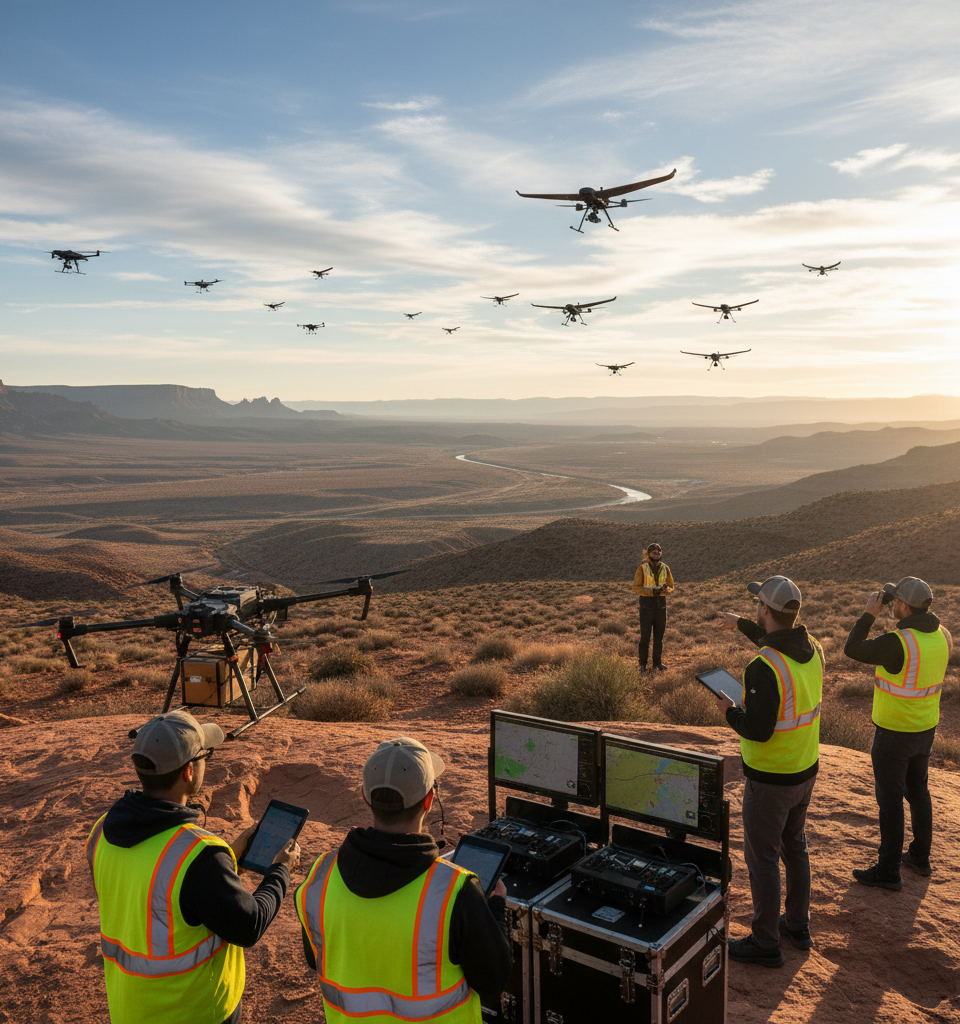
The commercial drone industry stands on the precipice of a transformative expansion, fueled by forthcoming changes in Federal Aviation Administration (FAA) regulations. Currently, nearly all drone operations are constrained by a requirement for constant visual contact between the pilot and the drone, known as visual line of sight (VLOS). This mandate severely limits the operational range and practical utility of drones, hindering their widespread commercial adoption. However, when the FAA finalizes rules permitting flights beyond visual line of sight (BVLOS), experts predict a substantial surge in drone deployment across numerous sectors.
Current Limitations and Their Impact
The existing VLOS requirement mandates that drone operators maintain an unobstructed view of their aircraft at all times. This rule, designed primarily for safety, effectively confines drone operations to relatively small, contiguous areas. For industries considering drone integration for tasks such as infrastructure inspection, large-scale survey mapping, or long-distance delivery, the VLOS constraint presents a formidable barrier. It necessitates multiple ground crews, frequent landing and repositioning, and significantly increases operational costs and complexity. Consequently, many potential commercial applications for drones remain theoretical rather than practical under current FAA guidelines.
The Promise of BVLOS Operations
Flight beyond visual line of sight will fundamentally reshape how drones are utilized. By removing the need for a human operator to constantly see the drone, craft will be able to fly much longer distances, cover vast areas, and perform tasks that are currently infeasible or prohibitively expensive. This shift promises to unlock a wide spectrum of applications, from monitoring extensive agricultural fields and inspecting miles of power lines or pipelines with greater efficiency, to facilitating drone delivery services over significant geographical spans. The ability to operate drones autonomously or semi-autonomously over extended ranges is expected to drive innovation and create new business models.
Predicted Commercial Explosion
Industry analysts and stakeholders are anticipating a "skyrocketing" demand for drone technology once BVLOS capabilities are fully realized. This regulatory evolution is seen as the critical enabler for the drone market to move beyond niche applications into mainstream commercial use. Sectors such as logistics, energy, agriculture, construction, and public safety are particularly poised to benefit. For instance, a drone could inspect hundreds of miles of utility lines in a single flight, replacing arduous and often dangerous manual inspections or expensive helicopter operations. Similarly, in agriculture, drones could monitor crop health across vast farmlands, delivering precise data for targeted interventions without the need for an operator to follow the drone across every acre.
Economic and Operational Advantages
The economic implications of widespread BVLOS drone use are considerable. Businesses could see significant reductions in labor costs, improved operational efficiency, and enhanced safety for workers who might otherwise perform hazardous tasks. The extended range and endurance of BVLOS drones mean fewer deployments, less equipment, and a more streamlined workflow. This increased efficiency will likely translate into cost savings that can be passed on to consumers or reinvested into further technological development, fostering a virtuous cycle of innovation and adoption.
Future Outlook and Implementation
The finalization of these FAA rules is not just a regulatory update; it is a catalyst for an entirely new era of aviation. While specific timelines for the release of the finalized rules remain dynamic, the expectation across the industry is that their implementation will be a watershed moment. Challenges will undoubtedly emerge during the rollout, including the development of robust detect-and-avoid technologies, refined air traffic management systems for uncrewed aircraft, and enhanced cybersecurity protocols.
However, the foundational change in operational capability that BVLOS offers is projected to overcome these hurdles, leading to a pervasive integration of drone technology into the commercial landscape. The ability to fly a drone beyond the operator's line of sight will not merely expand capabilities but fundamentally redefine the operational paradigm for uncrewed aerial systems, ushering in an era of unprecedented utility and economic growth.