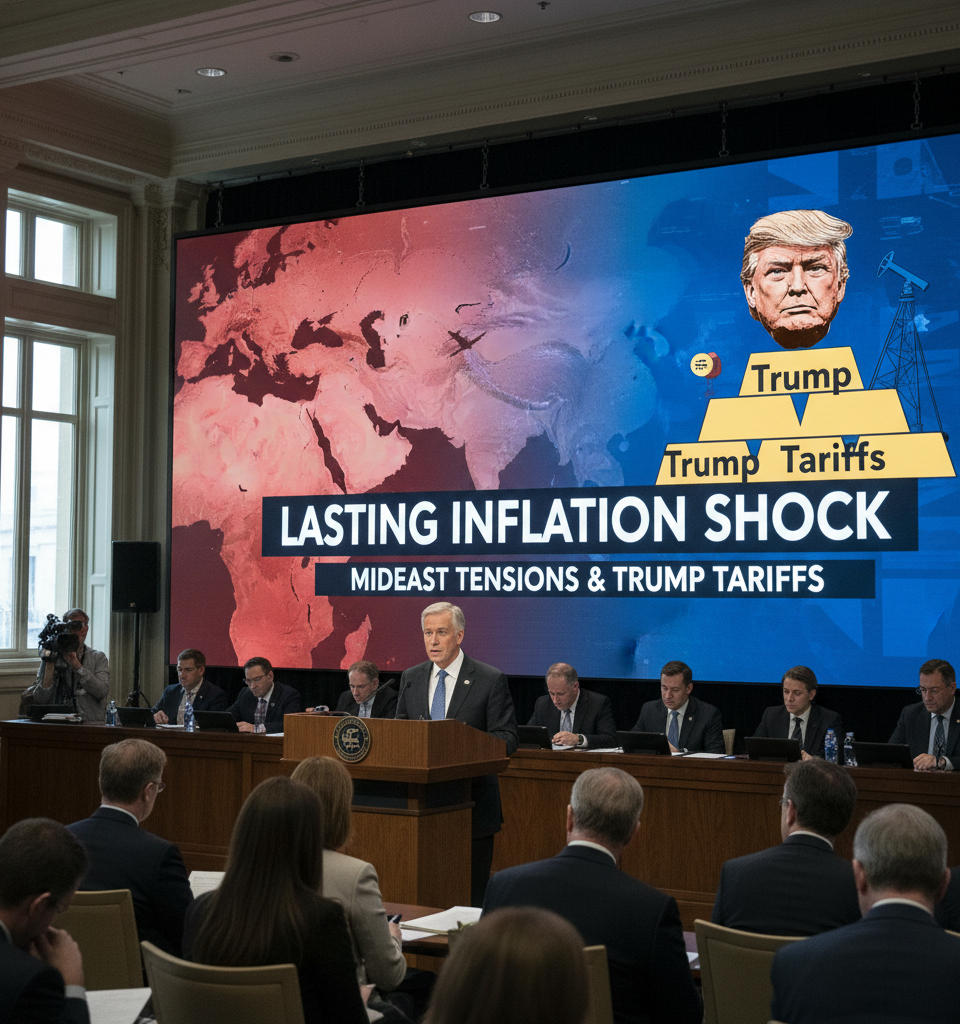
Washington D.C. — Christopher Waller, a governor on the Federal Reserve Board, delivered a sobering assessment on Tuesday, cautioning that a potential conflict involving Iran could ignite a “lasting” inflationary shock to the global economy. Speaking at a conference, Waller highlighted the confluence of higher oil prices, inevitably triggered by regional instability, and the prospect of renewed protectionist trade policies, such as those advocated by former President Donald Trump, as a potent recipe for prolonged price pressures. This warning reverberates through financial markets and central banking circles, signaling significant headwinds to the Fed's ongoing battle against inflation.
The Geopolitical-Economic Nexus
Waller's remarks underscore the intricate connection between geopolitical stability and economic tranquility. The Middle East, a pivotal region for global energy supplies, has historically demonstrated its capacity to disrupt global markets through supply shocks. Past conflicts, such as the 1973 oil crisis or the Iran-Iraq War in the 1980s, provide stark historical precedents for how regional instability can translate into global inflationary spirals. Coupled with the potential for tariffs, which intrinsically raise import costs and consumer prices, the scenario painted by Waller presents a formidable challenge to central banks attempting to guide economies towards price stability.
Key Factors Driving Inflationary Concerns
The primary concern, according to Waller, is the potential for a significant and sustained increase in crude oil prices. An escalation of tensions involving Iran, a major oil producer and strategic player in the Strait of Hormuz – a critical chokepoint for global oil shipments – could severely constrict supply, driving Brent crude futures well beyond recent peaks. Furthermore, the specter of a second Trump administration, which has openly discussed implementing widespread tariffs, including a 10% universal tariff on all imports and potentially higher duties on specific countries, adds another layer of inflationary risk. Such tariffs directly increase the cost of goods for businesses and consumers, offsetting any potential disinflationary gains from domestic monetary policy.
Broad Economic and Market Implications
Should these risks materialize, the implications for the broader economy would be profound. Businesses would face higher input costs, potentially compressing profit margins or leading to further price increases for consumers. Households would grapple with higher energy bills and increased costs for everyday goods, eroding purchasing power. Financial markets would likely react with increased volatility, particularly in energy commodities and equity markets, as investors reassess inflation expectations and the trajectory of corporate earnings. The Federal Reserve, already delicate in its approach to interest rate policy, would face immense pressure to either aggressively tighten monetary policy – risking an economic slowdown – or accept a sustained period of higher inflation.
Expert Perspectives and Policy Dilemmas
Economists broadly agree that while direct conflict carries immediate price shock risks, the duration of the inflationary impact would depend on the scope and longevity of the geopolitical event. "A limited skirmish might cause a transient spike," noted Dr. Evelyn Reed, a senior economist at Global Macro Advisors, "but a protracted conflict involving significant energy disruptions, coupled with broader trade protectionism, could anchor inflation expectations at higher levels for years." This scenario would present a grave dilemma for central bankers like Jerome Powell, who have consistently emphasized the importance of returning inflation to the 2% target. They would need to weigh the risks of overtightening against the long-term damage of embedded inflation.
The Path Ahead: Monitoring and Mitigation
The immediate future hinges on the evolving geopolitical landscape and the upcoming U.S. presidential election. Policymakers and market participants will be closely monitoring developments in the Middle East for any signs of escalation or de-escalation. Similarly, the rhetoric and policy proposals from leading presidential candidates regarding trade will be scrutinized for their potential economic ramifications. While the Federal Reserve hopes to achieve a 'soft landing' for the economy, the complex interplay of geopolitical tensions and potential trade policy shifts could introduce significant turbulence, forcing a recalibration of assumptions and strategies to mitigate the risks of a lasting inflationary shock.
Data Points and Projections
- Oil Prices: A proxy for potential impact, Brent crude prices averaged around $85/barrel in recent months. Analysts project a sustained conflict could push prices above $120-$150/barrel. (Source: EIA, Goldman Sachs estimates)
- Tariff Impact: The Peterson Institute for International Economics estimates a 10% universal tariff could increase U.S. consumer prices by 0.5% to 1.5% annually. (Source: PIIE)
- Inflation Target: The Federal Reserve's long-run inflation target is 2% as measured by the Personal Consumption Expenditures (PCE) price index.
- Strategic Chokepoint: Approximately 20% of the world's oil supply passes through the Strait of Hormuz daily. (Source: U.S. Energy Information Admin.)