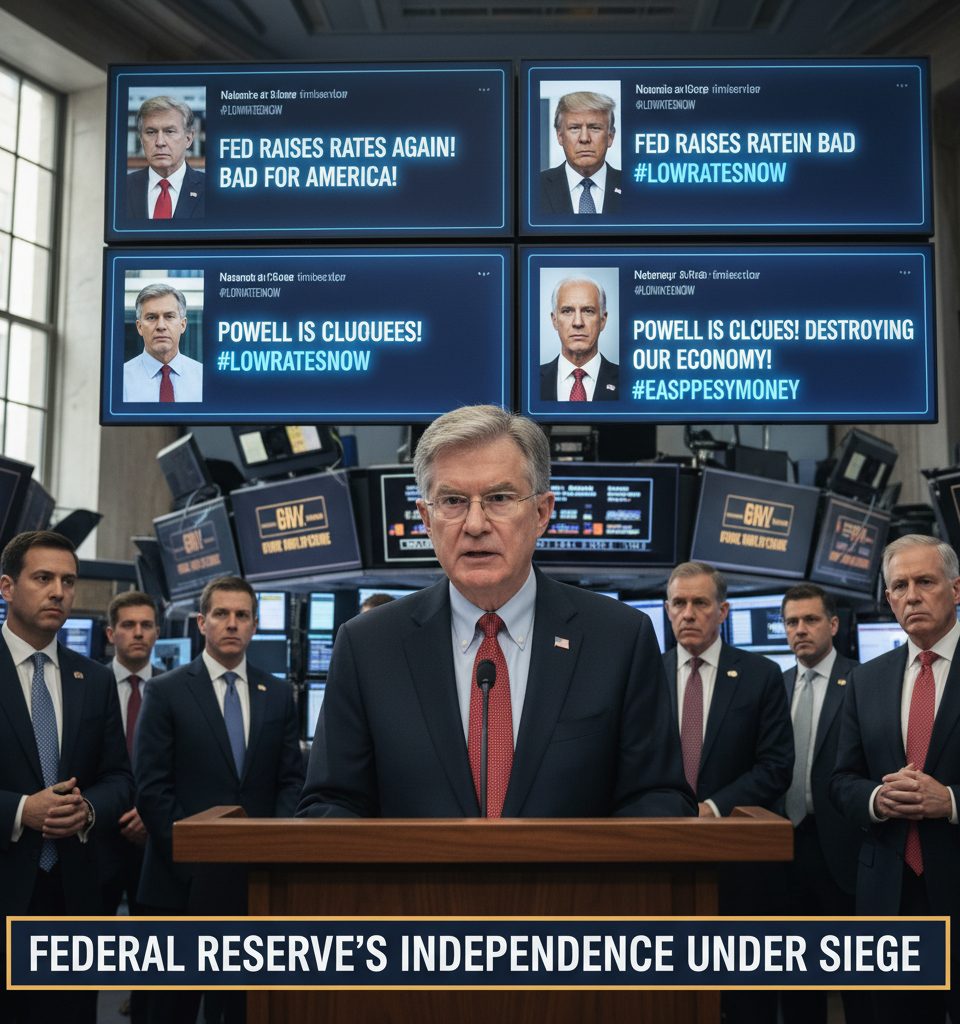
S. economy. For several months, President Trump has been openly pressuring the Federal Reserve to reduce the federal funds rate, a move he believes would further stimulate economic growth and maintain a competitive edge for American exports. This unprecedented level of public admonition has sparked a heated debate among economists, policymakers, and financial markets about the sanctity of the Fed's independence and the potential for political interference in monetary policy decisions.
The Roots of the Conflict
This dispute underscores a fundamental tension between political expediency and economic stewardship. Historically, the Federal Reserve has operated with a degree of insulation from day-to-day political pressures, a design intended to allow it to make objective decisions in the long-term interest of the economy, free from electoral cycles. This independence is generally seen as crucial for maintaining credibility and effectively managing inflation and employment. The current administration's consistent vocal criticism, often delivered via social media and public statements, challenges this long-held principle, suggesting that the Fed's current policy stance is a hinderance rather than a help to economic prosperity. This is not the first time a president has disagreed with the Fed, but the regularity and intensity of the public comments are particularly noteworthy.
Key Players and Specific Demands
The most prominent figure in this confrontation is President Trump, who frequently argues that the Fed's interest rate hikes have been too aggressive and that lower rates are essential to combat the economic slowdowns experienced by other major economies, particularly in Europe and China. He has often called for interest rate cuts of perhaps an additional 50 to 100 basis points, suggesting that such action would unleash a new wave of growth. Federal Reserve Chairman Jerome Powell, appointed by President Trump himself, has consistently maintained that the Fed’s decisions are based solely on economic data and its dual mandate of maximum employment and price stability, rather than political directives. Other members of the Federal Open Market Committee (FOMC) have largely echoed Powell’s sentiment, emphasizing their non-partisan approach to monetary policy.
Broad Economic and Market Implications
The ramifications of this power struggle extend far beyond the immediate impact on borrowing costs such as mortgage rates or credit card interest. Financial markets are particularly sensitive to perceived political interference in central bank operations. Any impression that the Fed's decisions are being swayed by political pressure could lead to increased market volatility, a decline in investor confidence, and potentially a devaluing of the U.S. dollar as foreign investors become wary of the stability of economic policy. Furthermore, if the Fed were to capitulate to political demands without a strong economic rationale, it could undermine its ability to effectively combat future recessions or manage inflationary pressures, essentially stripping away one of the most powerful tools for economic stabilization.
Expert Commentary and Concerns Economists and former
Fed officials have largely expressed alarm over the situation. Former Fed Chair Janet Yellen, for example, has stressed the importance of the Fed's independence for its effectiveness and credibility. Many analysts believe that maintaining this independence is critical for global financial stability, given the oversized role of the U.S. dollar and the U.S. economy. They warn that a politically compromised Fed could find it much harder to implement unpopular but necessary tightening policies during inflationary periods, potentially leading to long-term economic instability. The International Monetary Fund (IMF) has also periodically stressed the importance of central bank independence for global economic health.
The Path Forward and Potential Scenarios
The future trajectory of this high-stakes standoff remains uncertain. Chairman Powell has repeatedly affirmed the Fed's commitment to independence, suggesting that it will continue to base its decisions on economic fundamentals rather than external pressure. However, the continuous vocal criticism from the White House creates a challenging environment for the central bank. Potential scenarios include the Fed maintaining its current course, leading to continued political friction; a move by the Fed to cut rates, which could be interpreted by some as a concession to political demands; or, in a more extreme scenario, an unprecedented legislative attempt to curtail the Fed’s autonomy. Upcoming FOMC meetings and congressional testimonies from Fed officials will be closely watched for any indications of evolving dynamics or shifts in policy stance, particularly as the next presidential election cycle approaches, potentially intensifying the political heat on monetary policy decisions.