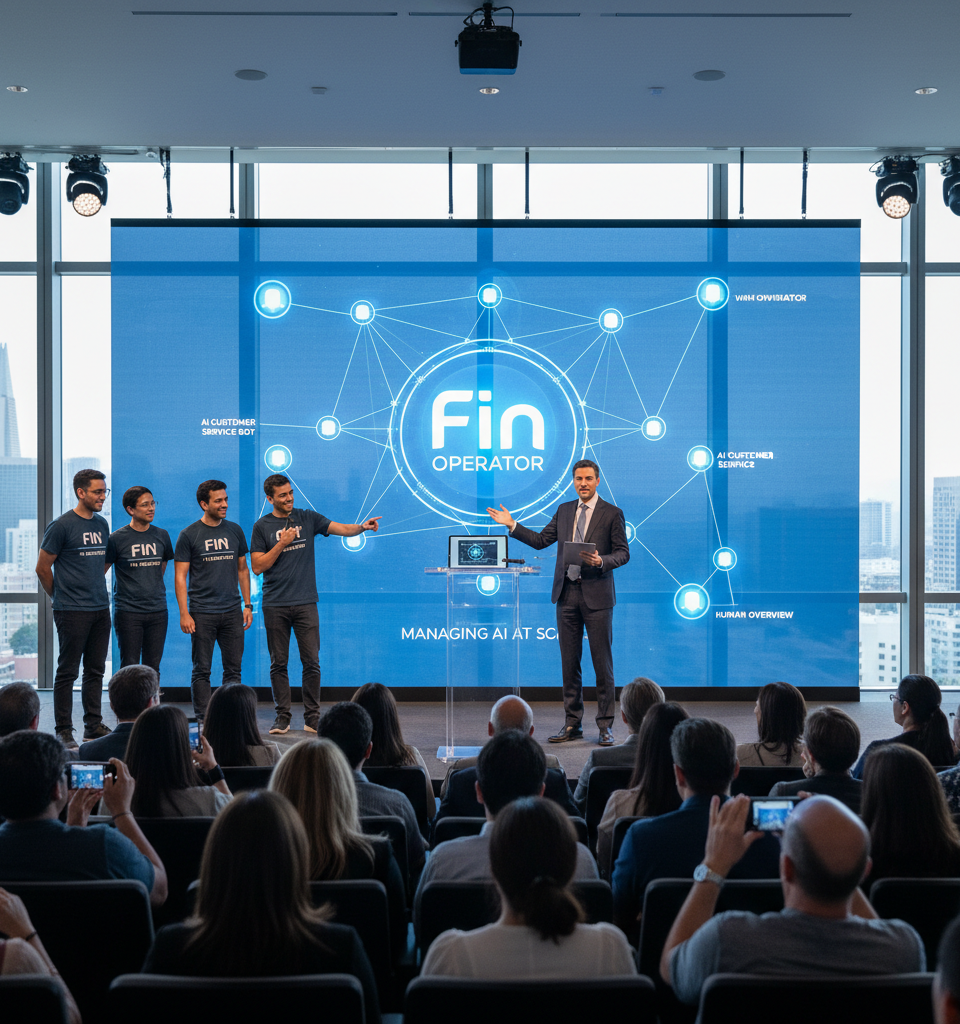
Fin, the company formerly known as Intercom, has announced a significant advancement in artificial intelligence deployment with the introduction of Fin Operator. Unveiled at a live event in San Francisco, Fin Operator is an AI-powered system engineered specifically to manage, monitor, and enhance the performance of Fin, the company's established customer-facing AI agent. This development signals a strategic shift in how AI can be leveraged within business operations, creating a tiered AI structure rather than merely replacing human roles.
A New Era of AI Management
This move is particularly notable as it positions Fin at the forefront of AI innovation in the customer service sector. While many platforms are focused on developing AI to directly interact with customers, Fin has taken the unprecedented step of building an AI whose sole purpose is to optimize another AI. This internal, back-office AI agent is designed to empower human teams responsible for the configuration and improvement of Fin, rather than supplanting them. It represents a layer of automation that previously required extensive human oversight, aiming to make Fin's primary AI more efficient, accurate, and responsive over time.
Functionality and Impact
Fin Operator is not intended to replace human support agents. Instead, its function is to enhance the existing capabilities of human teams by providing sophisticated tools for AI management. The system will allow back-office personnel to fine-tune Fin's responses, monitor its interactions for quality assurance, identify areas for improvement, and implement changes more rapidly. This indirect approach to improving customer experience through AI-driven optimization of another AI agent is a novel concept at scale, promising to unlock new levels of efficiency and personalization in automated customer support.
Industry Ramifications
This innovative deployment could set a new benchmark for the customer service industry. Historically, the challenge with large-scale AI customer support has been the complexity and resource intensity of continuous improvement and oversight. By introducing Fin Operator, Fin is effectively creating a self-optimizing loop—an AI-driven feedback mechanism that can lead to faster iterations and more robust AI models. This could compel other major customer service platforms to explore similar tiered AI architectures, potentially accelerating the development of more sophisticated and autonomous AI systems across the industry.
Expert Insights
Industry analysts are closely watching Fin's strategy. "This is a clever and potentially groundbreaking application of AI," commented Dr. Anya Sharma, a lead AI researcher at Gartner. "The bottleneck in deploying advanced AI often lies in its ongoing management and refinement. An AI designed specifically to tackle that challenge could significantly reduce operational overheads and improve the overall efficacy of customer-facing AI. It's a testament to the increasing sophistication of AI applications beyond mere task automation." This sentiment underscores the potential for Fin Operator to not only improve Fin's own performance but also to influence broader AI strategy.
The Road Ahead
Looking forward, Fin's development team plans to continuously expand Fin Operator's capabilities, integrating more advanced analytics and predictive maintenance features. Future enhancements may include proactive identification of potential issues in Fin's customer interactions before they escalate, providing an even sharper edge in customer experience management. The company anticipates that this two-tiered AI approach will allow Fin to adapt more quickly to changing customer needs and business requirements, ensuring that its AI-powered customer service remains at the cutting edge of technological innovation.
This strategic investment in AI-driven AI management highlights a commitment to long-term scalability and autonomous optimization within the rapidly evolving landscape of artificial intelligence. It will be crucial to observe how Fin measures the tangible benefits and ROI of this advanced AI architecture in the coming months.