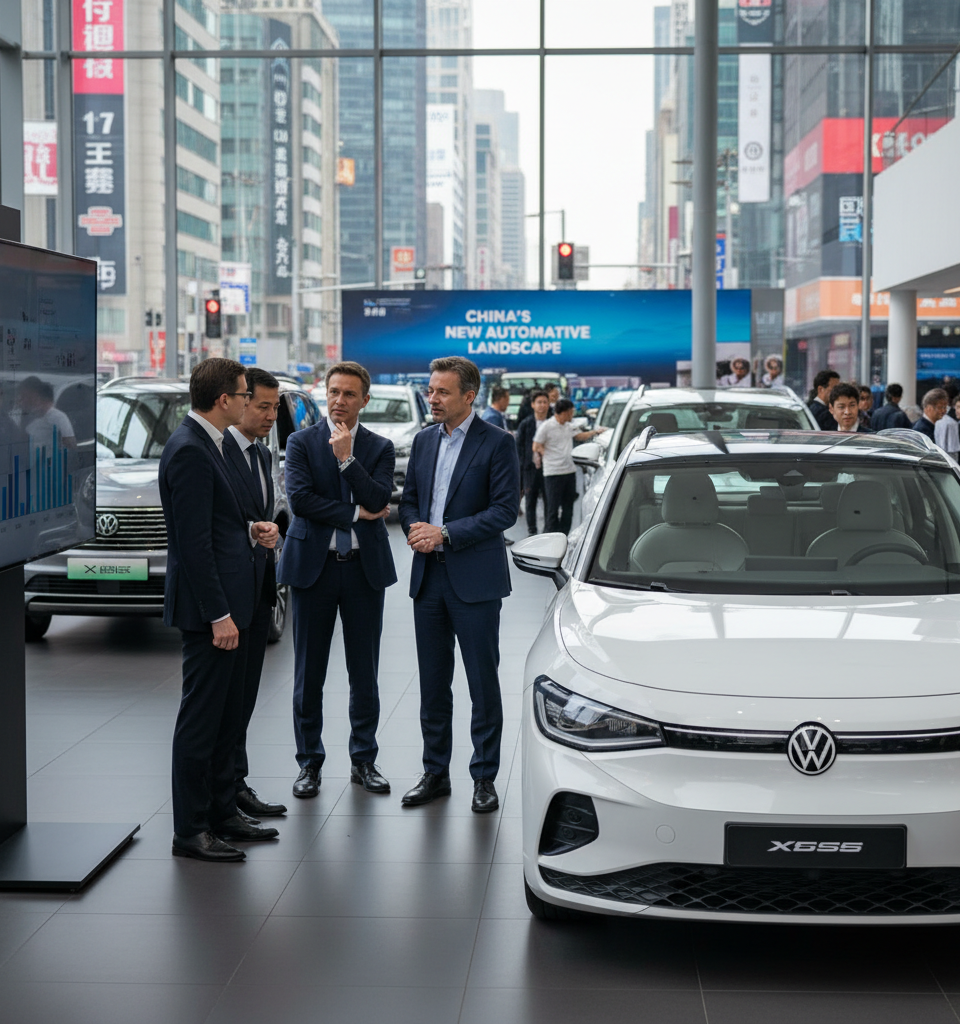
In January and February of 2026, Volkswagen staged a notable, albeit potentially temporary, resurgence in China's passenger vehicle market, securing the top position with a 13.9 percent share. This performance narrowly edged out Chinese automotive giant Geely, which followed closely at 13.8 percent. Meanwhile, Toyota's various joint ventures collectively held 7.8 percent, while BYD, a dominant force throughout 2024 and much of 2025 as the world's largest electric vehicle (EV) maker, saw its share slip to 7.1 percent, placing it fourth. This latest data signals a dynamic and increasingly challenging landscape for international automakers within one of the world's largest and most rapidly evolving automotive markets.
Contextualizing China's Auto Market Evolution
The narrative of foreign automakers in China has dramatically shifted over the past decade. For many years, brands like Volkswagen, General Motors, and Toyota enjoyed significant market share and profitability, often through joint ventures that offered access to the rapidly expanding Chinese consumer base. These partnerships were often characterized by foreign firms dictating technology and design. However, the rise of domestic champions, particularly in the EV sector, has fundamentally altered this dynamic. Chinese manufacturers, often backed by robust government support and equipped with agile R&D capabilities, have rapidly innovated, particularly in battery technology and smart car features, challenging the established order.
Shifting Market Dynamics and Key Players
While Volkswagen's brief reclamation of the top spot is noteworthy, it masks underlying trends. The battle for market share is no longer solely about traditional internal combustion engine (ICE) vehicles; new energy vehicles (NEVs), encompassing EVs and hybrids, are the primary growth drivers. BYD's recent dominance underscores this, having surpassed legacy global automakers in EV sales. Geely's near parity with Volkswagen highlights the growing prowess of Chinese brands across all vehicle segments. This increasingly competitive environment forces foreign stalwarts to adapt rapidly, often by deepening their technological collaboration with Chinese partners or by localizing their product development to meet specific Chinese consumer demands.
Industry and Market Impact of Domestic Rise
The ascendancy of Chinese domestic brands is having a profound impact on the global automotive industry. It is accelerating the shift towards electrification and smart technologies, as Chinese consumers have shown a strong preference for tech-rich vehicles. This trend is also influencing global supply chains, with China becoming a critical hub not just for manufacturing but also for advanced automotive R&D. Foreign automakers are finding that to remain competitive, they must increasingly cede autonomy in product development and even strategic decision-making to their Chinese counterparts, transforming them from senior partners into more collaborative, or even junior, roles within their shared enterprises.
Expert Perspectives on Future Strategy
Analysts widely view the current situation as a pivotal moment. "The days of foreign brands dictating terms in China are over," states Kevin Li, an automotive industry consultant based in Shanghai. "Chinese consumers demand speed, cutting-edge technology, and localized features that often only domestic players can quickly deliver. Foreign automakers must become more agile and humble, learning from their Chinese counterparts rather than just leading." Another expert, Dr. Chen Wei, an economics professor specializing in global trade, notes, "This isn't just about market share; it's about the future of automotive technology. Chinese companies are pushing boundaries in areas like autonomous driving and battery efficiency, compelling global players to integrate these innovations rapidly or risk being left behind."
Looking Ahead: Innovation, Localization, and Collaboration
The path forward for foreign automakers in China is likely to involve even greater localization and deeper collaboration. This includes establishing more independent R&D centers within China, tailoring vehicle designs specifically for the Chinese market, and potentially adopting a more flexible approach to joint ventures, where technology transfer flows both ways. Expect accelerated investments in software, digital services, and advanced driver-assistance systems (ADAS) specifically designed for Chinese road conditions and consumer preferences. The future competitive landscape will likely see foreign brands striving to integrate seamlessly into a market increasingly defined by Chinese innovation, recognizing that their long-term success may depend on embracing a partnership dynamic where they are not always the dominant force in the driver's seat.