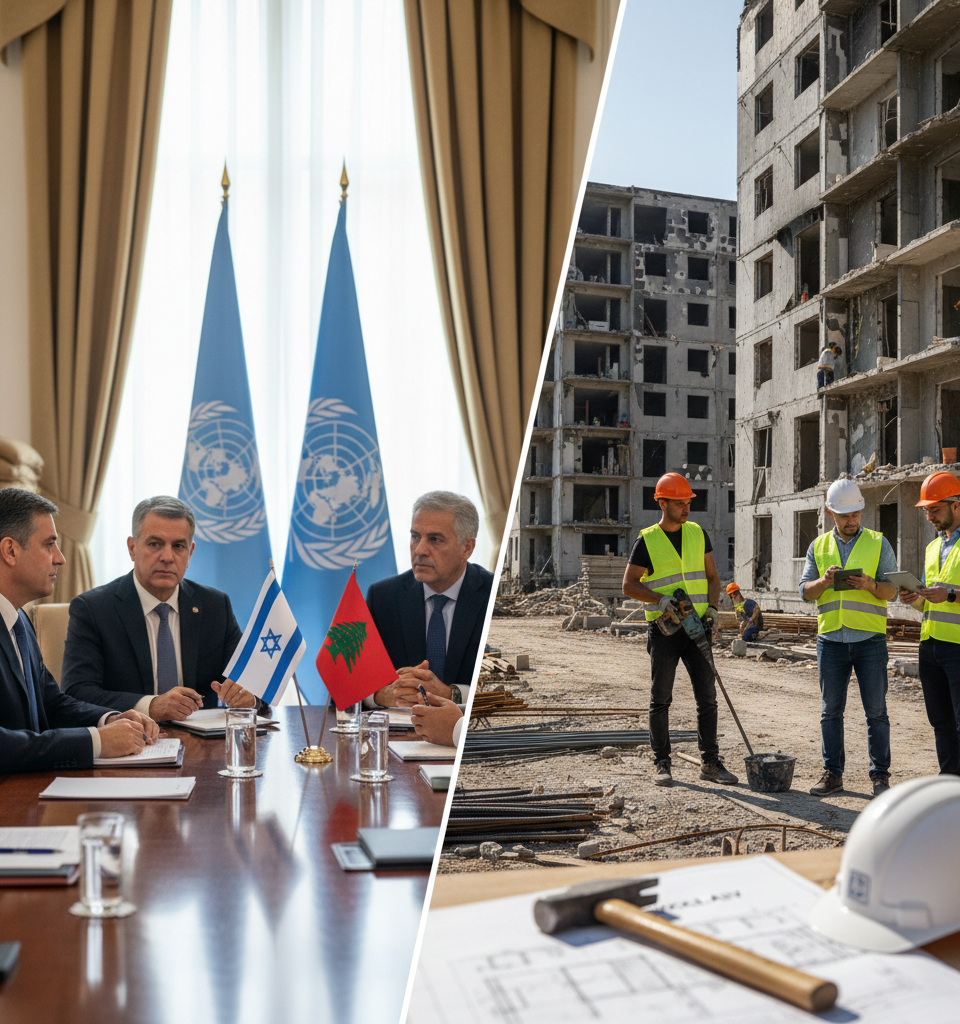
BEIRUT, LEBANON / TEL AVIV, ISRAEL – While artillery exchanges and cross-border incidents continue to punctuate the volatile Israel-Lebanon border, a fragile dialogue between the two nations persists, underscoring the intricate geopolitical landscape of the Middle East. These intermittent, indirect diplomatic engagements reportedly aim to de-escalate tensions and prevent a broader conflict, even as rhetoric on both sides frequently hardens. The persistence of these communications amidst ongoing hostilities reveals a cautious strategic calculus to maintain some semblance of stability, contrasting sharply with the immediate realities of continued armed clashes.
Historical Context and Enduring Conflict Drivers
The current dynamic is deeply rooted in decades of unresolved territorial disputes and proxy conflicts. Israel and Lebanon officially remain in a state of war, with their shared border, particularly the Shebaa Farms area, being a perennial flashpoint. The presence and operations of Hezbollah, a powerful Iran-backed Shiite militant group and political party within Lebanon, significantly complicate any peaceful resolution. Hezbollah’s formidable arsenal and stated aim to confront Israel mean that any minor incident along the Blue Line – the demarcation line between the two countries – carries the potential for rapid escalation, further exacerbating the humanitarian and economic challenges faced by both nations.
Key Diplomatic Channels and Strategic Tensions
Details surrounding the ongoing talks are sparse, typically communicated through international intermediaries such as the United States and the United Nations. These discussions often focus on maritime and land border demarcation issues, as well as the broader implications of regional security. Recent reports indicate a delicate balance being struck, where both sides acknowledge the necessity of de-escalation while simultaneously maintaining military readiness. For instance, recent skirmishes involving anti-tank missiles and retaliatory artillery fire underscore the precarious nature of the detente, with casualty figures often underreported by official channels. Analysts suggest that neither side desires a full-scale war, but miscalculation remains a significant risk factor.
Broader Regional Implications and Economic Strain
The ongoing tensions have profound implications for regional stability, drawing the attention of global powers and international organizations. Economically, both Israel and Lebanon face significant costs from prolonged instability. Lebanon, already grappling with an unprecedented financial crisis and political paralysis, can ill afford further conflict. The constant threat of escalation deters foreign investment, exacerbates inflation, and places immense strain on public services. For Israel, while its economy is more robust, a protracted conflict would divert substantial resources, disrupt vital sectors, and carry a heavy human cost, impacting its burgeoning tech and tourism industries.
Expert Perspectives on a Stalemate and Path Forward
Security analysts and foreign policy experts largely view the current situation as a dangerous stalemate. Dr. Elias Haddad, a senior fellow at the Middle East Institute, notes, “The willingness to talk while fighting is a testament to the deep-seated fear of an uncontrollable conflict, yet also reflects the fundamental lack of trust and political will for a lasting peace agreement.” He adds, “These are talks aimed at managing the conflict, not resolving it.” Others point to the critical role of international mediation in preventing a descent into war, emphasizing that without sustained diplomatic pressure, the conflict could easily intensify.
Ukraine's Resilient Rebuilding: The Mykolaiv Model
In a stark contrast of post-conflict rebuilding, the Ukrainian city of Mykolaiv has shown remarkable resilience in its recovery efforts, significantly bolstered by international aid. Despite enduring relentless bombardment in the early stages of the war, the city, a strategic Black Sea port, is experiencing a revitalization push, spearheaded by Denmark's substantial commitment. Danish Foreign Minister Lars Løkke Rasmussen recently reaffirmed Denmark's pledge of over €150 million (approximately $162 million USD) for Mykolaiv's reconstruction, focusing on critical infrastructure such as water supply, energy, and housing. This involves specific projects like the restoration of the Mykolaiv Waterworks and the construction of modular homes for displaced residents, aimed at not just rebuilding but "building back better" with modern, sustainable solutions. The initiative serves as a powerful testament to international solidarity and local determination in the face of adversity, offering a potential blueprint for other war-affected regions in Ukraine.
What Lies Ahead: Managing Tensions and International Commitments
For Israel and Lebanon, the immediate future will likely involve a continuation of the current pattern: indirect diplomacy aimed at de-escalation alongside high alert and periodic skirmishes. The focus will remain on managing border incidents to prevent any single event from spiraling into a broader war. The international community, particularly the UN and the US, will be crucial in maintaining these communication channels and enforcing ceasefire agreements. In Ukraine, the Mykolaiv model signals a broader trend of targeted international partnerships for reconstruction. As the conflict potentially extends, such focused, bilateral aid initiatives may become increasingly vital for Ukraine's long-term recovery and its aspirations for European integration, demonstrating different facets of global engagement in conflict and post-conflict scenarios.