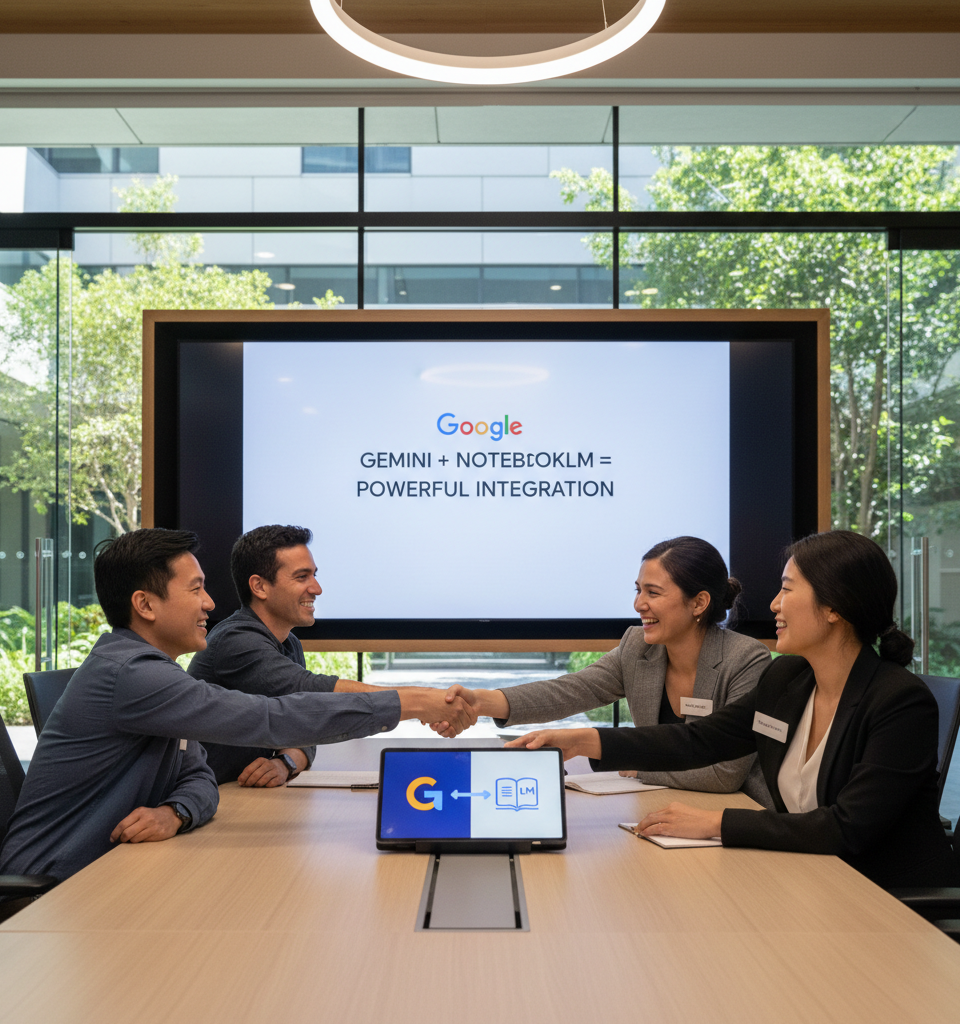
Google has announced a major upgrade to its AI ecosystem, integrating the powerful Gemini model with NotebookLM. This strategic move introduces a new organizational feature within Gemini, allowing users to create and manage "Notebooks" that synchronize directly with their NotebookLM projects. The integration aims to provide a more cohesive and efficient environment for users to handle conversational AI outputs and associated documents, signaling Google's continued push towards a unified and intelligent digital workspace.
The development comes amidst a rapidly evolving landscape for AI tools, where seamless integration and intuitive user experiences are becoming paramount. By linking Gemini, its flagship AI assistant, with NotebookLM, a platform designed for organizing research and notes, Google is directly addressing the growing need for better information management in an AI-driven world. This convergence is poised to enhance productivity for individuals and teams who rely on generative AI for content creation, research, and project management, streamlining workflows that traditionally involved juggling multiple applications.
Synergies and User Benefits
The core of this integration lies in the new "Notebooks" feature accessible within Gemini. Users can now categorize and save their Gemini chat histories, AI-generated content, and relevant files directly into these Notebooks. These digital binders are designed to mirror the organizational structure of NotebookLM, allowing for instant synchronization. This means that a research project compiled in NotebookLM, complete with source documents and annotations, can be directly augmented and enriched by Gemini's AI capabilities, and vice-versa. The goal is to eliminate the friction of data transfer and contextual switching, enabling a more fluid intellectual process.
The immediate benefit for users is a significantly improved ability to maintain context across different tasks. Imagine conducting extensive research using Gemini to summarize articles and generate ideas, then seamlessly saving these outputs into a designated Notebook for a specific project. Later, when working in NotebookLM, all the AI-generated insights and raw materials are readily available, neatly organized alongside traditionally sourced information. This interconnectedness is expected to reduce the time spent on administrative tasks and allow users to focus more on creative and analytical work.
Industry Implications and Future Outlook
This integration underscores a broader trend in the tech industry: the move towards embedding AI capabilities deeply within existing productivity tools rather than presenting them as standalone applications. For Google, this is a strategic play to solidify Gemini's position as a central component of its productivity suite. By making Gemini indispensable for organizing complex information, Google aims to increase user adoption and lock-in, potentially setting a new standard for how AI assistants interact with knowledge management platforms.
The implications extend beyond individual user convenience. For businesses and educational institutions, this unified approach could translate into more efficient team collaboration and knowledge sharing. Projects can be structured with AI-powered insights from the outset, and all team members can access a consistent, AI-augmented knowledge base. This could lead to faster project completion cycles and more informed decision-making processes, particularly in fields requiring extensive research and documentation.
Enhanced Workflow and Competitive Edge
Google's move also positions it competitively against other AI and productivity tool providers. By offering a comprehensive solution that combines generative AI with robust organizational features, Google is building a more compelling ecosystem. The ability to keep conversations, documents, and AI-generated content in a singular, synchronized environment provides a distinct advantage, reducing the fragmentation often associated with managing diverse digital assets.
The continuous evolution of AI integration suggests that future updates could further refine how Gemini interacts with NotebookLM. Potential enhancements might include more sophisticated AI-driven summarization of entire notebooks, proactive suggestions based on content, or even the ability for Gemini to draft reports directly from organized NotebookLM projects. As Google continues to iterate on these integrated experiences, the line between AI assistant and productivity tool is expected to become increasingly blurred, paving the way for more intuitive and powerful digital work environments.