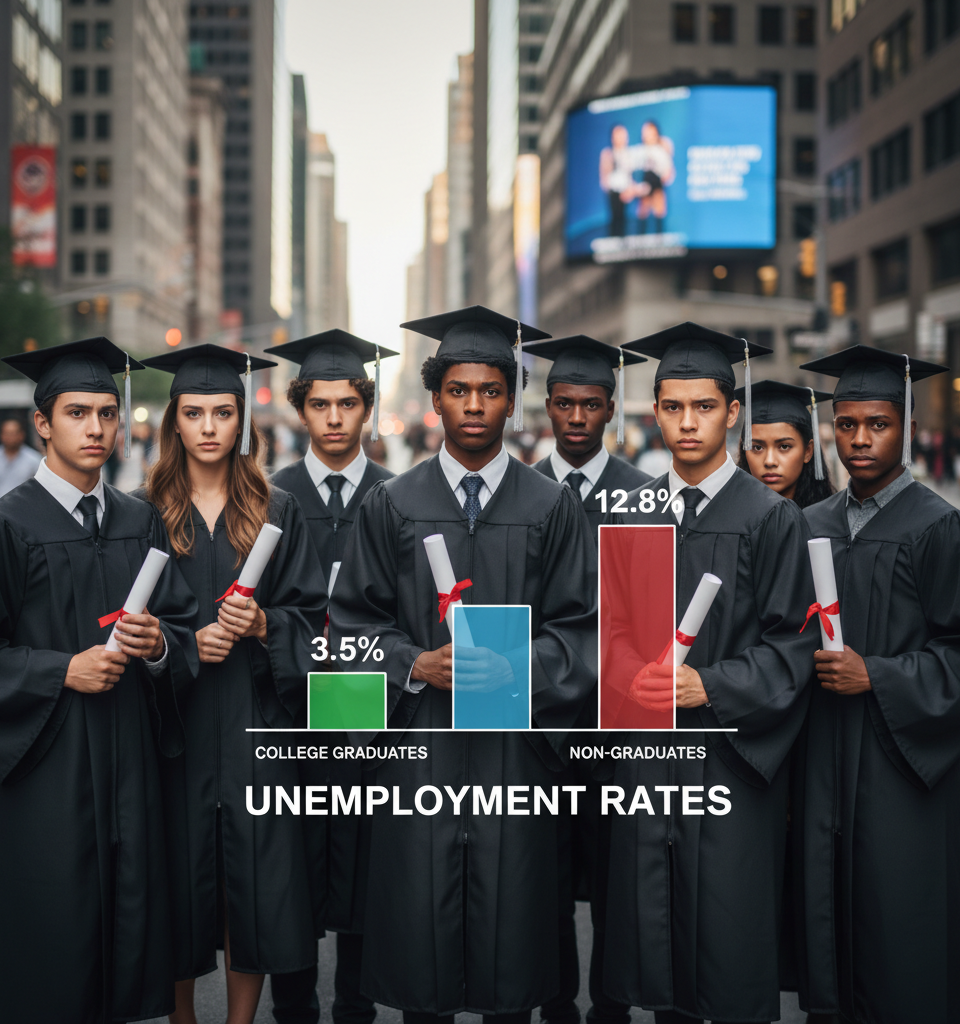
A significant disconnect is emerging between the perceptions of younger generations, particularly Gen Z, and the enduring realities of the labor market regarding the value of a university education. While the narrative of crippling student debt and underpaid entry-level jobs resonates loudly, two decades of employment data unequivocally demonstrate that college graduates consistently exhibit the lowest unemployment rates. This finding challenges the increasing skepticism surrounding higher education's utility, underscoring its long-term benefits in career stability and economic resilience.
The Enduring Value of a Degree
For years, a college degree was widely considered the quintessential gateway to professional success and financial security. However, rising tuition costs—which surged by an average of 169% at public universities and 125% at private institutions between 1980 and 2019, adjusted for inflation—coupled with a competitive job market post-graduation, have fueled a perception among younger demographics that the return on investment for a degree is diminishing. A recent survey indicated that over 40% of Gen Z question the value of a traditional four-year degree, citing debt burdens and a perceived lack of practical skills taught in academia. Yet, employment statistics paint a starkly different picture: individuals with at least a bachelor's degree consistently post unemployment rates significantly lower than those with only a high school diploma or some college education.
Data Decades: A Clear Trend
Analysis of labor market data stretching back 20 years consistently reveals a protective effect of higher education against unemployment. For instance, in December 2023, the unemployment rate for individuals aged 25 and older with a bachelor’s degree or higher stood at a mere 2.1%. This compares sharply with 3.8% for those with an associate's degree, 4.3% for individuals with some college but no degree, and 5.7% for those with only a high school diploma. Even during economic downturns, such as the 2008 financial crisis or the initial impact of the COVID-19 pandemic in early 2020, graduates' unemployment figures remained notably lower, demonstrating a robust insulation against market volatility. This persistent disparity highlights that while initial job searches may be challenging, the long-term career trajectory and stability afforded by a degree remain substantial.
Economic Impact and Broader Implications
This data isn't merely statistical; it carries profound economic implications. A workforce with higher educational attainment is generally more productive, adaptable, and innovative, contributing to a nation's overall economic health. The lower unemployment rate among graduates translates to higher tax revenues, reduced reliance on social welfare programs, and increased consumer spending capacity. Conversely, a growing segment of the population struggling with underemployment or unemployment due to a lack of advanced skills can strain public resources and stifle economic growth. The perceived devaluation of degrees, if it leads to fewer students pursuing higher education, could have long-term adverse effects on critical sectors requiring specialized knowledge, from healthcare and technology to research and development.
Expert Analysis: Beyond Initial Struggles
Economists and labor market experts concur that while the initial financial outlay and the challenge of securing a first job are real concerns for graduates, the long-term career benefits are undeniable. Dr. Emily Chen, a labor economist at the University of Pennsylvania, notes, "The starting salary for many graduates might feel underwhelming, especially when weighed against student loan payments.
" This perspective emphasizes that the perceived "uselessness" often stems from short-term financial pressures rather than a comprehensive view of career longevity and earning potential.
Addressing the Disconnect and Future Prospects
The ongoing debate prompts a critical need for institutions and policymakers to address the genuine concerns of Gen Z regarding affordability and job readiness. Initiatives like more robust career services, stronger industry partnerships, and curriculum adjustments focused on practical, high-demand skills could help bridge the gap between academic offerings and market needs. Furthermore, promoting clear pathways for alternative post-secondary education, such as vocational training, can complement university degrees, ensuring diverse routes to employment stability.
As the economy continues to evolve with technological advancements, the ability to continuously learn and adapt—skills often honed in higher education—will remain paramount. The data serves not as a refutation of Gen Z's anxieties, but as a compelling argument for strategic improvements in the higher education system to better prepare students for the complexities of the modern workforce without dismissing the proven long-term advantages of a degree.