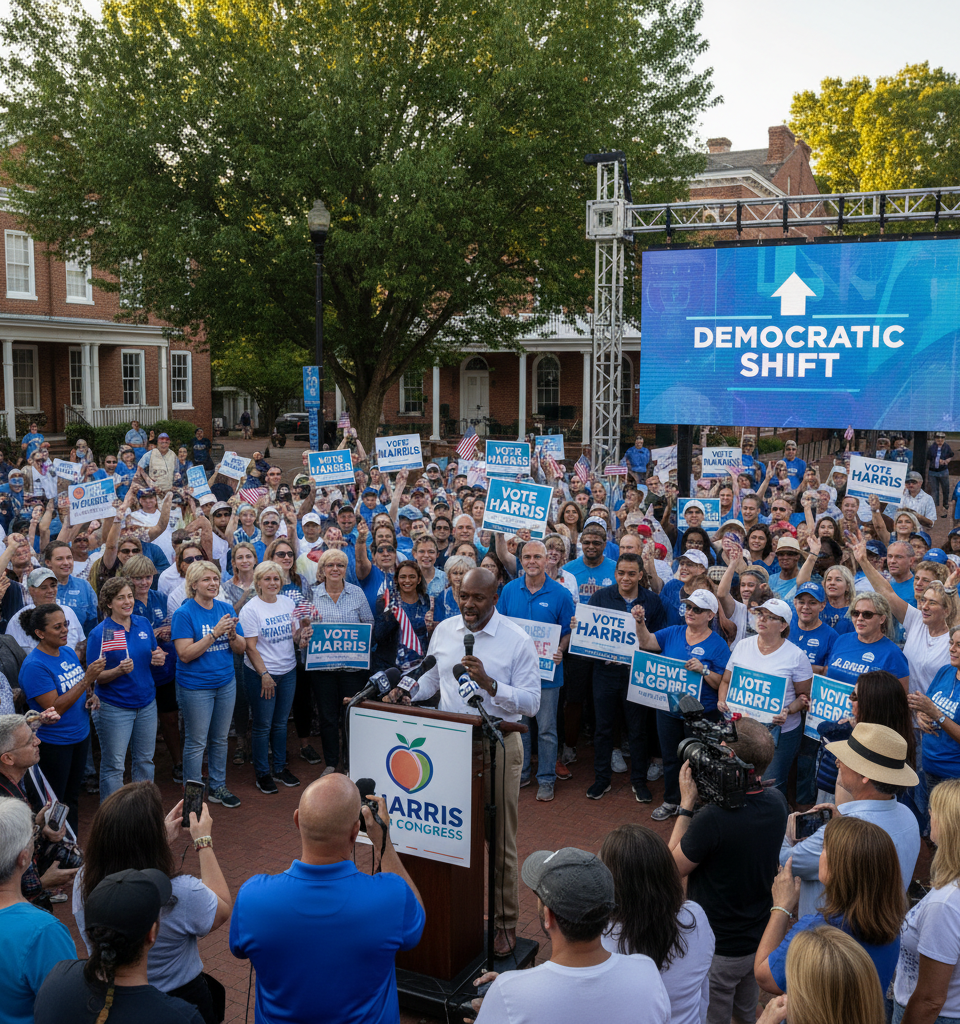
In a special runoff election held on, Democratic candidate Shawn Harris, despite ultimately losing to his Republican opponent, orchestrated a remarkable political feat in Georgia's 14th Congressional District. Harris narrowed the margin of defeat to approximately 12 percentage points, a stark improvement that translated into an astonishing 25-point shift towards the Democratic Party compared to previous electoral performances in the district. This outcome, while not resulting in a Democratic victory, has sent ripples through political circles, signaling a potential recalibration of electoral competitiveness in a historically ruby-red bastion.
This dramatic swing transcends the immediate election result, underscoring a significant and largely unexpected shift in voter sentiment within the district. The 14th Congressional District, encompassing parts of conservative Northwest Georgia, has long been considered a safe Republican seat, consistently delivering commanding victories for the GOP. Understanding the mechanics behind such a substantial shift — from a typical Republican winning margin of over 35-40 points to a mere 12 — is crucial for political strategists and provides a compelling case study on the evolving political landscape, even in deeply entrenched partisan areas. This contest moves beyond a simple win/loss dichotomy, instead becoming a narrative of partisan re-alignment and strategic engagement.
Key data points underpin the magnitude of this shift. In the preceding general election, the Republican candidate secured a victory with a margin exceeding 37 percentage points. Harris's ability to nearly halve this gap, closing in on a 12-point deficit, demonstrates an unprecedented mobilization of Democratic voters and potentially, a successful appeal to a segment of independent or disaffected Republican voters. While exact demographic breakdowns of the shift are still being analyzed, early indications suggest increased turnout among traditionally underrepresented groups and a strategic messaging approach that resonated beyond the typical Democratic base. Campaign finance reports, though not fully detailed for this special election, likely played a role in Harris's improved visibility and outreach efforts.
The implications of this electoral performance extend far beyond Georgia's borders, offering valuable insights for both national parties. For Democrats, it provides a potential roadmap for making inroads in previously unwinnable districts, suggesting that persistent grassroots organizing and tailored messaging can chip away at established Republican majorities. For Republicans, the result serves as a cautionary tale, highlighting the need to address evolving voter concerns and not take traditionally safe seats for granted. This shift could influence resource allocation for future election cycles, potentially drawing more national attention and investment to districts once deemed uncompetitive.
Political analysts are deliberating the various factors contributing to this substantial partisan swing. Dr. Eleanor Vance, a professor of political science at Emory University, commented, "While a 12-point loss is still a loss, the 25-point shift is phenomenal. It suggests a combination of a highly engaged Democratic base, potentially a weaker-than-expected Republican incumbent or candidate who failed to energize their base, and perhaps a broader dissatisfaction with national political trends filtering down to local elections." She added, "This isn't just about one candidate; it speaks to deeper currents at play, possibly related to economic anxieties or specific policy issues that resonated with a wider spectrum of voters than anticipated."
Looking ahead, the reverberations of this special runoff will undoubtedly shape political strategies for the upcoming electoral cycles. Democrats will likely seek to replicate Harris's approach in other challenging districts, focusing on candidate recruitment, message refinement, and voter turnout initiatives in areas previously written off. Republicans, on the other hand, will need to critically assess how to reinforce their base and counter more effective Democratic challenges in districts they have historically dominated. The 14th District, once a mere footnote in Republican strongholds, is now firmly on the national political radar, poised to be a battleground where future elections could become increasingly unpredictable and fiercely contested, with both parties investing significant resources to either consolidate gains or reclaim lost ground. The 2024 general election will be a crucial test of whether this shift was an anomaly or the harbinger of a more competitive political landscape in Georgia and beyond.