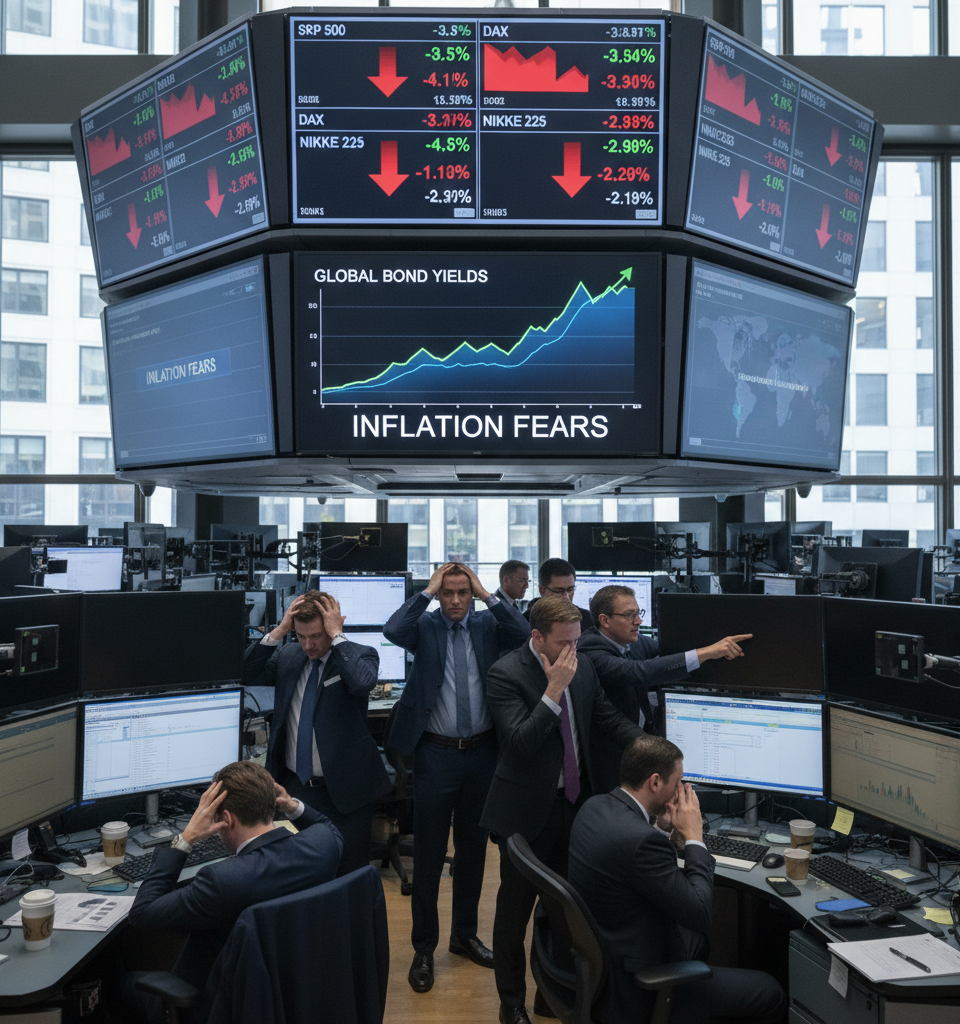
Global equity markets concluded trading sharply lower across the board today, with investors reacting nervously to a pronounced spike in government bond yields. The sell-off, which intensified throughout the afternoon, was primarily fueled by escalating fears that surging inflation could prompt central banks to accelerate their monetary tightening policies. Major indices like the S&P 500, Dow Jones Industrial Average, and Nasdaq Composite all registered substantial declines, reflecting a broad-based retreat from risk assets as the cost of borrowing rises and future corporate earnings face headwinds.
The Catalytic Surge in Bond Yields
The immediate catalyst for today's market downturn was the notable upward movement in benchmark government bond yields. The yield on the 10-year U.S. Treasury note, a key indicator for borrowing costs, climbed by over 10 basis points, reaching its highest level in several months at around 4.65%. Similar spikes were observed in European and Asian bond markets. This upward trajectory in yields signals investors demanding greater compensation for holding debt, a direct consequence of persistent inflation pressures. Recent economic data, including hotter-than-expected consumer price index (CPI) figures released last week, have underscored the challenge policymakers face in taming inflation without stifling economic growth. The prospect of higher interest rates makes future corporate profits less valuable and increases the cost of capital for businesses, dampening investor sentiment.
Broad Market Impact and Key Figures
The repercussions were felt across all sectors. The S&P 500 closed down 1.8%, shedding approximately 90 points, while the Dow Jones Industrial Average fell by over 550 points, or 1.6%. The technology-heavy Nasdaq Composite, particularly sensitive to rising interest rates due to its growth-oriented nature, bore the brunt of the selling, dropping 2.1%. Defensive sectors, typically less volatile, also experienced declines, indicating the widespread nature of the market anxiety. Large-cap technology stocks such as Apple, Microsoft, and Amazon all saw their share prices fall by more than 2%. Small-cap stocks, represented by the Russell 2000 index, also faced significant pressure, declining 2.5%.
Industry and Sectoral Vulnerabilities
Industries with high debt loads or those that rely heavily on consumer discretionary spending are expected to be particularly vulnerable to sustained periods of high interest rates and inflation. Real estate, for instance, could see a slowdown as mortgage rates climb, cooling housing demand. Growth stocks, which derive a significant portion of their valuation from future earnings expectations, tend to underperform in a rising rate environment as discount rates increase. Conversely, sectors like energy and financials, which can sometimes benefit from inflation and higher interest margins, respectively, showed some relative resilience but ultimately succumbed to the broader market sell-off today.
Expert Commentary on the Outlook
Market analysts and economists are offering cautious assessments. "The bond market is sending a clear message that inflation is not as transitory as some had hoped, and the Federal Reserve might have to be more aggressive than currently priced in," commented Dr. Eleanor Vance, Chief Market Strategist at Global Capital Advisors. She added, "This isn't just a technical correction; it's a recalibration of risk given the shifting macroeconomic landscape." Others echoed concerns about potential overtightening by central banks, which could tip economies into recession. "The dance between fighting inflation and avoiding a hard landing is becoming increasingly precarious," noted financial commentator David Chen on a widely watched business network.
The Path Forward: Monitoring Central Bank Signals
Looking ahead, investor focus will remain squarely on upcoming economic data releases, particularly inflation indicators and employment figures, which will guide central bank policy decisions. The next Federal Reserve meeting and the accompanying statement will be scrutinized for any hints regarding the pace and magnitude of future interest rate hikes. Market participants will also closely monitor corporate earnings reports for signs of how businesses are managing rising input costs and evolving consumer demand. Volatility is expected to persist in the near term as markets grapple with the uncertainty surrounding inflation's trajectory and central banks' response, potentially creating both challenges and opportunities for shrewd investors.