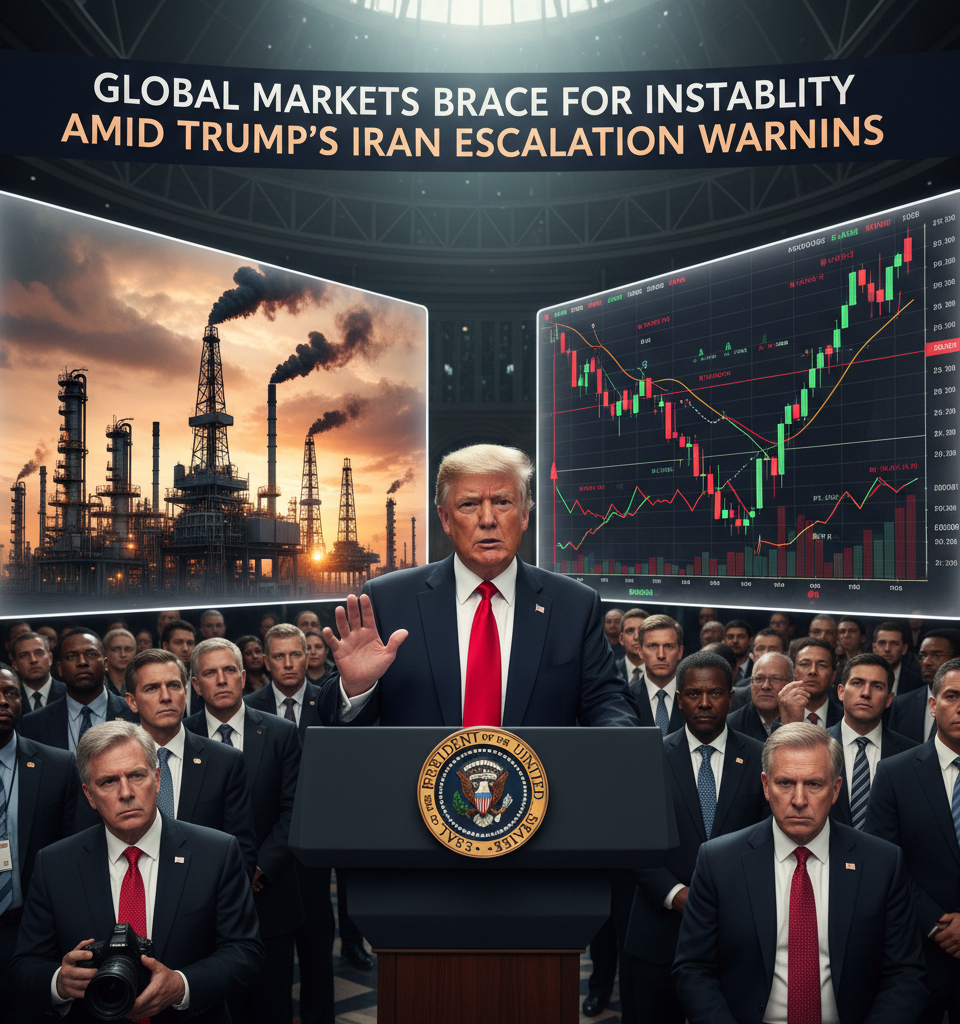
Global financial markets commenced the trading week under a thick cloud of uncertainty this Monday, as investors grappled with the implications of US President Donald Trump's recent statements. The President issued a stark warning, indicating a potential significant escalation in the ongoing conflict with Iran, a development that risks plunging the global economy into a deeper crisis. This pronouncement has immediately sent ripples across equity, bond, and crude oil markets, which are now bracing for the volatile aftermath of a potential energy-price shock that could fundamentally alter the trajectory of the global economic recovery.
This latest escalation threat emerges against a backdrop of already heightened geopolitical tensions in the Middle East, particularly surrounding key oil-producing regions. The rhetoric from the White House marks a critical juncture, raising questions about the stability of the global energy supply chain and the potential for a direct military confrontation. Historically, such geopolitical flashpoints have invariably led to significant market disruptions, with the 1973 oil crisis and the 1990 Gulf War serving as stark reminders of how regional conflicts can have global economic repercussions, particularly through the commodity markets.
The immediate fallout has been palpable. Crude oil futures, specifically Brent and West Texas Intermediate (WTI), saw an immediate uptick in pre-market trading, with Brent crude futures nearing the $85 per barrel mark, a jump of approximately 3% from Friday's close. Analysts anticipate further volatility, with some projecting a potential spike to over $100 per barrel should a full-scale conflagration erupt. Concurrently, safe-haven assets benefited; gold prices surged by nearly 1.5%, while the yield on the 10-year U.S. Treasury bond dipped by 5 basis points as investors sought refuge from perceived risk. Equity markets, conversely, experienced downward pressure, with futures for the S&P 500 and Dow Jones Industrial Average indicating opening losses of around 0.8% and 0.9% respectively, as risk aversion took hold.
The reverberations of this geopolitical tension extend far beyond immediate market movements, threatening to derail the delicate balance of the broader global economic landscape. An exacerbated energy-price shock would directly translate into increased inflationary pressures, impacting consumer spending power and corporate profit margins. Sectors reliant on stable energy costs, such as manufacturing, transportation, and aviation, would face immediate headwinds. Furthermore, central banks, already navigating a complex landscape of sticky inflation and tepid growth, would face increased pressure to either maintain or even accelerate monetary tightening, potentially tipping economies into recession. The International Monetary Fund (IMF) had recently revised its global growth forecasts downwards, citing geopolitical risks as a significant impediment, and this latest development only exacerbates those concerns.
Economists and market analysts are unequivocal in their assessment of the gravity of the situation. "President Trump's latest remarks introduce an unprecedented level of uncertainty into an already fragile global economy," stated Dr. Evelyn Thorne, Chief Economist at Global Financial Insights. "A significant escalation in the Middle East, leading to a sustained energy price shock, could easily shave 0.5% to 1% off global GDP growth within the next 12 months, triggering a domino effect across various industries." Other analysts point to the potential for supply chain disruptions, not just in oil, but also in shipping lanes crucial for global trade, further compounding the economic damage.
Looking ahead, the market will be keenly watching for further statements from the White House and the Iranian government, as well as any diplomatic interventions from international bodies. Key indicators to monitor include crude oil inventories, shipping insurance premiums for vessels traversing the Strait of Hormuz, and the performance of defense sector stocks. The coming days and weeks will be critical in determining whether these threats remain rhetorical or translate into concrete action, with profound implications for global economic stability and market sentiment. Further geopolitical developments in the region, including any actions by proxy groups, will also be under intense scrutiny, as they could serve as early warning signs of escalating tensions.
Ultimately, the path forward remains fraught with peril. Investors are advised to recalibrate their portfolios to account for increased volatility and potential downside risks. The specter of a full-blown energy crisis, coupled with the broader implications of military conflict, ensures that the trading week has opened on a highly precarious note, leaving financial markets navigating uncharted and potentially dangerous waters.