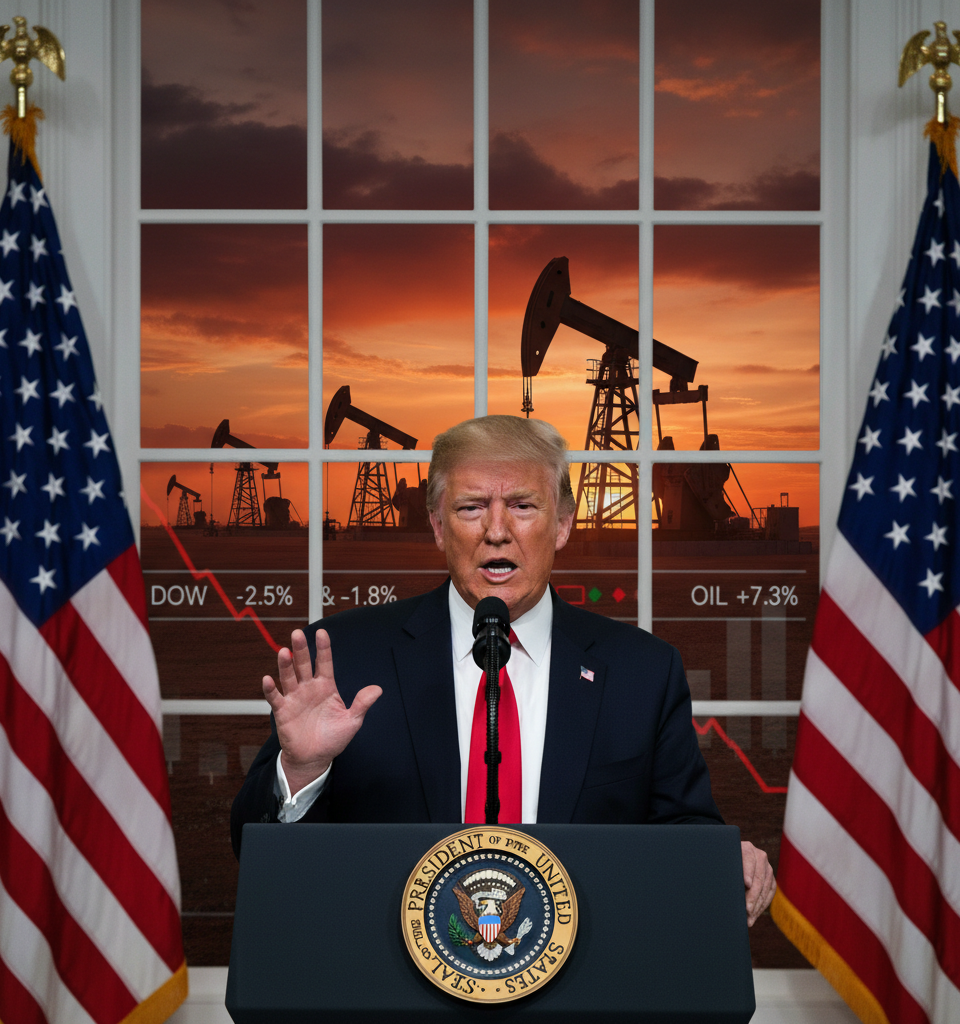
New York, NY – Global financial markets reacted with immediate apprehension today as President Donald Trump's stern warnings to Iran signaled a potential sharp escalation in military hostilities, heightening fears of an energy supply shock. US equity-index futures registered significant declines, while crude oil benchmarks extended their gains, reflecting investor anxiety over geopolitical instability impacting an already tenuous global economic landscape.
Geopolitical Flashpoint Ignites Market Volatility
The current market turmoil is rooted in a fresh wave of threats from President Trump directed at Iran, following recent events in the Persian Gulf. This marks a concerning intensification of tensions that have simmered for months, with the potential for military confrontation now appearing more palpable. The Strait of Hormuz, a critical passageway for a significant portion of the world's oil supply, remains a focal point of these anxieties. Any disruption to this artery would have profound implications for global energy prices and, by extension, the world economy. The specter of an enduring energy crisis looms large, casting a shadow over growth forecasts across major economies still recovering from trade-related uncertainties and slower manufacturing activity.
Market Reponses: Futures Slump, Black Gold Shines
As trading commenced, S&P 500 futures fell by approximately 0.8%, while Dow Jones Industrial Average futures dipped by a similar margin. European bourses followed suit, with the Euro Stoxx 50 index showing declines of over 1%. The most dramatic market reaction was seen in the energy sector; Brent crude oil futures jumped by more than 3%, trading above $70 per barrel, while West Texas Intermediate (WTI) crude also saw a substantial increase, breaching the $65 mark. Gold, a traditional safe-haven asset, also witnessed an uptick, reflecting a flight to safety by risk-averse investors. The yen, another preferred haven currency, strengthened against the dollar amidst the uncertainty.
Broader Economic Repercussions and Sectoral Impacts
Beyond immediate market movements, the implications for the broader economy are substantial. A prolonged period of elevated crude oil prices could act as a significant drag on global economic growth, increasing input costs for businesses and potentially leading to higher inflation. Industries heavily reliant on energy, such as transportation, manufacturing, and chemicals, are expected to bear the brunt of these price surges. Conversely, oil and gas exploration and production companies may see short-term gains, while defense contractors could anticipate increased demand. However, the overall sentiment is one of caution, with many economists warning that an energy shock could easily tip already decelerating economies into recession.
Expert Insights: "A Powder Keg Moment"
Market analysts and geopolitical experts are weighing in on the severity of the situation. "This is a powder keg moment," stated Dr. Eleanor Vance, Chief Economist at Global Macro Advisors. "The market is pricing in a significant risk premium for oil, reflecting the potential for a severe supply disruption. Beyond the direct military implications, the mere uncertainty will dampen investment and consumer confidence globally." John Peterson, a senior energy analyst, added, "We are seeing a clear indication that geopolitics, not just supply-demand fundamentals, are now the dominant force in oil pricing. Traders are anticipating a worst-case scenario." Analysts are revising their growth forecasts downwards for several key economies, including China and Europe, citing the escalating tensions as a primary factor.
The Path Ahead: Diplomacy or Further Escalation?
The immediate future remains highly uncertain. All eyes are on the diplomatic channels and any further statements from the White House or Tehran. The international community is urging de-escalation, but the unpredictable nature of the current geopolitical environment leaves markets vulnerable to rapid shifts. Investors will be closely monitoring oil inventories, shipping routes in the Persian Gulf, and any multilateral efforts to mediate the conflict. Major central banks may also come under pressure to consider monetary policy adjustments if the situation leads to a sustained period of high inflation and slowed growth, further complicating the global economic recovery trajectory. Businesses are advised to review supply chain resilience and energy cost hedging strategies in anticipation of continued volatility.
Data Points:
- S&P 500 futures: ↓ 0.8%
- Dow Jones Industrial Average futures: ↓ 0.7%
- Brent Crude Oil: ↑ 3.2% (trading above $70/barrel)
- West Texas Intermediate (WTI) Crude: ↑ 2.9% (trading above $65/barrel)
- Gold: ↑ 0.5%
- Euro Stoxx 50: ↓ 1.1%