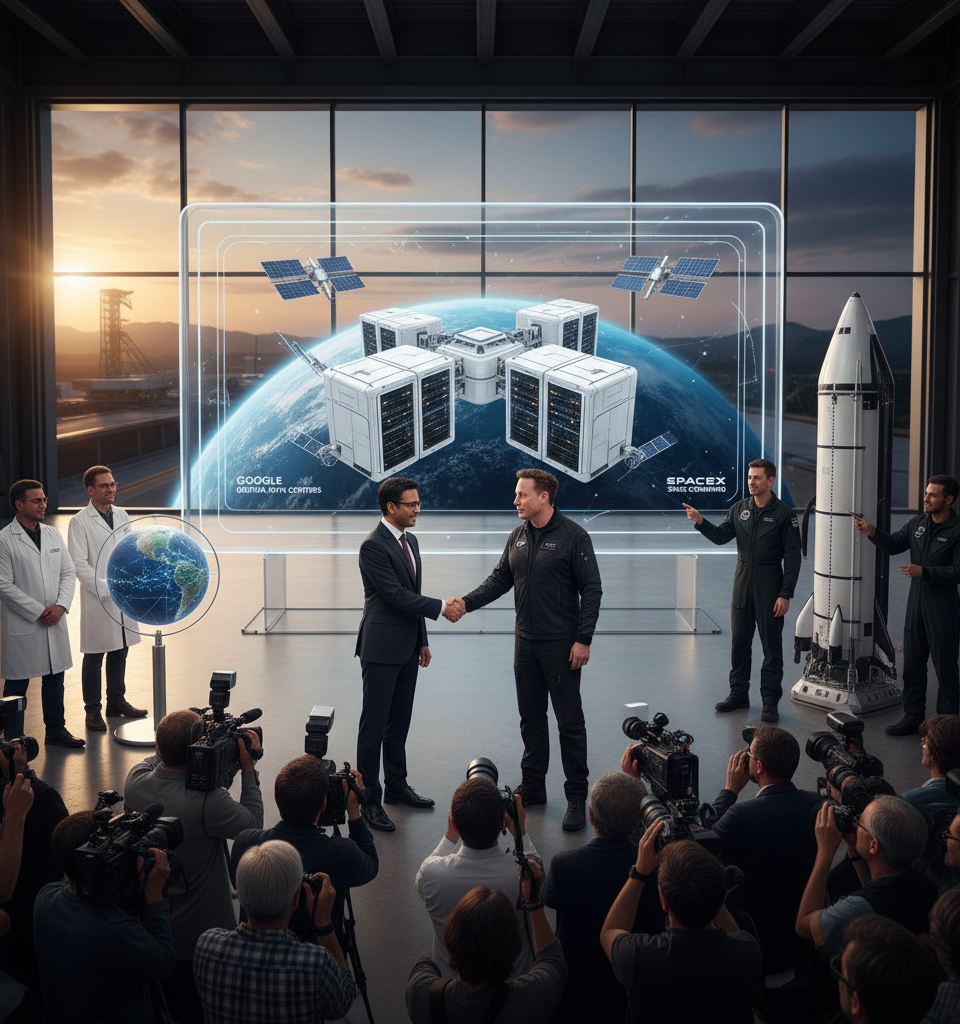
Reports this week suggest that technology titan Google is in advanced discussions with Elon Musk's space exploration company, SpaceX, to explore the feasibility and development of orbital data centers. This potential collaboration marks a pivotal moment in the burgeoning space computing sector, pushing the boundaries of AI infrastructure from terrestrial facilities into low-Earth orbit. The move underscores a growing recognition among tech giants that space-based platforms could offer unique advantages for data processing and AI applications.
The Dawn of Orbital Computing
The notion of data centers floating in space, once relegated to science fiction, is rapidly transitioning into a tangible technological pursuit. This development is not occurring in a vacuum; it follows a series of significant industry indicators. A recent space computing startup, for instance, secured a staggering valuation exceeding $2 billion, demonstrating robust investor confidence in the sector's potential. Furthermore, a major defense contractor recently unveiled plans for a space-based edge computing platform tailored for secure, low-latency processing. These concurrent advancements highlight a collective push by both private enterprises and government entities to leverage the unique environment of space for advanced computational needs.
Key Players and Strategic Implications
While details of the Google-SpaceX discussions remain confidential, their potential partnership carries immense strategic weight. Google's prowess in AI, cloud computing, and data center management, combined with SpaceX's unparalleled capabilities in rocket manufacturing, satellite deployment, and Starlink's global internet constellation, creates a formidable alliance. Orbital data centers could offer several compelling benefits: reduced latency for satellite-based applications, enhanced security through physical isolation, and access to unique environmental conditions like microgravity that could aid in certain scientific computations or materials research. This collaboration could also fast-track the establishment of a robust computational backbone for future lunar and Martian missions, addressing the critical need for local processing power far from Earth.
Market Disruption and Industry Impact
Should Google and SpaceX proceed with this venture, the impact on both the space industry and the broader technology sector would be profound. It would likely catalyze further investment and innovation in space-hardened hardware, advanced power solutions for orbital platforms, and new paradigms for data management in extreme environments. Traditional terrestrial data center operators might face competitive pressure to innovate, particularly for applications requiring ultra-low latency or independent computational grids. The move could also cement Starlink's position as a critical data transport layer, connecting orbital data centers with ground stations and end-users globally, thereby enhancing the value proposition of SpaceX's rapidly expanding satellite internet service.
Expert Perspectives
Industry analysts are keenly watching these developments. Dr. Elena Petrova, a leading aerospace engineering professor at a prominent university, commented, "The Google-SpaceX talks are a logical, albeit audacious, next step in the space economy. The challenges are immense – radiation hardening, thermal management in space, autonomous operations – but the potential rewards, particularly for AI processing at the edge of the solar system, are transformative." Another expert, Mr. Mark Jamison, a partner at a technology consulting firm, noted, "This move suggests a strong belief that the future of compute is not solely Earth-bound. It's about distributed processing, and space offers an ultimate form of distribution with unique advantages for specific high-value workloads. We could see entirely new business models emerge from this frontier."
The Path Forward
The road to fully operational orbital data centers is fraught with technical and financial hurdles. Significant research and development will be required to develop robust, autonomously operating systems capable of withstanding the harsh space environment for extended periods. Regulatory frameworks for space-based computing infrastructure will also need to evolve, addressing issues of data ownership, international law, and cybersecurity. However, the combined engineering might and financial resources of Google and SpaceX suggest that these challenges, while substantial, are not insurmountable. The next few years will likely witness initial prototypes and demonstration missions as this ambitious vision moves closer to becoming a commercial reality, fundamentally reshaping how we perceive and utilize computational power.
Future Implications for Global Connectivity
Beyond immediate computational benefits, orbital data centers could have far-reaching implications for global connectivity and access to advanced AI. By placing powerful computing resources closer to users in remote or underserved areas, they could reduce reliance on terrestrial infrastructure, offering greater resilience in times of disaster or conflict. This distributed processing capability, powered by AI models hosted in orbit, could accelerate scientific discovery, improve disaster response, and foster new services that are currently limited by network latency and geographic boundaries. The partnership, if realized, would not only launch data centers into space but also usher in a new era of global, resilient, and highly distributed AI compute capabilities.