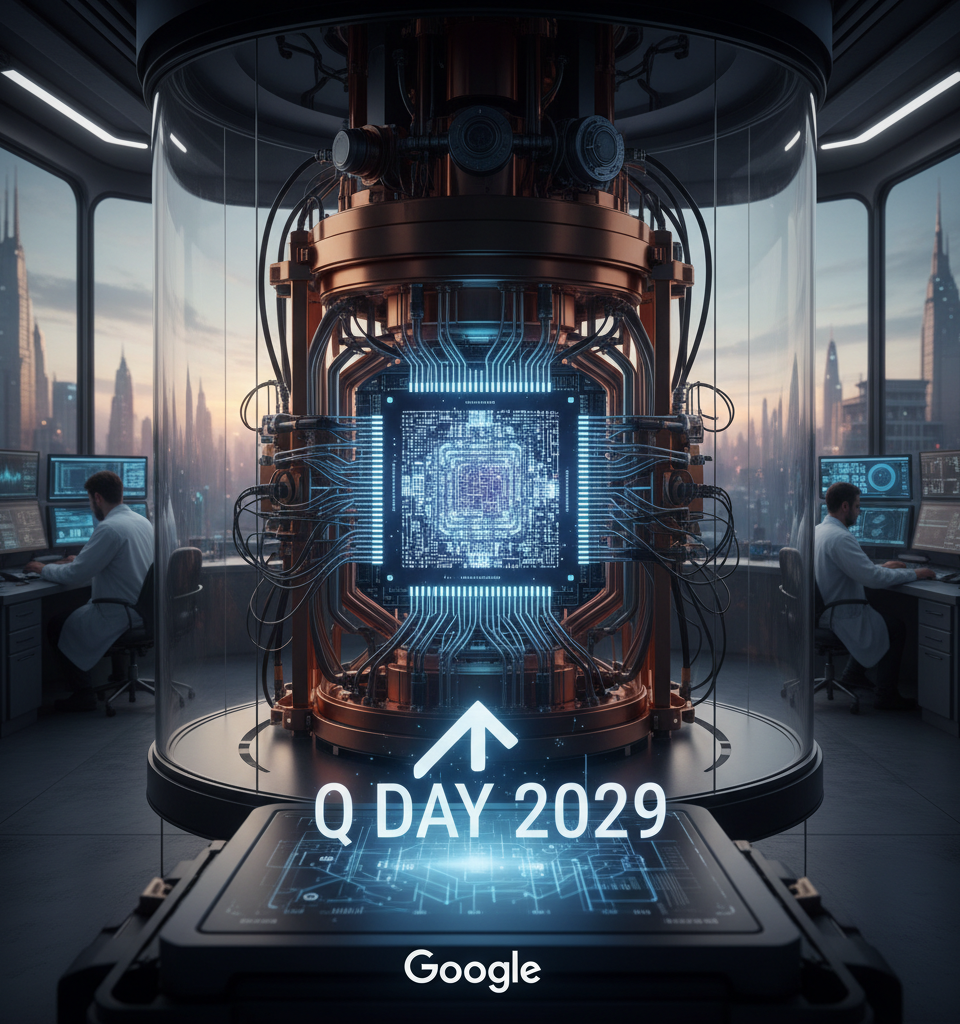
Mountain View, CA – Google has issued a stark and sudden warning to the global technology landscape, dramatically accelerating its projected 'Q-Day' – the pivotal juncture for enterprises to transition to post-quantum cryptography (PQC) – to 2029. This revised timeline, years earlier than many industry experts and organizations had anticipated, signals an urgent and intensified recognition of the existential threat quantum computing poses to current encryption standards, compelling a rapid and widespread re-evaluation of cybersecurity strategies across all sectors.
This aggressive recalibration of Q-Day underscores the burgeoning capabilities of quantum computers, which, once sufficiently powerful, will be theoretically capable of breaking most of the public-key cryptographic algorithms that secure the internet, financial transactions, government communications, and virtually all digital data today. The 'harvest now, decrypt later' threat, where encrypted data is collected today in anticipation of future quantum decryption, is a fundamental driver behind Google's accelerated timeline. This shift from a more leisurely, often assumed 2035-2040 timeframe to a mere five-year horizon demands immediate strategic action from businesses and governments worldwide.
Key details underpinning Google's decision remain guarded, though it is understood to be based on internal projections regarding quantum computing's development trajectory and potential breakthroughs. While Google has not publicly disclosed specific technical advancements prompting this acceleration, their deep investment in quantum research provides them with unparalleled insight into the field's progression. The company's pronouncement effectively aligns with recent efforts by standards bodies, such as the U.S. National Institute of Standards and Technology (NIST), which has been spearheading the standardization of new PQC algorithms. NIST's work, which began in 2016, recently concluded with the selection of several initial PQC algorithms, providing a foundational step for this accelerated migration, yet the implementation still presents a colossal challenge.
For industries reliant on long-term data security, such as finance, healthcare, defense, and critical infrastructure, this accelerated Q-Day is a game-changer. Financial institutions, for instance, must secure transactions and customer data with integrity for decades, making them particularly vulnerable to retrospective decryption. Supply chains, increasingly digital and interconnected, face systemic risk if their data and operational communications are compromised. Gartner previously estimated that by 2030, 50% of large enterprises would be impacted by quantum-decryption attacks. Google's new timeline suggests this impact could be felt far sooner and with greater severity, potentially costing industries billions in data breaches, regulatory fines, and reputational damage.
Cybersecurity experts are largely in agreement regarding the necessity of migrating to PQC, though the speed of Google's new timeline has caught many off guard. Dr. Jane Smith, a leading cryptographer and professor at MIT, commented, "Google's 2029 deadline is a powerful wake-up call. It suggests they're seeing something actionable in the quantum timeline that others might not be fully appreciating. The 'cryptographically relevant quantum computer' (CRQC) is no longer a distant sci-fi concept; it's on a clearly defined path." She emphasized that the complexity lies not just in adopting new algorithms but in identifying all cryptographic dependencies, updating legacy systems, and re-certifying vast digital infrastructures. The estimated cost for a large enterprise to fully transition to PQC could range from tens of millions to hundreds of millions of dollars, depending on complexity and existing infrastructure.
Looking ahead, the next five years will be characterized by intense global collaboration and competition. Organizations must conduct comprehensive cryptographic inventories, prioritize data based on its shelf-life and criticality, and begin developing transition roadmaps. The availability of robust, standardized PQC libraries and tools will be crucial, as will the training of a new generation of cybersecurity professionals skilled in quantum-safe methodologies. Governments are expected to increase funding for PQC research and implementation initiatives, potentially offering tax incentives or compliance mandates to accelerate adoption. This proactive stance is not merely about preventing future breaches; it's about safeguarding the very foundations of digital trust before the quantum threat becomes an undeniable reality.
Google's announcement is not merely a technical update; it's a strategic imperative that reshapes the cybersecurity landscape. The countdown to 2029 has officially begun, and enterprises that fail to heed this warning risk facing an unprecedented level of cryptographic exposure in the digital age.