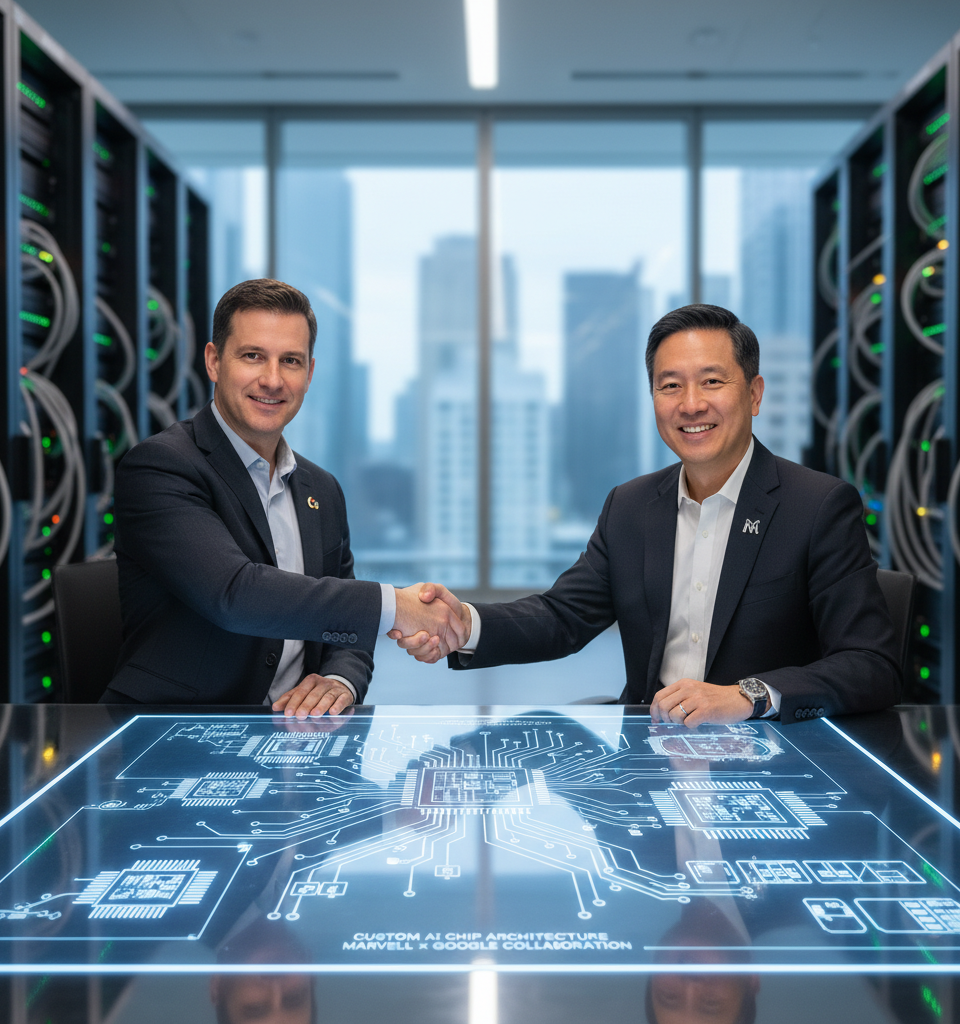
Google Explores Marvell Partnership for Custom AI Chips, Diversifying Beyond Broadcom
Alina Maria Stan•April 19, 2026•5 min read
Key Takeaways
Read this first — then go as deep as you need.
Google Targets Marvell for Custom AI Chips, Deepening Diversification Effort Google is reportedly engaged in substantive discussions with Marvell Technology to co-develop two critical artificial intelligence (AI) chips: a dedicated memory processing unit and an enhanced AI inference-optimized Tensor Processing Unit (TPU). This potential partnership marks a significant strategic maneuver by the tech behemoth to further diversify its custom silicon supply chain, adding Marvell as a third key design partner alongside existing collaborators Broadcom and MediaTek. The talks, though not yet culminating in a signed contract, surface just days after Broadcom reportedly secured an extended supply agreement with Google, highlighting the dynamic and competitive landscape of AI hardware development. This initiative comes at a pivotal time for Google, as the company grapples with the immense computational demands of its rapidly expanding AI portfolio, including advanced models like Gemini. Historically, Google has invested heavily in custom silicon, exemplified by its internally designed TPUs, to gain a competitive edge in AI inference and training workloads within its expansive data centers. The reported outreach to Marvell underscores a strategic imperative to de-risk its supply chain, mitigate dependency on any single vendor, and potentially accelerate the technological evolution of its AI infrastructure in an increasingly complex geopolitical and industrial environment. Sources familiar with the discussions indicate that the proposed memory processing unit (MPU) for potential development with Marvell would be distinct from traditional memory, focusing on optimizing memory access and processing specifically for AI tasks. The inference-optimized TPU would aim to significantly enhance Google's capabilities in deploying AI models at scale, enabling faster and more efficient responses across its vast array of services, from search and cloud computing to advanced generative AI applications. While specific financial terms or development timelines have not been disclosed, industry analysts anticipate that such a partnership would involve substantial investment from Google and signify a long-term commitment to Marvell's expertise in specialized silicon. The broader industry impact of such a collaboration could be profound. It signals a growing trend among hyperscale cloud providers to move beyond general-purpose CPUs and GPUs, leveraging custom silicon to achieve unparalleled performance and energy efficiency for AI workloads. This diversification by Google puts further pressure on established chipmakers like NVIDIA, while simultaneously opening new avenues for specialized designers such as Marvell to command significant market share in niche, high-value segments of the AI hardware ecosystem. The move could also inspire other tech giants to recalibrate their own custom chip strategies, potentially leading to a more fragmented yet highly innovative chip design landscape. Analysts view this potential partnership as a shrewd move by Google to bolster its competitive position in the fiercely contested AI arena. "Google's engagement with Marvell illustrates a clear intent to broaden its strategic options and secure tailored silicon solutions for its burgeoning AI needs," commented a senior semiconductor analyst at a leading financial institution. "By adding Marvell, Google gains access to specialized IP and engineering talent, which could lead to bespoke chip architectures that offer superior performance-per-watt ratios compared to off-the-shelf alternatives. This also acts as a negotiating lever with existing partners like Broadcom." Such diversification is crucial for mitigating supply chain risks, particularly in light of ongoing global semiconductor shortages and geopolitical tensions affecting chip manufacturing. Looking ahead, if the discussions materialize into a formal agreement, it could usher in a new era of accelerated AI innovation for Google. The development of highly specialized MPs and inference TPUs would allow the company to fine-tune its hardware for optimal neural network performance, potentially translating into faster model deployment, reduced operational costs, and a significant boost to its Google Cloud Platform offerings. The market will be closely watching for Google's official announcement and any accompanying details regarding development timelines and expected performance benchmarks, which could further delineate the tech giant's aggressive AI hardware roadmap. This ongoing pursuit of custom silicon excellence is poised to redefine the future of AI infrastructure. Furthermore, this development highlights the critical importance of intellectual property (IP) and advanced packaging technologies in the modern semiconductor industry. Marvell, known for its expertise in networking, storage, and custom ASIC solutions, brings a wealth of specialized knowledge that could be instrumental in designing a memory processing unit that efficiently handles the massive data flows inherent in large AI models. The success of these custom chips could significantly impact Google's ability to maintain its leadership in generative AI and expand its market share against competitors like Microsoft and Amazon, who are also heavily investing in their own proprietary AI hardware solutions. The strategic rationale extends beyond mere performance. By collaborating with multiple partners, Google builds redundancy into its supply chain, a critical lesson learned from recent global disruptions. This multi-vendor approach safeguards against potential manufacturing bottlenecks, intellectual property disputes, or geopolitical pressures that could impact any single supplier. The pursuit of highly optimized, custom silicon also reflects Google's long-term vision of owning the entire AI stack, from foundational research and software development down to the very silicon that powers its innovative applications. This holistic approach is increasingly becoming the gold standard for tech titans vying for supremacy in the AI era. The financial implications are substantial. Developing custom semiconductors is an incredibly capital-intensive endeavor, often costing hundreds of millions to billions of dollars in R&D, design tools, and prototyping. Google's willingness to make such investments underscores its conviction that proprietary silicon will be a key differentiator in the AI race. Should the Marvell collaboration prove successful, it would not only strengthen Google's in-house capabilities but also potentially reduce its long-term operational expenses by lowering reliance on high-margin off-the-shelf components. This strategic pivot signals Google's unwavering commitment to solidifying its future as an AI-first company.
Discussion
Join the discussion
Sign in to leave a comment on this article.
Loading comments...
Enjoying this article?
Get more like it delivered to your inbox — free.
This article was compiled by GlobalSell News from publicly available reporting and has been edited for clarity and length. For full details, read the original source.