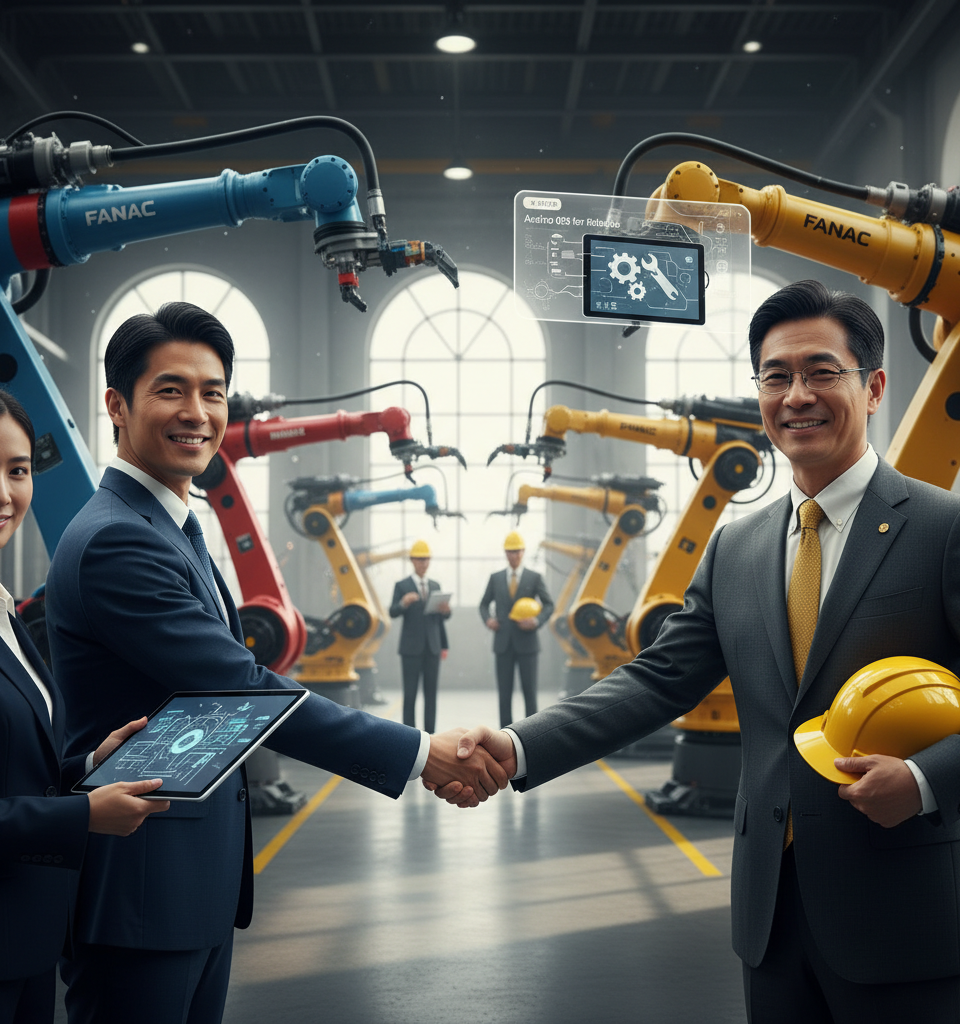
In a strategic move poised to redefine the industrial automation landscape, technology giant Google and leading robotics manufacturer Fanuc have officially unveiled a groundbreaking partnership. The collaboration, announced recently, will see Fanuc integrate Google Cloud’s advanced Gemini Enterprise AI and Google's Intrinsic robotics platform directly into its extensive lineup of industrial robot systems. This synergy is designed to infuse Fanuc's vast installed base of 1.1 million robots worldwide with enhanced software capabilities, mirroring the transformative impact Android had on the mobile phone industry.
Context and Strategic Alignment
This alliance marks a significant convergence of hardware manufacturing prowess and cutting-edge software innovation. Fanuc, a Japanese behemoth, commands approximately 25% of the global industrial robot market share, producing more robots than any other company. Google, on the other hand, is a software and AI powerhouse, renowned for developing pervasive platforms. The strategic rationale for both companies is clear: Fanuc seeks to future-proof its offerings in an increasingly data-driven manufacturing environment, while Google aims to deepen its penetration into the lucrative industrial sector, extending its platform dominance beyond consumer devices and enterprise cloud services. The move signals a shift from rigid, proprietary robot programming to a more open, AI-driven, and adaptable software-defined approach.
Key Details and Technological Integration
Under the terms of the agreement, Fanuc will embed Google Cloud's Gemini Enterprise, a powerful AI model, to enable more intuitive programming, predictive maintenance, and higher levels of autonomy for its robots. Concurrently, Google's Intrinsic platform, a specialized operating system for industrial robotics, will provide a unified software layer, simplifying development and deployment. Intrinsic, which Google acquired in 2021, focuses on machine learning and advanced sensing to make robots easier to program and more adaptable to new tasks. This integration is expected to allow Fanuc robots to learn new tasks faster, adapt to variations on the production line, and optimize workflows with greater efficiency, potentially reducing programming time by up to 50% for complex tasks.
Industry and Market Impact
This partnership sends immediate ripples across the industrial automation and manufacturing sectors. Competitors like ABB, Kuka, and Yaskawa will undoubtedly feel pressure to enhance their software capabilities or seek similar alliances. The ability for millions of Fanuc robots to access sophisticated AI and a more flexible development environment could accelerate the adoption of automation in small and medium-sized enterprises (SMEs) that have traditionally found robotics deployment too complex or costly. Analysts predict a surge in demand for AI-enabled industrial robots, potentially boosting the global industrial robotics market, which was valued at over an estimated $50 billion in 2023, by an additional 10-15% over the next five years due to increased accessibility and utility.
Expert Perspectives on the Partnership
Industry analysts have largely hailed the collaboration as a game-changer. "This is not just about connecting robots; it's about fundamentally changing how manufacturers interact with their automation," commented Dr. Lena Schmidt, a robotics expert at the Fraunhofer Institute. "By providing a common software backbone, akin to Android for smartphones, Google and Fanuc are democratizing advanced robotics. Factories will gain unprecedented agility, reducing time-to-market for new products and unlocking new levels of efficiency." Others emphasize the data aspect, noting that the sheer volume of operational data flowing into Google Cloud will provide invaluable insights for further AI development and application optimization in manufacturing.
Future Implications and Developments
Looking ahead, the partnership is expected to evolve, with future iterations potentially extending to edge computing solutions for real-time robotic control and enhanced cybersecurity protocols for interconnected factory systems. The success of this collaboration could also pave the way for other hardware manufacturers to adopt Intrinsic and Gemini Enterprise, effectively creating a standardized, AI-powered ecosystem for industrial automation. Developers and integrators are anticipated to flock to the Intrinsic platform, fostering a vibrant third-party application market for factory robots, much like the app economy for smartphones. This long-term vision aims to make factory automation more accessible, intelligent, and scalable for businesses worldwide, fundamentally altering global manufacturing processes and supply chains.
Early deployments are expected within the next 12-18 months, with Fanuc customers likely seeing initial benefits in areas such as quality inspection, assembly, and materials handling. The ultimate goal is a fully adaptive factory environment where robots can seamlessly reconfigure and learn, driving the next wave of industrial productivity. While challenges remain in integrating complex systems and ensuring data privacy, the potential rewards for global manufacturing are substantial.