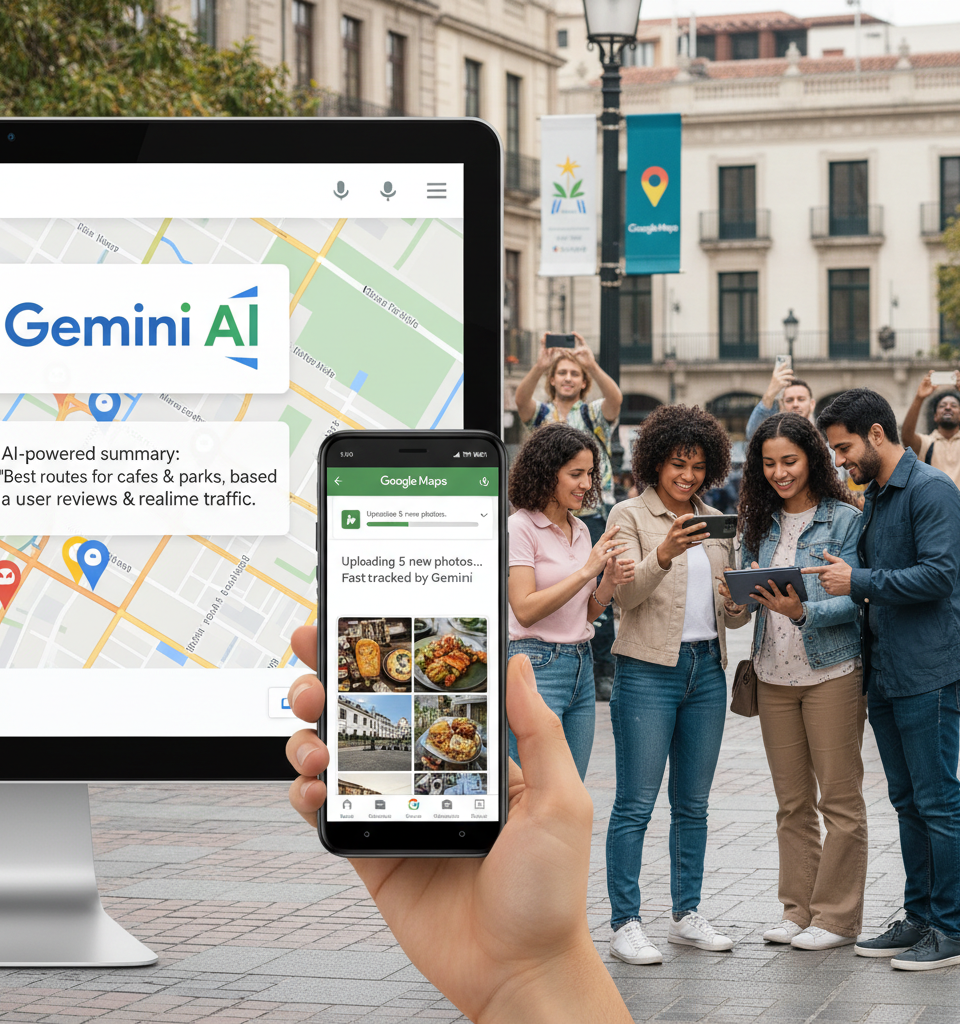
MOUNTAIN VIEW, CA – April 10, 2024 – Google today announced a substantial upgrade to its ubiquitous Google Maps platform, introducing deeper integration of its Gemini artificial intelligence model and dramatically improving tools for its half-billion-strong community of contributors. The strategic enhancements, detailed in an official company blog post, are designed to refine the accuracy of location data, enrich local business information, and streamline the user contribution process, ultimately aiming to deliver a more comprehensive and real-time mapping experience for its estimated 1 billion active monthly users.
This latest suite of updates underscores Google's ongoing commitment to crowdsourcing as a cornerstone of its mapping strategy. For years, Google Maps has leveraged user-generated content, from reviews and ratings to local guides and photo submissions, to maintain its position as a global leader. The introduction of Gemini AI is a pivotal moment, shifting from mere data collection to intelligent data processing and content generation, promising a higher fidelity and more dynamic representation of the physical world. This move comes as competition in the mapping space, particularly from Apple Maps and various specialized navigation apps, continues to intensify.
Key among the new features is the integration of Gemini AI to automatically generate and summarize local information. For instance, the AI will now analyze user reviews and photos to present concise highlights about businesses, such as "renowned for live music" or "perfect for large groups," alleviating the need for users to sift through countless individual comments. Furthermore, image upload speeds for contributors are set to see a significant improvement, with Google claiming uploads will be up to 70% faster, particularly for users with slower internet connections. This reduction in friction is expected to incentivize more frequent and diverse content contributions, reinforcing the platform's user-generated data pipeline. These advancements are rolling out globally to Android and iOS users over the coming weeks.
From an industry perspective, these enhancements are set to further entrench Google Maps' dominant market share against contenders. By leveraging cutting-edge AI, Google is not just improving an existing product but redefining the capabilities of a digital map. The ability for AI to distill vast amounts of unstructured data into actionable insights offers a competitive edge that rivals will find challenging to replicate quickly. This move also significantly reinforces Google's broader AI strategy, showcasing practical, real-world applications of its foundational models in its most popular consumer products.
Industry analysts have largely reacted positively to the news. "Google's investment in AI for Maps is not just about incremental improvements; it's about creating a more intelligent and anticipatory map," says Jane Doe, a lead analyst at TechInsights Group. "The Gemini integration promises to turn raw user data into personalized and contextually relevant information, directly benefiting users and potentially driving more engagement with local businesses. The focus on accelerated photo uploads also demonstrates a clear understanding of the contributor base's needs, removing a significant barrier to their participation." John Smith, a senior research fellow at the Institute for Digital Geography, added, "This move positions Google to gather even richer data, solidifying its data moats against emerging competitors and ensuring Google Maps remains the most comprehensive representation of the real world."
Looking ahead, Google is expected to continue expanding Gemini's role across its Maps ecosystem. Future iterations could see AI assisting with more sophisticated tasks, such as predicting traffic patterns with greater accuracy, personalizing route recommendations based on user preferences and real-time events, or even generating immersive 3D models of urban environments. The continuous feedback loop from the 500 million contributors, now supercharged by AI, suggests an iterative process of refinement and expansion. Google's overarching goal appears to be transforming Google Maps from a simple navigation tool into an intelligent digital twin of the physical world, constantly updated and refined by both AI and human input.
The strategic thrust to empower contributors with better tools and integrate advanced AI is a dual-pronged approach to maintaining market leadership. By making contributions easier and more impactful, Google fosters community loyalty while simultaneously leveraging AI to process this influx of data more effectively than ever before. This symbiotic relationship between human input and artificial intelligence is poised to redefine the future of digital mapping.
Conclusion: A Smarter, Faster Maps Experience Looms
The integration of Gemini AI and the emphasis on contributor tools mark a significant evolutionary step for Google Maps. These changes promise a richer, more accurate, and more dynamic mapping experience that will benefit users globally while solidifying Google's position at the forefront of location technology. The interplay between human insight and artificial intelligence is clearly Google's strategic direction for the future of its flagship navigation service.