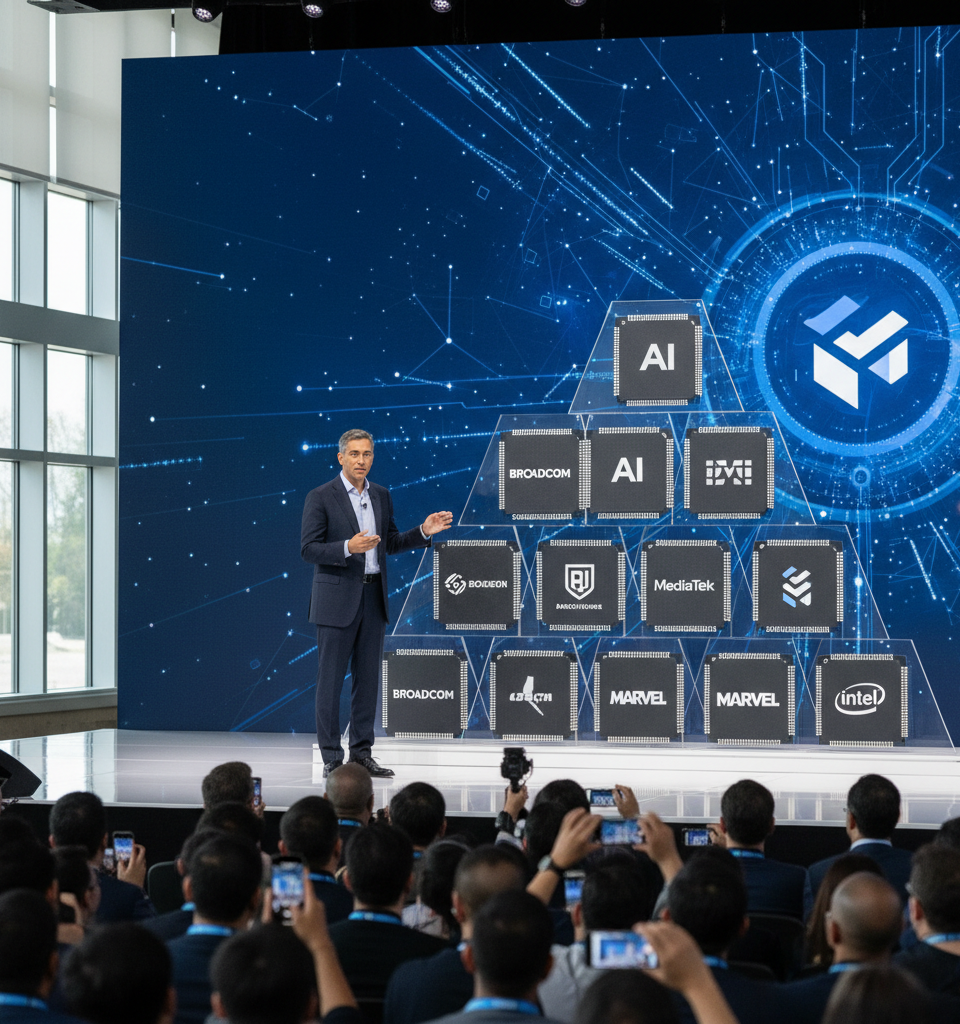
Google's Ambitious Custom AI Chip Strategy: Diversifying Supply Chain to Challenge Nvidia
Ana Maria Constantin•April 20, 2026•5 min read
Key Takeaways
Read this first — then go as deep as you need.
Google's Multi-Partner Custom Chip Initiative Targets AI Dominance Mountain View, CA – Google is proactively constructing what is arguably the artificial intelligence (AI) industry's most diversified custom chip supply chain, enlisting four prominent design partners – Broadcom, MediaTek, Marvell, and Intel – to power its burgeoning AI inference operations. This expansive strategy, a clear intent to diminish reliance on a single vendor and directly compete with market leader Nvidia, was detailed ahead of the Google Cloud Next conference. The ambitious roadmap extends from the currently shipping Ironwood Tensor Processing Unit (TPU), deployed in millions, to forthcoming TPU v8 chips anticipated at TSMC's cutting-edge 2nm fabrication process by late 2027. This strategic pivot underscores Google's commitment to optimizing its AI infrastructure for both cost-efficiency and performance, critical factors in the hyper-competitive cloud and AI development spheres. Historically, Google has been at the forefront of custom silicon for AI, pioneering the TPU since 2016. However, the sheer scale and complexity of current AI models, particularly in inference workloads for services like Search, Gmail, and Google Assistant, necessitate a more robust and resilient supply chain than a single-source approach can provide. The move addresses long-standing concerns about chip availability, supply chain disruptions, and the escalating costs associated with specialized AI hardware from dominant players like Nvidia. The core of Google's new strategy involves a split development approach for its next-generation custom silicon. While specific financial terms of these partnerships have not been disclosed, the involvement of industry behemoths like Broadcom, MediaTek, Marvell, and Intel signifies investments likely in the hundreds of millions, if not billions, of dollars across research, development, and manufacturing. The Ironwood TPU, already in mass deployment, represents a significant milestone in this journey, demonstrating Google's capability to integrate and scale custom silicon effectively. The subsequent TPU v8, projected for a 2027 release and leveraging TSMC's most advanced 2nm node, highlights Google's long-term vision and willingness to embrace bleeding-edge manufacturing technologies to maintain a performance edge. This aggressive diversification poses a direct, long-tail challenge to Nvidia, which currently commands an estimated 80% or more of the AI chip market, particularly in data center graphics processing units (GPUs) essential for both training and inference. By cultivating multiple distinct design paths and manufacturing partners, Google aims to reduce procurement risks, foster competitive innovation among its partners, and ultimately drive down the per-unit cost of its AI inference hardware. This could set a precedent for other hyperscalers and major AI developers to evaluate similar multi-vendor strategies, potentially fragmenting a market currently dominated by a few key players. Industry analysts view Google's move as a pragmatic and necessary evolution in the AI hardware race. "Google is strategically de-risking its future AI ambitions by avoiding over-reliance on any single chip manufacturer," stated Dr. Anya Sharma, a lead analyst at TechInsights. "This multi-partner approach not only ensures supply chain resilience but also creates an internal competitive environment among its silicon partners, potentially accelerating innovation and curbing costs. It's a clear signal that Google intends to control its own destiny in AI, rather than being beholden to external roadmaps and pricing." She also noted that this strategy could put significant pressure on Nvidia's inference market share in the coming years, particularly within Google's vast ecosystem. Looking ahead, Google's bespoke chip initiative is expected to fuel a new wave of innovation in AI model development and deployment. The tightly integrated hardware-software stack, a hallmark of Google's TPU strategy, will likely see further optimization, leading to more efficient AI services and potentially entirely new capabilities for Google Cloud customers. The successful execution of the TPU v8 at TSMC's 2nm process will be a critical benchmark, demonstrating not only Google's design prowess but also the robustness of its diversified supply chain. Further announcements regarding the specific applications and performance metrics of these next-generation TPUs are anticipated at upcoming industry events, shaping the future of efficient, scalable AI. Moreover, this proactive stance on custom silicon could inspire other major tech firms, particularly those with significant AI workloads, to accelerate their own internal chip development programs. The move signifies a broader trend towards vertical integration in the technology sector, as companies seek greater control over their core enabling technologies. The implications extend beyond just AI inference, potentially influencing chip development for edge computing, specialized networking, and other areas where custom silicon can offer a decisive competitive advantage in terms of performance per watt and overall cost. Google's decision to embrace a four-partner custom chip supply chain marks a watershed moment in the AI hardware landscape. It’s a testament to the company's long-term vision, its commitment to innovation, and its determination to secure a leading position in the increasingly competitive world of artificial intelligence. The path ahead, while complex, promises to yield significant advancements and potentially redraw the competitive lines in the battle for AI supremacy. This bold strategy is a direct reflection of the escalating importance of AI to Google's core business and future growth. By taking greater control over the foundational hardware, Google aims to ensure its AI services remain at the cutting edge, offering unparalleled performance and efficiency to its vast global user base and cloud enterprise clients. The coming years will reveal the full impact of this ambitious undertaking on the broader AI technology ecosystem.
Discussion
Join the discussion
Sign in to leave a comment on this article.
Loading comments...
Enjoying this article?
Get more like it delivered to your inbox — free.
This article was compiled by GlobalSell News from publicly available reporting and has been edited for clarity and length. For full details, read the original source.