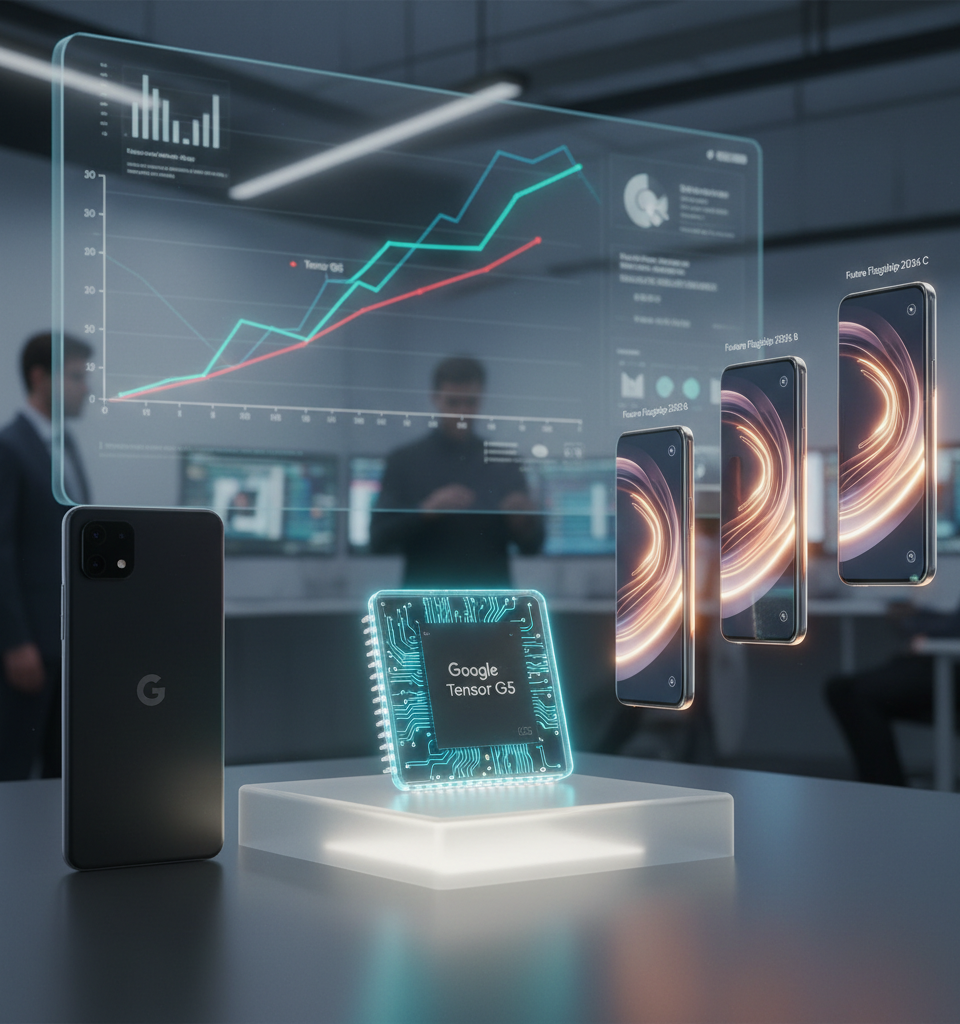
Google's semiconductor division is reportedly making strides with its forthcoming Tensor G5 chip, expected to power the Pixel 9 series later this year. While initial benchmarks suggest respectable, albeit incremental, performance improvements, an emerging consensus among industry analysts indicates a more concerning trajectory for 2026 flagships, particularly the Pixel 10. The "good enough" performance of the G5 is increasingly viewed as a temporary reprieve, with a significant performance deficit projected to widen considerably against leading competitors, thereby challenging the Pixel's position in the fiercely contested premium smartphone market.
The implications of this widening performance gap are substantial for Google. Since the introduction of the Tensor chip with the Pixel 6, Google has touted its custom Silicon as a differentiator, enabling unique AI capabilities and optimizing the Android experience. However, the core CPU and GPU performance has consistently trailed behind offerings from Qualcomm (Snapdragon) and Apple (A-series). This persistent lag is not merely a benchmark curiosity; it directly impacts user experience, particularly as applications become more demanding, and on-device AI processing becomes central to flagship features. The current situation echoes past struggles where Google's hardware was often perceived as trailing competitors in terms of raw power, relying instead on software prowess.
Key details from recent leaks and industry reports paint a sobering picture. The Tensor G5, codenamed "Laguna," is rumored to be manufactured on TSMC's 3nm process, a significant technological jump from the 4nm process used for the Tensor G3 and G4. This shift is expected to yield improved power efficiency and moderate performance gains, potentially in the range of 15-20% for CPU and 20-30% for GPU over its predecessor. However, projections for 2026 suggest that Qualcomm's Snapdragon 8 Gen 6 and Apple's A19 Bionic, also expected to leverage advanced 2nm or even 1.8nm processes, could be operating on an entirely different level. Some estimates predict a performance differential where the 2026 Pixel, powered by the then-current Tensor chip, might be 30-40% less powerful in raw computing tasks compared to its rivals, a chasm that could significantly hamper its appeal.
This trend directly impacts the broader smartphone market. As Google positions the Pixel as its vision for Android's future, a performance bottleneck could deter power users and tech enthusiasts. While the Pixel line currently holds a modest single-digit percentage of the global smartphone market, its influence on Android's ecosystem is disproportionately large. A flagging Pixel flagship could undermine Google's efforts to drive innovation and set benchmarks for the Android platform, potentially forcing other Android OEMs to further differentiate themselves through hardware specifications, including faster processors. This could also fuel the narrative that Android, even on its "purest" form, struggles to match the integrated hardware-software synergy of Apple's ecosystem.
Technophile Insights, a leading market research firm, recently published an analysis highlighting the potential challenges. Dr. Evelyn Reed, lead analyst at Technophile, stated, "While Google’s focus on AI and software optimization is commendable, there's a foundational level of raw performance required for a true flagship experience. If the Tensor G5 is merely 'good enough' for 2024, it will be demonstrably insufficient for the demands of 2026. This isn't just about benchmarks; it's about real-world user experience, from complex gaming to advanced on-device generative AI workloads that are just beginning to emerge." She further emphasized the long-term impact on Google's brand perception in the competitive hardware space.
Looking ahead, Google faces critical decisions regarding its chip strategy. Potential solutions include more aggressive investment in chip design to accelerate performance gains, or a re-evaluation of its market positioning, perhaps focusing more intensely on niche segments where its software strengths can uniquely shine, even with a performance delta. The Pixel 10 generation in 2026 will serve as a crucial litmus test. Success will depend not just on the raw power of the Tensor chip, but on Google's ability to convincingly mask any performance gaps through software optimizations and by offering compelling, exclusive AI features that genuinely justify a premium price point, despite potentially trailing hardware. The coming years will reveal if Google's "good enough" strategy can truly withstand the relentless pace of innovation from its competitors.