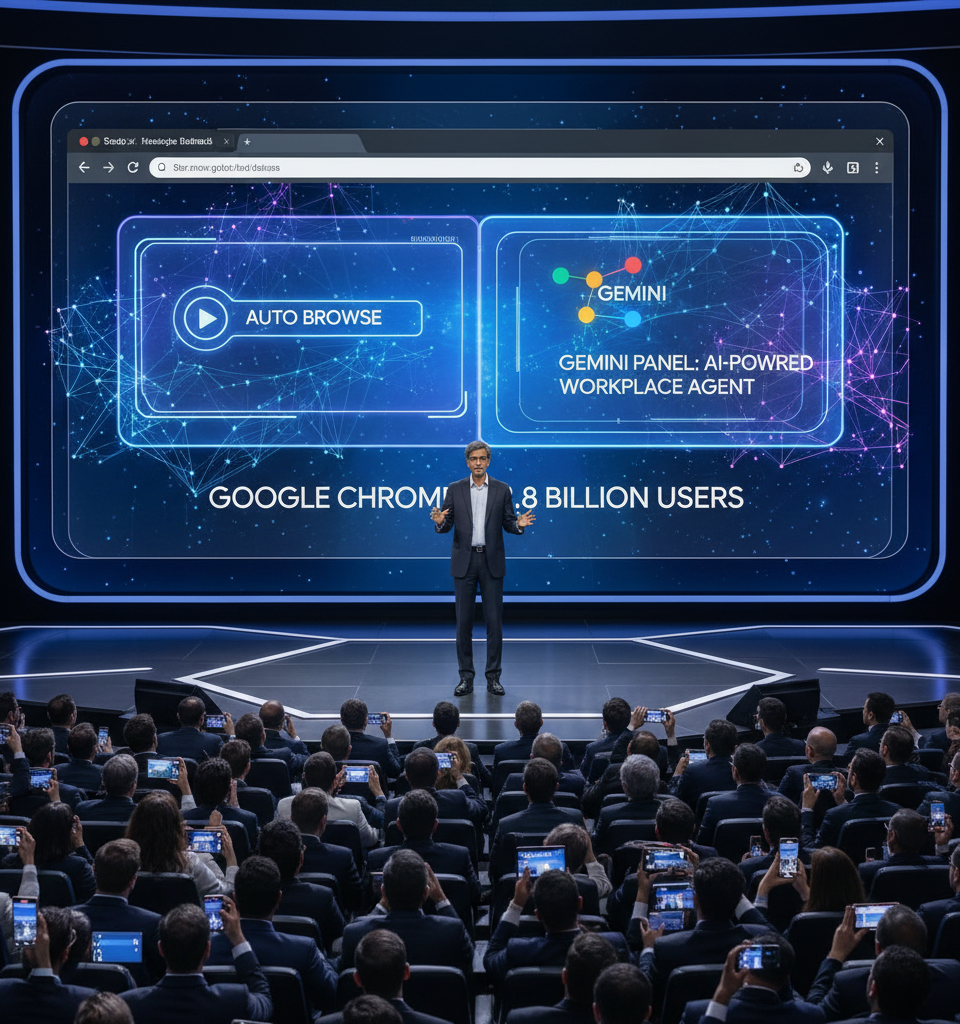
Shifting Paradigms: Chrome as an AI Workplace Hub
This evolution represents a significant paradigm shift from Chrome as merely a web browser to a sophisticated AI-driven productivity hub. Google's vision addresses the growing demand for intelligent automation and personalized assistance within dynamic enterprise environments. By embedding agentic AI capabilities directly into the browser, Google seeks to streamline complex workflows, mitigate data security risks, and enhance overall operational efficiency for businesses. This move is particularly relevant in an era where digital transformation and hybrid work models necessitate more intelligent and adaptable software solutions.
Core Innovations: Auto Browse, Chrome Skills, and Gemini Integration
The cornerstone of this initiative includes several groundbreaking features. Auto Browse will enable autonomous multi-step task completion, allowing the browser to execute routine or complex processes without constant human intervention. Complementing this, Chrome Skills introduces the ability to save and reuse AI workflows, empowering users to automate repetitive tasks and share best practices across teams. A persistent Gemini side panel, deeply integrated with Google Workspace, will offer real-time AI assistance, contextual information, and intelligent recommendations directly within the user's workflow. Furthermore, the integration of on-device AI APIs via Gemini Nano ensures enhanced privacy and reduced latency for certain AI operations. For enterprise clients, the introduction of Chrome Enterprise Premium at $6 per user per month significantly bolsters security and governance. This premium tier offers real-time Data Loss Prevention (DLP), intelligent data masking, and robust AI governance tools, addressing critical concerns for data-sensitive organizations.
Impact on the Enterprise Software Landscape
The implications of Google's announcement for the enterprise software market are profound. By embedding sophisticated AI directly into a ubiquitous browser, Google challenges traditional enterprise resource planning (ERP) and customer relationship management (CRM) systems, positioning Chrome as a primary interface for a wide array of business functions. This could lead to increased competition within the AI-powered productivity tools sector, potentially forcing rivals like Microsoft (with its Copilot integrations) and other SaaS providers to accelerate their own AI development and browser integration strategies. Analysts predict this move could solidify Chrome's dominance in the enterprise browser market, driving increased adoption of Google Workspace and Cloud services.
Expert Analysis: A Strategic Power Play
Industry analysts view this as a strategic power play by Google to leverage its massive Chrome user base and its leading position in AI research. "Google is effectively turning the browser into an operating system for AI agents," states Dr. Anya Sharma, a principal analyst at Tech Insights Group. "The integration of these features, especially the enterprise-grade DLP and AI governance, positions Chrome as a central platform for managing both productivity and compliance in the AI era. The $6 monthly fee for Chrome Enterprise Premium appears competitive, offering significant value for enhanced security and advanced AI capabilities." There is also anticipation of how this will influence the broader ecosystem of developers, as the new APIs could foster a rich environment for third-party AI-powered extensions and services.
The Road Ahead: Future Developments and Market Adoption
Looking ahead, Google is expected to roll out these features incrementally, beginning with controlled pilots for select enterprise clients. Future developments are likely to include deeper integrations with third-party business applications and further enhancements to the AI's contextual understanding and autonomous capabilities. The success of this initiative will hinge on seamless user experience, robust AI performance, and, crucially, Google's ability to assuage enterprise concerns regarding data privacy and security. Market adoption will also depend on the perceived return on investment for businesses, balancing the $6 per user per month cost against the promised gains in efficiency and reduced operational overhead. The 3.8 billion potential users represent a monumental opportunity for Google to redefine digital work.
Data Privacy and Security Considerations
The rollout of such pervasive AI capabilities naturally raises questions concerning data privacy and security, especially within corporate environments. Google has preemptively addressed these by highlighting the advanced security features of Chrome Enterprise Premium. The real-time DLP and data masking functionalities are designed to prevent sensitive information from leaving the corporate perimeter or being mishandled by AI agents. Furthermore, the commitment to on-device AI with Gemini Nano indicates an effort to process sensitive data locally where possible, reducing reliance on cloud-based processing for certain tasks. However, ongoing transparent communication and auditable compliance frameworks will be critical for gaining and maintaining enterprise trust.