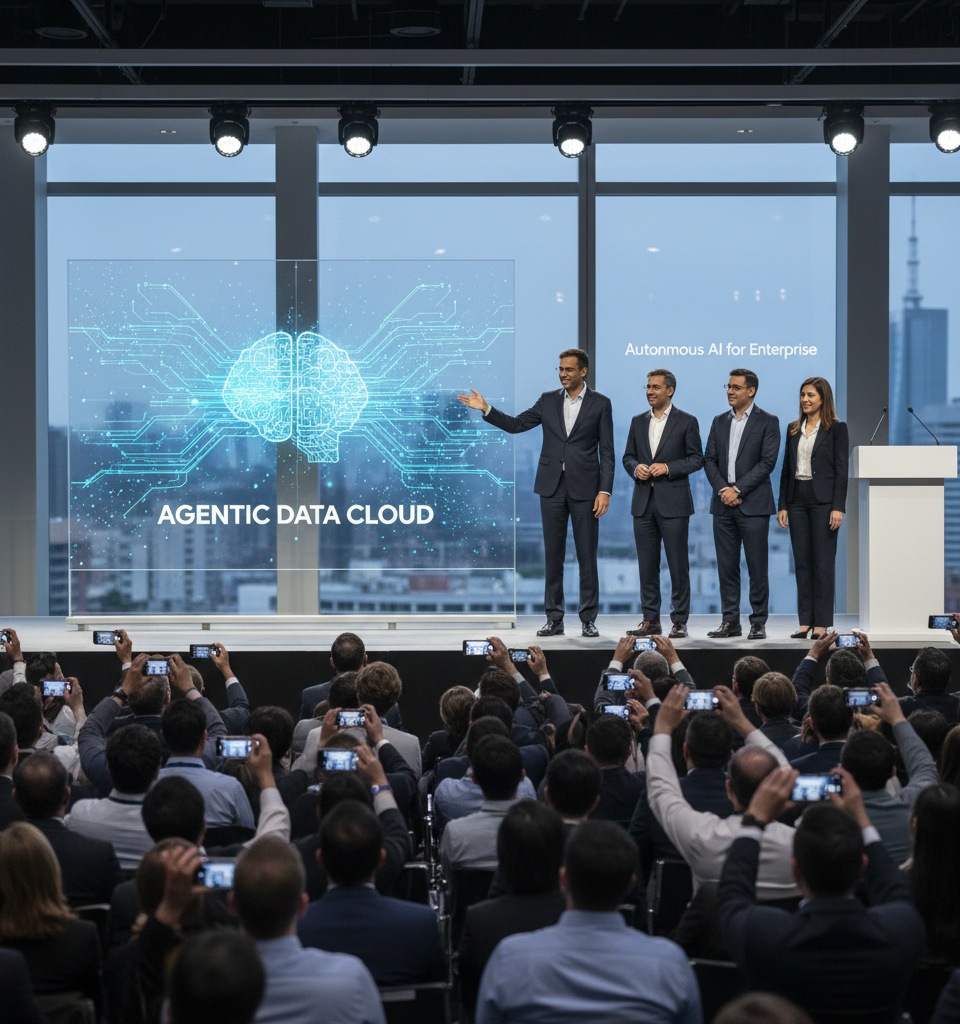
The Shifting Paradigm: From Human Queries to Agentic Actions
The established paradigm of enterprise data management, often termed the 'modern data stack,' was engineered around human analysts running periodic queries to extract insights. While effective for its time, this architecture exhibits inherent limitations when confronted with the demands of autonomous AI. AI agents operate 24/7, requiring instant access to contextually rich, dynamically updated data to make decisions and execute actions without human intervention. This shift from 'human asking questions' to 'agents taking action' necessitates a complete re-evaluation of data pipelines, metadata management, and processing capabilities. Google's Agentic Data Cloud is explicitly engineered to address this architectural breakdown, preparing businesses for a future where AI agents form the backbone of operational intelligence.
Pillars of the New Agentic Architecture The Agentic Data
Cloud is predicated on three core pillars designed to facilitate seamless agentic operation. The first is the Knowledge Catalog, an innovative component that automates semantic metadata curation. Crucially, it infers business logic directly from query logs, significantly reducing the need for manual data steward intervention. This automation ensures that data interpretation is consistent, up-to-date, and readily consumable by AI agents. The second pillar extends this capability to a Cross-cloud environment, enabling agents to access and process data seamlessly across various cloud platforms, breaking down traditional data silos. While specific details on the third pillar were less emphasized in initial announcements, the overarching theme points to enhanced data processing capabilities and integrations tailored for AI agent interactions, likely involving sophisticated real-time data ingestion and transformation services.
Industry-Wide Implications and Market Response
The introduction of the Agentic Data Cloud marks a pivotal moment for the cloud and data management industry. As AI adoption accelerates – with market forecasts predicting the global AI market to reach over $1.8 trillion by 2030 – the demand for robust, AI-ready data infrastructure is paramount. Competitors like Microsoft Azure and Amazon Web Services (AWS) are expected to respond with their own innovations, likely accelerating the development of similar agent-centric data solutions. This initiative pushes the boundaries beyond mere data lakes and warehouses, moving towards 'data fabrics' and 'data meshes' that are intelligent and self-optimizing. The potential for competitive advantages for early adopters of agentic data strategies is immense, promising efficiencies and new revenue streams previously unattainable.
Expert Perspectives on the AI-Driven Data Future
Industry analysts have largely lauded Google's proactive stance. Dr. Evelyn Stone, Chief Data Scientist at Quantum Insights, commented, "Google's Agentic Data Cloud isn't just an incremental improvement; it's a foundational shift. By automating semantic understanding and breaking down cloud barriers for AI agents, they're addressing the core bottleneck in enterprise AI adoption. This could unlock a new wave of autonomous enterprise applications, from predictive supply chain management to self-optimizing marketing campaigns." Others point to the potential challenges, including data governance in an autonomous agent environment and the complexity of integrating legacy systems into this new architecture.
The Road Ahead: Future Developments and Challenges
The immediate future will likely see Google Cloud focusing on expanding the functionalities of the Knowledge Catalog and enhancing cross-cloud interoperability. We can anticipate deeper integrations with Google's existing suite of AI/ML tools, such as Vertex AI, to provide a more holistic agent development and deployment environment. Key challenges will include ensuring data security and privacy in an increasingly automated landscape, managing the ethical implications of autonomous decision-making, and driving widespread enterprise adoption across industries with varying levels of AI maturity. Ultimately, the success of the Agentic Data Cloud will depend on its ability to demonstrate tangible ROI for businesses grappling with the complexities and exponential data growth of the AI era, projected to exceed 180 zettabytes globally by 2025.